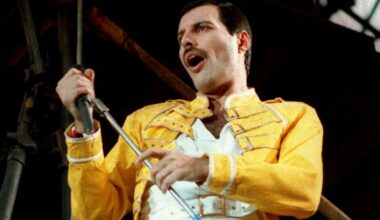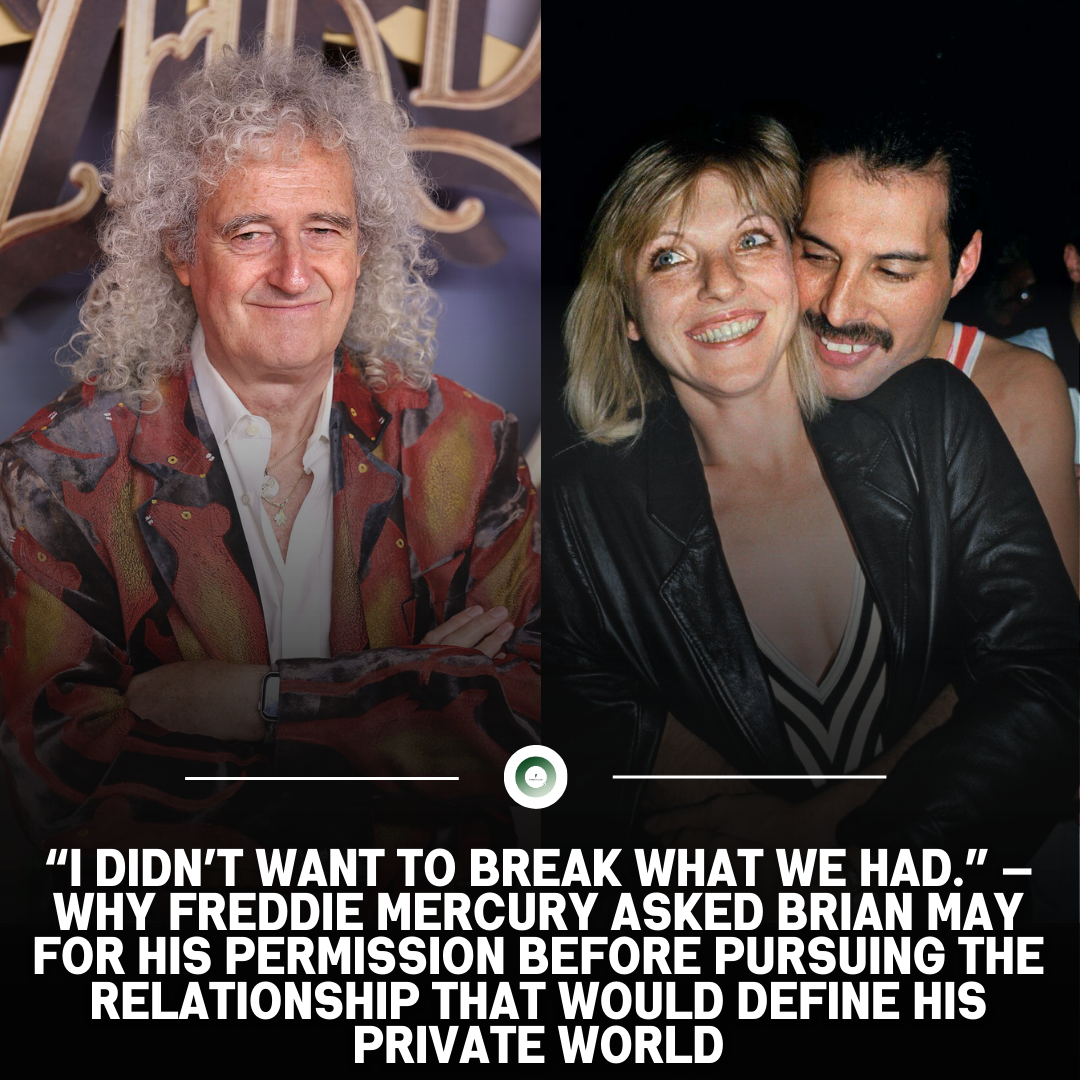
Freddie Mercury was not someone who asked for permission easily. His identity, both on and off the stage, was built on instinct. He moved toward what he felt drawn to, not toward what felt safe. This decisiveness became part of his mythology. The voice did not hesitate. The presence did not doubt. The person did not appear to seek approval.
But there was one moment, early in Queen’s existence, where Freddie Mercury paused.
And he asked Brian May first.
Before Freddie Mercury Became Freddie Mercury
Before the stadiums, before the operatic ambition, before Queen became something permanent, they were still fragile. They were not yet inevitable. Their future depended on proximity—on trust, on shared space, on the quiet bonds that exist before recognition alters everything.
Mary Austin existed inside that early world.
She was not an outsider. She was present before success created distance. She knew Freddie before the world gave him a version of himself he could not easily escape. She understood him without requiring explanation.
But she also existed inside Brian May’s orbit.
And that changed the emotional architecture of the moment.
The Question Freddie Mercury Did Not Avoid
Brian May had met Mary Austin first. Their connection was not permanent, but it existed long enough to establish emotional ground. When Freddie’s feelings for her began to take shape, he did not move forward immediately.
He asked Brian first.
Not formally. Not ceremonially.
Personally.
It was not a question of ownership. It was a question of respect.
Freddie understood that relationships did not exist in isolation. They existed inside systems of trust. And Queen, at that stage, was still dependent on trust more than certainty.
He did not want to fracture something that had not yet proven its resilience.
Why the Question Mattered More Than the Answer
Brian May did not respond with resistance. He did not assert control over the situation. He understood that Mary’s agency existed independently of either of them. What Freddie was asking for was not permission to pursue her.
He was asking for confirmation that doing so would not damage something larger.
The band had not yet achieved permanence. Their future still depended on emotional stability as much as musical ability. Conflict at that stage could have altered outcomes that were not yet secure.
Freddie recognized this.
He was not yet insulated by success. He could not assume that Queen would survive internal fracture.
The question itself became evidence of something rarely associated with him: restraint.
Mary Austin’s Role Inside Freddie Mercury’s Private Identity
Mary Austin would later become one of the most stable figures in Freddie’s life. Not defined by traditional permanence, but by emotional continuity. She existed across multiple versions of him. The version before fame. The version during fame. The version after fame had begun to extract its cost.
Freddie once described her in terms that exceeded conventional romantic language.
He did not reduce her importance when their relationship changed form. He preserved it.
This preservation began with that initial moment of restraint.
He had not acted as someone above consequence. He had acted as someone aware of it.
The Version of Freddie Mercury That Rarely Became Public
Public mythology simplifies people. It preserves the version that appears inevitable. It removes hesitation. It removes internal negotiation. It removes the moments where outcomes were still uncertain.
But Freddie Mercury was not immune to those moments.
He understood that his life did not exist independently of the people who had been present before the world arrived. He understood that success did not erase prior bonds. It complicated them.
Asking Brian May before pursuing Mary Austin did not diminish Freddie’s authority.
It revealed the private structure behind it.
He was not simply someone who took what he wanted.
He was someone who understood what taking it could change.
The Question That Exists Quietly Inside Their History
Queen would go on to achieve permanence. Their internal relationships would survive pressures far greater than this early moment. But permanence did not exist yet when Freddie asked that question.
Everything was still reversible.
The band could still fracture. Trust could still fail. The future could still move in directions they could not control.
Freddie Mercury asked Brian May because he understood that some decisions do not only belong to the person making them.
They belong to the structure that allowed that person to exist in the first place.
And he was not yet willing to risk breaking it.