The Exit That Didn’t Break the Brotherhood
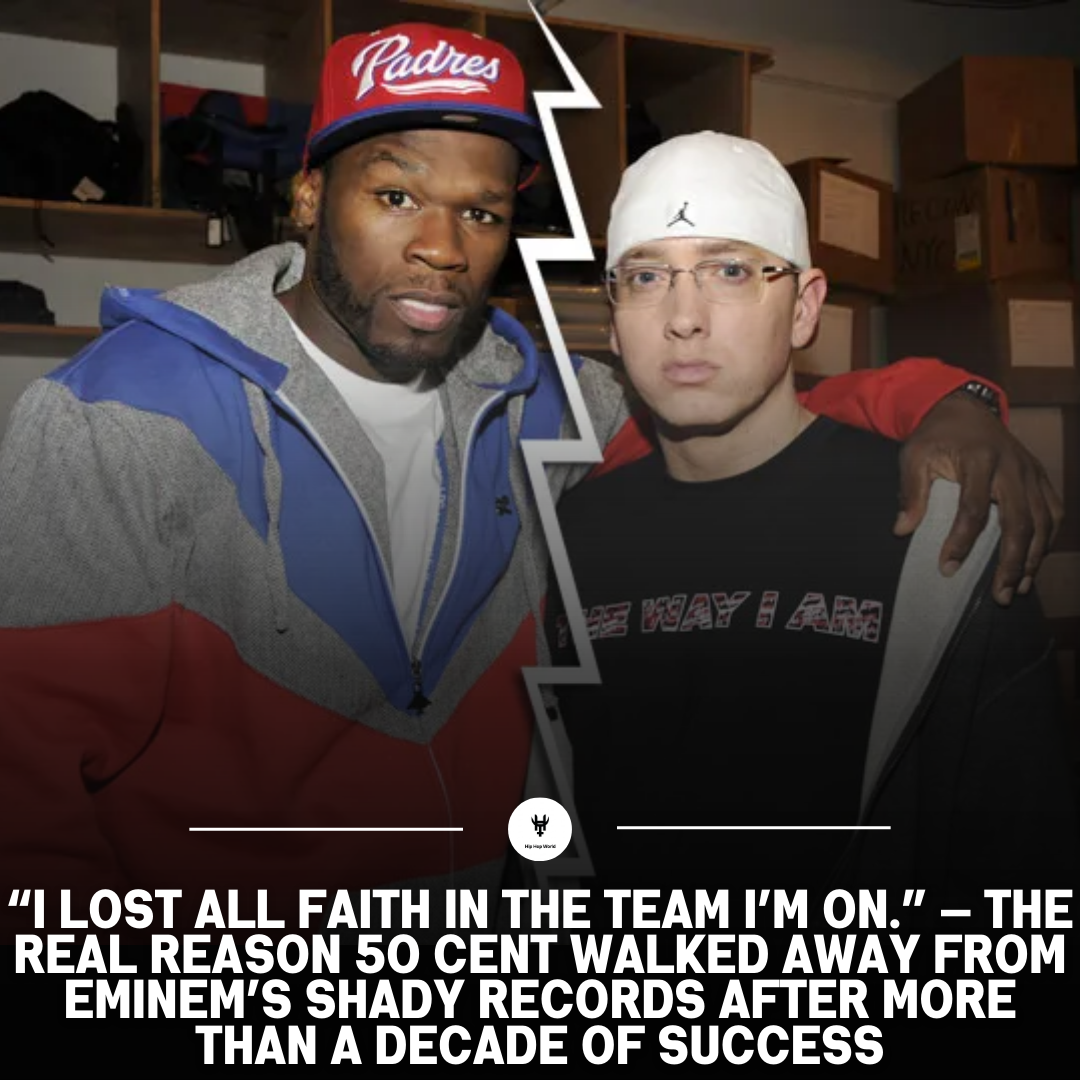
In the early 2000s, few alliances in hip-hop felt as powerful as the partnership between 50 Cent and Eminem. What began as a co-sign from one of rap’s biggest stars quickly turned into one of the most commercially successful runs the genre had ever seen.
But more than a decade later, the moment eventually arrived when 50 Cent chose to walk away from the very label system that helped build his career.
The surprising part was not the departure itself.
It was the fact that their relationship never fractured.
A Career Built Under Shady
When 50 Cent signed to Shady Records in 2002, the partnership instantly reshaped hip-hop’s commercial landscape. Backed by Eminem and Dr. Dre through a joint arrangement with Aftermath Entertainment and Interscope Records, the New York rapper stepped into the spotlight with enormous momentum.
His debut album, Get Rich or Die Tryin’, arrived in 2003 and quickly became one of the defining rap releases of the decade. The project’s success introduced a new voice that blended street storytelling with undeniable commercial appeal.
Over the following years, 50 Cent continued releasing albums through the same label partnership, including The Massacre in 2005, Curtis in 2007, and Before I Self-Destruct in 2009.
The run placed him among the most successful rappers of his generation.
But by the early 2010s, the relationship between the artist and the industry structure surrounding him had begun to shift.
A Growing Desire to Move Forward
By 2012, 50 Cent had begun expressing frustration about the direction of his career within the label system.
In a social media post at the time, he made his feelings clear. He wrote that he had “lost all faith” in the team he was working with and suggested he would deliver his final album before focusing his attention elsewhere.
His message hinted at something larger than a simple business dispute.
For 50 Cent, the next chapter of his career involved expanding beyond music. Film and television projects were beginning to capture his attention, and the idea of controlling his own creative direction had become increasingly important.
Two years later, the shift became official.
In 2014, after more than a decade connected to the Shady/Aftermath/Interscope structure, 50 Cent parted ways with the Universal Music Group system.
A Rare Industry Departure
In the music business, leaving a label after years of success often leads to tension or public conflict. Contracts, royalties, and commercial expectations can quickly complicate relationships.
But 50 Cent’s situation unfolded differently.
Speaking about the departure later, he explained that his personal relationships with Eminem and Dr. Dre played a crucial role in allowing the transition to happen smoothly.
According to 50 Cent, the two artists understood that forcing him to remain in a situation where he felt creatively restricted could damage their friendship.
He described the decision as a “special case,” explaining that the strength of those relationships allowed him to step away without hostility.
In an industry known for fractured partnerships, the moment stood out as unusual.
Eminem’s Response
For Eminem, the move never felt like a betrayal.
When news of the departure became public, he responded with calm support rather than disappointment. He acknowledged the success they had shared over the years and emphasized that their friendship remained unchanged.
The statement reflected a bond that extended far beyond business.
Over the years, the two artists had collaborated on music, supported each other’s careers, and navigated the pressures of fame together. Even as their professional paths began to diverge, that personal connection remained intact.
The Next Chapter
Shortly after leaving the Shady/Aftermath/Interscope structure, 50 Cent released Animal Ambition in June 2014 through his own G‑Unit Records.
The album debuted at number four on the Billboard 200 and featured a wide range of collaborators, including Jadakiss, Styles P, Prodigy, ScHoolboy Q, Yo Gotti, and Trey Songz.
While the project marked the end of one era, it also represented a new phase in 50 Cent’s career—one where he would increasingly focus on entrepreneurship, television production, and business ventures.
The shift eventually helped establish him as one of the most successful artist-turned-media producers in hip-hop.
A Friendship That Outlasted Business
Despite the changes in their professional arrangements, the connection between 50 Cent and Eminem never weakened.
In interviews years later, 50 Cent spoke openly about the role Eminem played in keeping him grounded during the height of his fame. He even compared Eminem’s presence in his life to that of his grandmother, explaining that he always knew he could speak with him honestly.
It was a striking comparison—one that revealed how deeply their friendship had grown beyond the music industry.
The partnership that began in 2002 may have evolved over time, but the trust behind it remained the same.
In hip-hop, where alliances often dissolve under the pressure of success, the relationship between 50 Cent and Eminem stands as a reminder that sometimes the strongest bonds survive even after the contracts end.