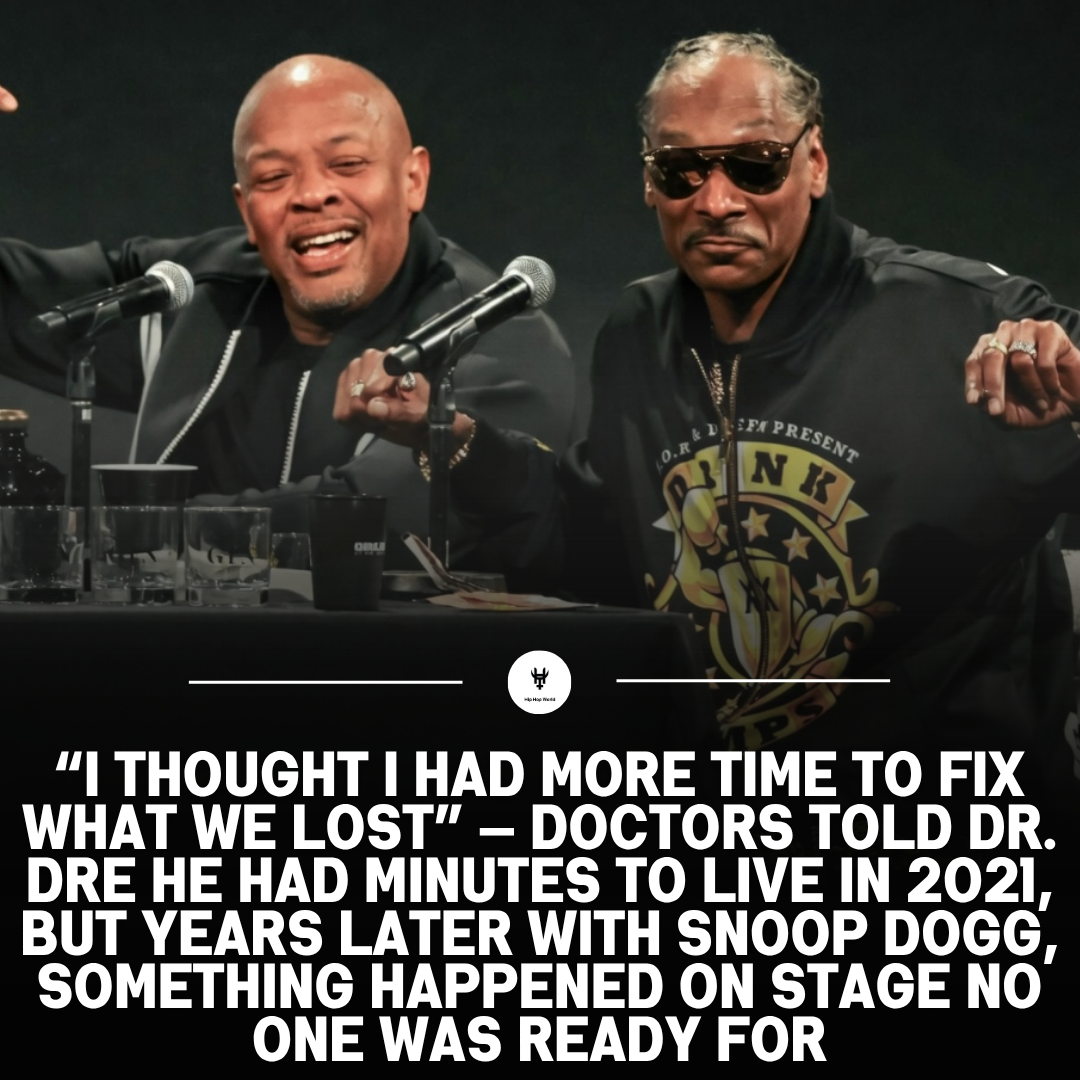
The stadium was alive in a way only legends can command. Tens of thousands of voices moved in sync, every lyric echoing across the night as Dr. Dre and Snoop Dogg stood at the center of it all—two figures who had shaped an era that still refuses to fade.
It was supposed to be a celebration. A victory lap decades in the making.
But then, the music stopped.
At first, it felt like a pause—something technical, something temporary. The kind of interruption crowds brush off without thinking. But as the silence stretched, something shifted. Dre stepped forward, gripping the mic, his composure no longer as controlled as it had been just moments before.
This wasn’t part of the show.
A Legacy Built on Control
For most of his career, Dr. Dre has represented precision. From the groundbreaking sound of The Chronic to building an empire that reshaped West Coast hip-hop, his image has always been tied to control—of sound, of business, of narrative.
That image was shaken in 2021.
A sudden brain aneurysm nearly took his life. Doctors warned that the situation was critical, that everything could end within minutes. For someone who had spent decades dictating every detail, it was a confrontation he couldn’t control.
He survived. But the experience didn’t just pass—it stayed.
A Different Return
By 2026, Dre was back on stage, but something about the moment felt different. Reuniting with Snoop Dogg, the performance carried more than nostalgia—it carried history. The kind that shaped cities, influenced generations, and turned underground voices into global power.
The crowd expected dominance. Energy. The same untouchable presence.
Instead, they got something else.
The Moment Everything Changed
Standing in front of thousands, Dre didn’t raise his voice. He didn’t perform. He paused.
And then he said it.
“I wish I fixed it before he was gone.”
There was no buildup. No explanation.
Just eight words that cut through everything.
The name didn’t need to be spoken. Everyone knew he was talking about Eazy-E—his former collaborator in N.W.A, and the man whose relationship with Dre had shifted from brotherhood to rivalry before ending without resolution in 1995.
The stadium didn’t react the way crowds usually do.
There were no cheers. No phones rising.
Just silence.
More Than Music
For decades, the story of West Coast hip-hop has been told through impact—records, influence, cultural dominance. But in that moment, Dre stripped it down to something far more human.
Success hadn’t erased regret.
Time hadn’t healed everything.
And no amount of legacy could give him another chance to say what needed to be said.
Nearby, Snoop Dogg stood still, visibly moved, offering nothing but presence. It was one of the few times where words weren’t needed—where the weight of the moment spoke on its own.
A Different Kind of Power
The confession didn’t stay inside the stadium. It moved outward—through fans, through artists, through conversations that had nothing to do with charts or awards.
Because it wasn’t just about the past.
It was about what people carry.
In an industry built on image, Dre chose something else in that moment. No production, no beat, no performance—just honesty.
What Remains
Dr. Dre survived something that nearly ended everything. But standing on that stage years later, it became clear that survival isn’t just physical.
Some things stay with you.
Some moments never fully close.
And sometimes, the most powerful thing a legend can do… isn’t to perform, but to finally say what was left unsaid.