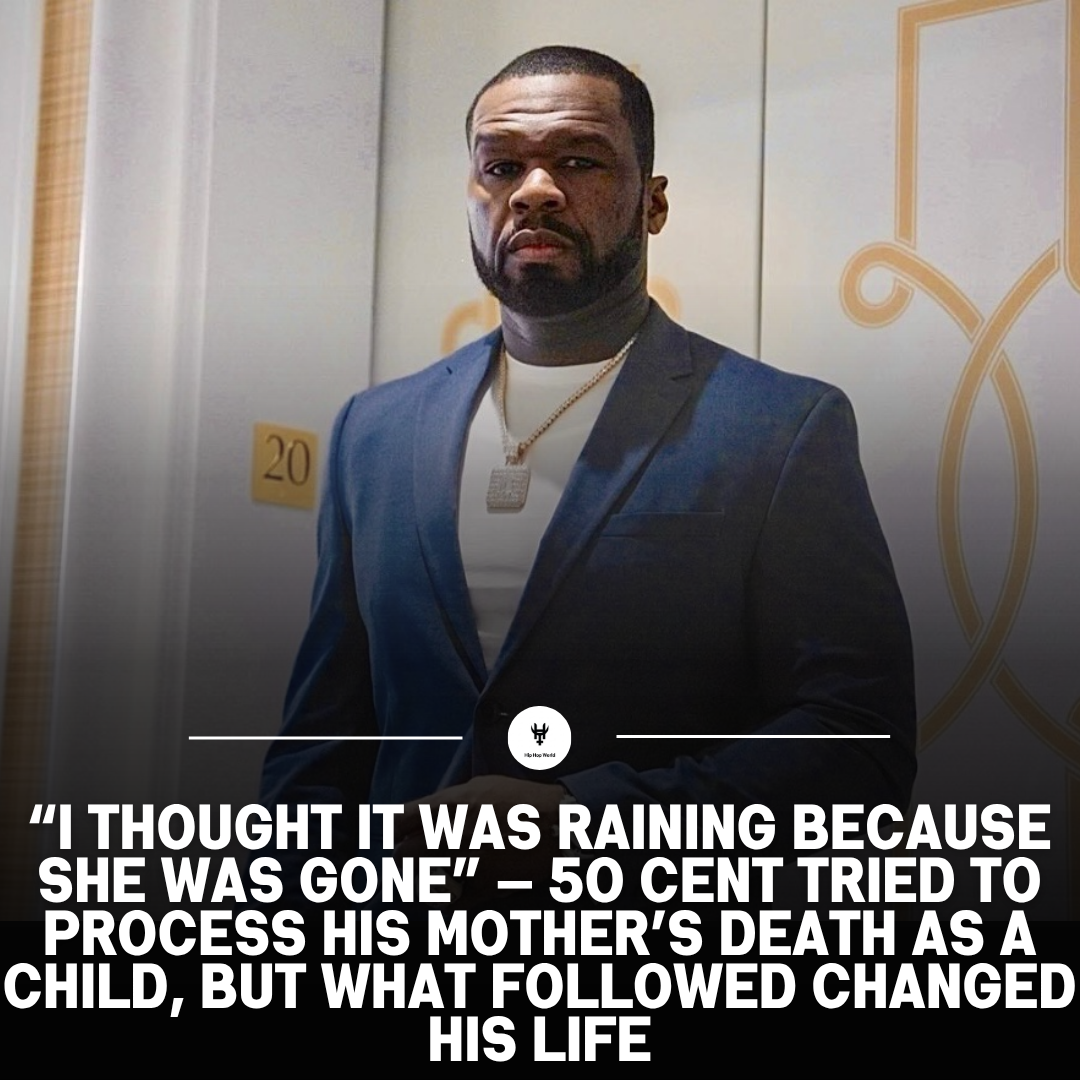
The memory didn’t come with clarity—it came with confusion. A young boy trying to understand something no one had fully explained to him, standing in a world that had suddenly changed without warning.
50 Cent was just eight years old when he lost his mother. At the time, he didn’t have the words to process it. “a baby,” as he later described himself, trying to make sense of a moment that felt bigger than anything he could understand.
A Childhood Built On Survival
His mother, Sabrina, had him when she was only 15. Life didn’t offer her many options, and she found a way to survive the only way she knew how. As a single mother, she turned to dealing drugs to provide for her son.
For 50, those early memories were simple. Every time she came home, she brought something with her—small things that felt like comfort, like stability. It was the only version of normal he knew.
Then it was gone.
The Moment Everything Shifted
Her death came suddenly, leaving behind a silence that didn’t make sense to him. “After I lost my mom,” he recalled, “I can remember feeling like I wanted to go into a park but it was raining outside, and I felt like it was raining because my mom was dead.”
The explanation he was given didn’t help. “I remember when she passed,” he said, “and my grandparents told me that she was going away, that she was going to be in a better place — I didn’t understand that. Went to her funeral and everything and still didn’t understand what was going on.”
All he could feel was the absence.
And with it, a realization that stayed with him. “everything that was good went away.”
A Path That Didn’t Feel Like A Choice
After that, his world didn’t rebuild—it shifted. The environment around him became his guide. The people who had something, who seemed to hold any kind of power or stability, were all involved in the same thing his mother had been.
He watched, he learned, and eventually, he followed.
The people in his neighborhood saw him as an extension of her. They called him “little Sabrina,” a name that carried both familiarity and expectation. They looked out for him in their own way—offering protection, giving him what he needed, and slowly pulling him into their world.
“And that’s giving you a licence to actually sell the shit in the neighborhood,” he said.
Even then, there was a structure to it. A hidden routine that existed within the boundaries of what his grandmother believed. “But even when I was selling, I had to do it between 3pm and 6pm, when my grandmother thought I was in the after-school program.”
It wasn’t framed as a decision. It felt like a continuation.
A Beginning Shaped By Loss
Looking back, it’s easy to connect the outcomes—to see how the environment, the loss, and the people around him shaped what came next. But at the time, it wasn’t a story being built. It was just a child trying to navigate a world that had already changed too much.
And sometimes, the moments that define everything don’t feel like turning points when they happen. They just feel like the only direction left.