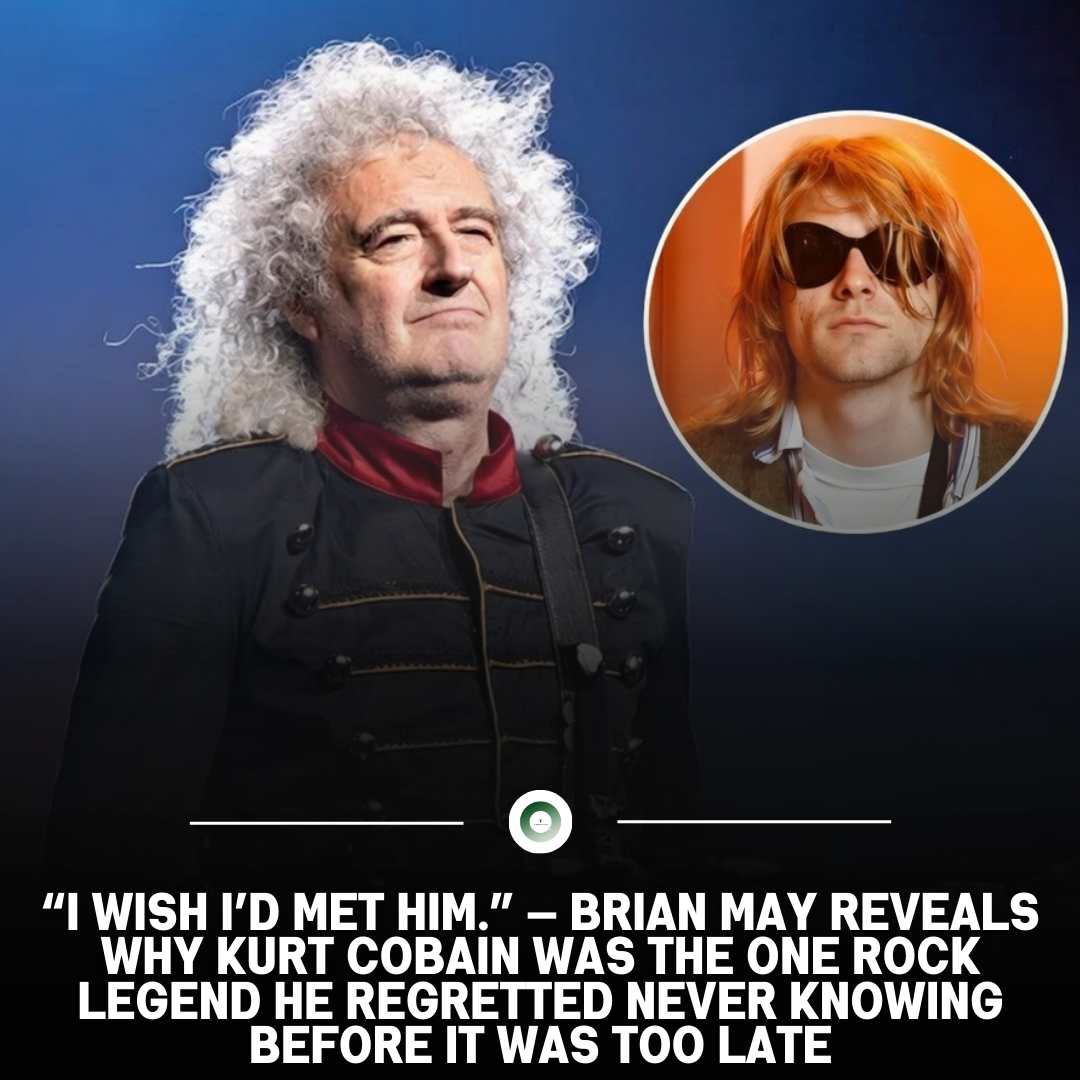
For decades, Brian May has stood at the center of rock history—not just as Queen’s legendary guitarist, but as a musician whose influence extends far beyond his own band. He has shared stages with generations of artists, collaborated across genres, and watched entire movements rise and fall. Yet despite crossing paths with so many defining figures, there remains one absence he has never been able to reconcile.
Kurt Cobain.
Not because they disagreed. Not because they clashed.
Because they never met at all.
A Guitarist Who Never Lost His Humility
Brian May’s career has placed him alongside some of the most powerful names in modern music. From stadium collaborations to unexpected guest appearances, he has proven repeatedly that his sound belongs in any era. Whether standing beside younger artists or fellow legends, May’s presence carries the same quiet authority—a musician who never needed to compete for attention, because his voice was already unmistakable.
But what separates May from many of his peers is not dominance.
It’s humility.
Despite his status, he has never stopped seeing himself first as a student of music. Every collaboration, every performance, every encounter has been approached with genuine appreciation. He never treated music as territory to defend. He treated it as something to explore.
That openness is what allowed him to recognize greatness—even in movements far removed from Queen’s origins.
The Movement He Watched From a Distance
By the early 1990s, rock itself was transforming. The polished theatricality of arena rock was giving way to something rawer, heavier, and more emotionally exposed. At the center of that shift stood Kurt Cobain.
May wasn’t deeply embedded in the grunge scene. It wasn’t his world.
But he understood its significance immediately.
He didn’t see Cobain as an outsider to Queen’s legacy.
He saw him as its continuation.
“I love people with passion,” May later reflected. “It’s not about dexterity. It’s what comes from the soul.”
And in Cobain, he saw exactly that.
Not technical perfection.
Not performance spectacle.
But truth.
May described Cobain as a “kindred spirit,” someone whose connection to music existed beyond mechanics or genre. Cobain wasn’t trying to impress. He was trying to express. And that authenticity was something May recognized instantly.
Yet recognition came without introduction.
And introduction never came at all.
The Regret That Never Left Him
May remembers visiting Seattle during the height of the grunge explosion. He could feel something changing—not just musically, but culturally. There was an energy in the air, a sense that rock was reinventing itself in real time.
He was witnessing history from the outside.
And he knew it.
“I wish I’d met him,” May admitted later.
It wasn’t professional regret.
It was personal.
Because May understood something few people did—that artists who reshape music rarely exist in isolation. They belong to a lineage. A chain of creative instinct that passes quietly from one generation to the next.
Cobain was part of that chain.
And May had recognized him.
But never reached him.
Finding That Spirit Again
Years later, May would come closer to that lost connection through his appearances alongside Foo Fighters, the band formed by Cobain’s former bandmate, Dave Grohl. Standing beside them, May felt something familiar—not imitation, but continuity.
He saw the same energy.
The same urgency.
The same purpose.
He even described Foo Fighters as the band that came closest to capturing Queen’s spirit, not because they sounded the same, but because they carried the same emotional force.
That rare, invisible quality.
The reason musicians step on stage in the first place.
The Connection That Never Needed to Happen
Brian May never met Kurt Cobain.
They never shared a studio.
They never shared a stage.
But in May’s mind, the connection existed anyway.
Not through conversation.
But through recognition.
Because sometimes, the deepest understanding between artists happens without a single word ever spoken.