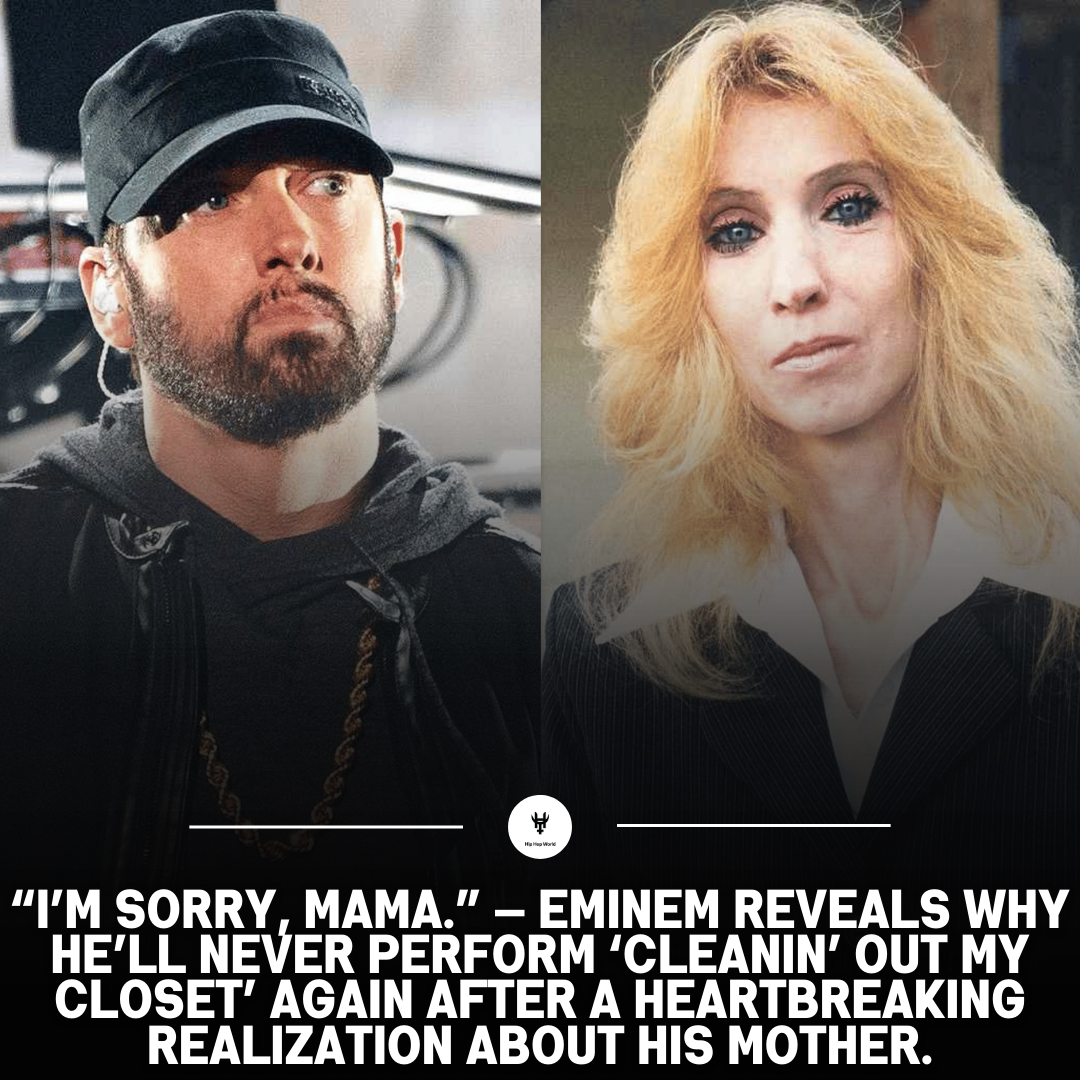
For much of his early career, Eminem built his reputation on brutal honesty—the kind that rarely softened its edges. His music often blurred the line between confession and confrontation, and few tracks captured that intensity more clearly than “Cleanin’ Out My Closet.” In the song, he aired years of resentment toward his mother, Debbie Nelson, channeling anger, sarcasm, and pain into a track that quickly became one of the most memorable moments of his early 2000s rise.
Crowds loved it.
Every performance ignited the same reaction—fans shouting the lyrics back with the same fury that made the record famous.
But time has a way of reshaping perspective.
More than a decade later, Eminem revisited that chapter of his life with a completely different voice. On The Marshall Mathers LP 2 in 2013, he released “Headlights,” a song that surprised listeners by doing something almost unthinkable for the rapper who built his career on confrontation: he apologized.
The track wasn’t filled with rage.
It carried reflection.
Instead of accusing his mother, Eminem acknowledged that while his anger once felt justified, it no longer represented the person he had become. The song was calm, introspective, and deeply personal—a stark contrast to the explosive bitterness that had defined “Cleanin’ Out My Closet.”
The change wasn’t symbolic. It soon became practical.
By 2014, Eminem made a decision that caught many fans off guard: he would no longer perform “Cleanin’ Out My Closet” on stage.
It wasn’t because the song had grown old.
It was because the meaning behind it had.
As the years passed—and especially as he raised his daughters—Eminem began looking at his music through a different lens. The same lyrics that once felt like catharsis started to carry a new weight. One day his children would hear those songs. They would hear their father publicly condemning his own mother.
And suddenly the applause didn’t feel the same.
With maturity came a deeper understanding of the complicated circumstances surrounding his upbringing and his mother’s struggles, including her health issues and the chaos that surrounded their relationship. Eminem never denied the pain of his childhood, but he eventually realized that continuing to broadcast that pain served no purpose anymore.
The anger that once fueled his creativity had begun to feel like something else—something heavier.
In interviews, he admitted that performing the song eventually felt wrong. What audiences experienced as emotional release started to feel, to him, like reopening a wound that had already begun to heal.
“Headlights” became his answer to that realization.
In the song, Eminem reflects on the past without pretending it didn’t happen. He doesn’t erase the history between them, but he acknowledges that the intensity with which he once expressed his resentment is something he now regrets. The apology isn’t dramatic or theatrical—it’s measured and sincere.
For an artist whose career was built on defiance and unfiltered truth, choosing restraint marked a profound shift.
Eminem had always believed in saying exactly what he felt, no matter how uncomfortable it made people. But growth sometimes means recognizing that the truth you once shouted no longer reflects the person you’ve become.
Walking away from “Cleanin’ Out My Closet” was not a small decision. The track remains one of the defining songs of his early success. Yet by removing it from his performances, Eminem quietly showed that personal healing mattered more than reliving old victories.
In a genre that often celebrates confrontation, this moment revealed a different kind of strength. Vulnerability isn’t only about exposing pain—it’s also about acknowledging when that pain has hurt others.
The transition from public rage to public apology revealed something deeper than artistic evolution.
It showed the transformation of a man who had grown beyond the anger that once defined him—not just as a rapper, but as a son and as a father.
Because sometimes the clearest sign of growth isn’t what you create.
It’s what you choose to leave behind.