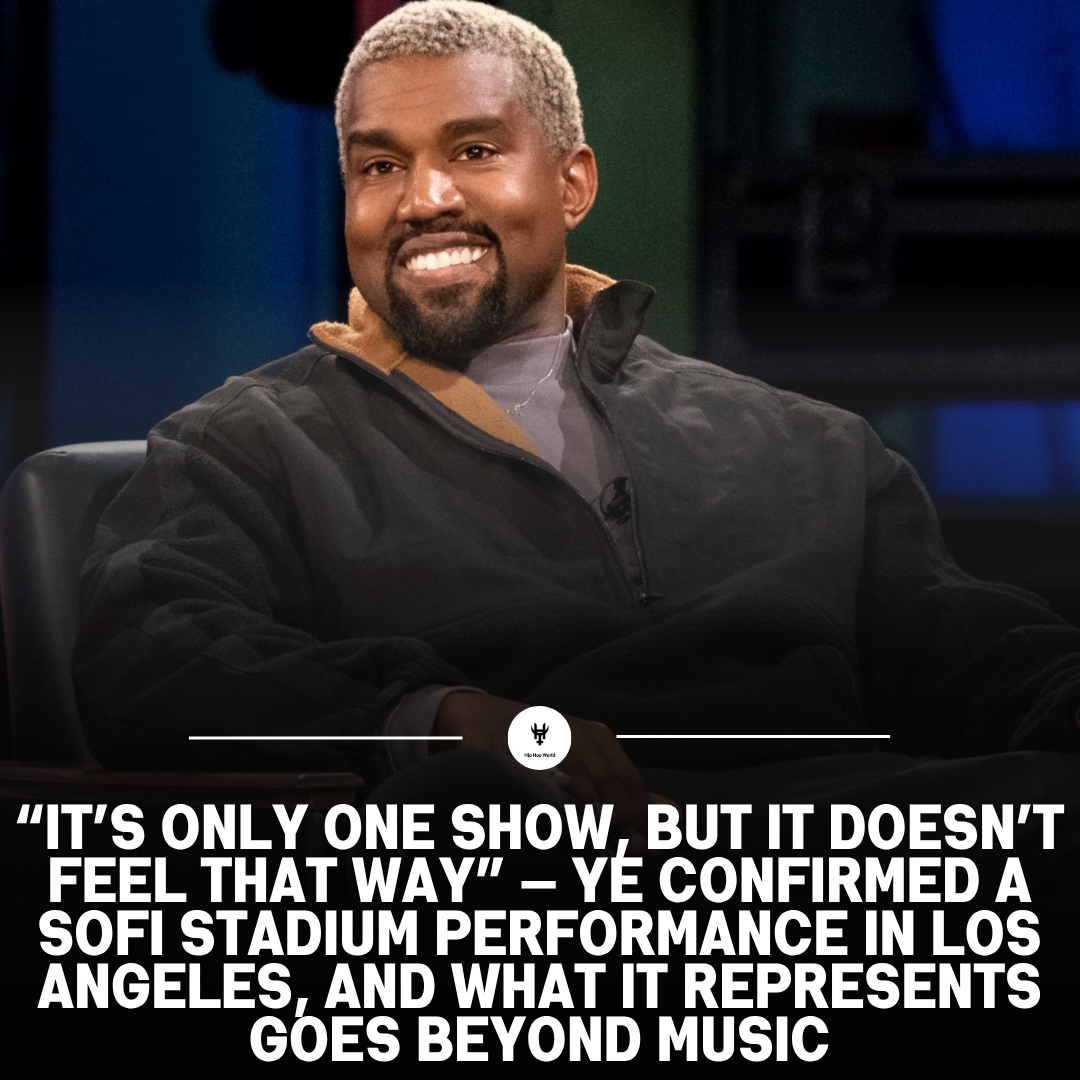
The announcement didn’t come with much buildup, but the timing made it impossible to ignore. After years away from U.S. stages, Ye is set to return—this time at SoFi Stadium in Los Angeles, a venue built for moments that carry weight beyond the music.
A Return Framed by Timing
The April 3 performance lands just weeks after the release of Bully, his upcoming album scheduled for March 20. Positioned as his “only performance in Los Angeles,” the show immediately stands apart—not just as another date, but as a singular moment tied directly to a new chapter.
Ticket demand is expected to move quickly, with pre-sale access opening on March 10 and general sale following a day later. But the interest surrounding the show isn’t just about availability. It’s about what this performance represents.
The Distance Since The Last Stage
Ye hasn’t performed a stadium show in the United States since 2021’s Free Larry Hoover benefit. The years that followed shifted the trajectory of his career in ways that extended beyond music. Public controversy, including antisemitic remarks beginning in 2022, led to the collapse of major partnerships and made live bookings increasingly difficult.
For a time, it wasn’t clear how—or if—a return of this scale would happen.
YE
LIVE IN CONCERTLOS ANGELES, CA 🇺🇸
APRIL 3RD 🚨 pic.twitter.com/VdQWiCXwrn
— Kurrco (@Kurrco) March 9, 2026
Momentum Building Outside The U.S.
Before announcing the SoFi date, Ye had already stepped back onto large stages internationally. Two sold-out shows in Mexico City signaled renewed demand, while upcoming European dates, including a performance at RCF Arena in Italy, continue to build that momentum.
The SoFi concert, however, carries a different kind of significance. It marks a return not just geographically, but symbolically.
The Sound Behind The Moment
Bully, released through independent distributor Gamma, is described as a project centered on “remorse, memory, ego, faith, and consequence” and “using music as storytelling rather than defence.” It’s a framing that suggests reflection, even as Ye continues to operate on his own terms.
Speaking about the album’s direction, he said, “This is more the way I remember Lauryn Hill[‘s] album, the way I remember Miseducation. I feel it is my Miseducation. It is my Gnarls Barkley album. Because Bully has a title and connotation that a lot of people are anti-bully. But I’m just hyper-next-level frequency right now.”
A Moment Still Taking Shape
The SoFi performance arrives with context that extends far beyond a single night. It sits between past controversy and a new release, between absence and return, between uncertainty and demand.
What happens on that stage may not answer every question surrounding Ye’s position in the industry, but it will define how this next phase begins—and how it’s received when the lights come back on.