For decades, Sir Brian May has been synonymous with scale. Stadium anthems. Operatic arrangements. Guitar tones that could fill continents. Yet beyond the amplified roar of Queen’s legacy, May has constructed something far quieter — and arguably just as enduring.
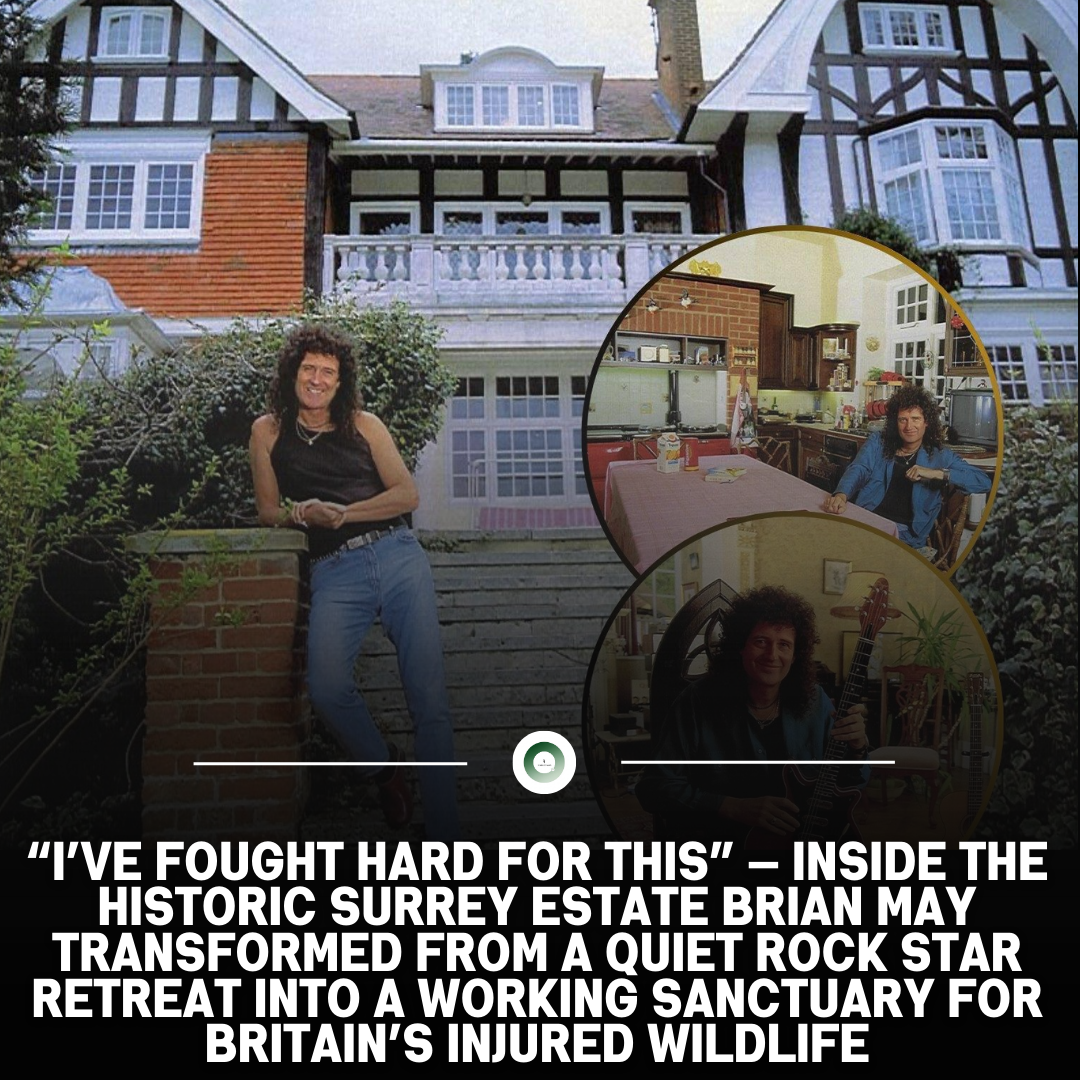
In the secluded countryside of Windlesham, Surrey, the guitarist’s long-standing private residence has evolved from a rock star’s rural retreat into the operational heart of a serious conservation mission. What appears, at first glance, to be an imposing English manor is in fact a working sanctuary — a place where injured native wildlife are treated, rehabilitated, and prepared for release back into the wild.
It is here that May’s second career has taken form.
The Rock Star’s Rural Haven
Located roughly an hour outside London, Windlesham offers the kind of privacy expected of a global music figure. But for May, the estate’s expansive grounds serve a deeper purpose than seclusion. The land provides the controlled, quiet environment required for wildlife recovery — space that has become increasingly rare across Britain.
May shares the historic Surrey property with his wife, actress Anita Dobson, whom he married in 2000. Dobson remains widely recognized for her iconic portrayal of Angie Watts in the long-running British soap EastEnders during the 1980s. Inside the home, the guitarist’s eclectic sensibilities are evident: Victorian stereographs, antique tin toys, and carefully preserved musical memorabilia line the interior.
Among its most meaningful rooms is a dedicated workshop where specialists maintain and restore the “Red Special,” the handmade guitar May built with his late father. The instrument — central to Queen’s sound — remains a living artifact, preserved with the same care May now extends to endangered species.
The vulnerability of the rural setting was sharply revealed in 2020, when a wildfire tore through nearby heathland bordering Sunningdale Golf Course. The blaze forced May to evacuate temporarily, prioritizing both personal safety and what he described as his most “precious things.” The incident underscored how fragile these landscapes have become — even those meant to provide refuge.
From Manor Grounds to Wildlife Hospital
The most significant evolution of May’s estate lies beyond the house itself.
In 2010, May co-founded the Save Me Trust alongside conservationist Anne Brummer. The charity focuses on animal welfare and wildlife protection, working in close partnership with Harper Asprey Wildlife Rescue (HAWR). The Windlesham property now functions as a secure and discreet setting for critical rescue operations.
Thousands of injured, orphaned, or sick native animals pass through this quiet sanctuary. Veterinary care, rehabilitation, and “soft release” programs are carried out on-site, allowing wildlife to reacclimate gradually before returning to their natural habitats.
What was once a silent garden has become a structured ecosystem of recovery.
The Hedgehog Crisis
Perhaps the most visible element of May’s activism centers on Britain’s endangered hedgehog population.
Once estimated at roughly 30 million in the 1950s, hedgehog numbers have plummeted to fewer than one million. Habitat destruction, road mortality, and modern agricultural practices have accelerated their decline. The issue is not symbolic — it is ecological.
Through the “Amazing Grace” campaign, the Save Me Trust brought national attention to the crisis. The initiative takes its name from Grace, a severely injured hoglet rescued by HAWR who became the face of the movement. May and singer Kerry Ellis recorded a version of “Amazing Grace” to amplify the cause, merging music and advocacy without spectacle.
Within the estate’s grounds sits what has become known as “Hedgehog Heaven” — a carefully maintained natural habitat designed to attract insects and allow rehabilitated hedgehogs to relearn foraging skills before release. It is a controlled reintroduction to the wild, conducted with patience rather than publicity.
A Different Kind of Legacy
There is a quiet symmetry in May’s dual identity. The guitarist who helped compose anthems like “We Will Rock You” now dedicates his time to protecting species that cannot amplify their own voices.
This is not a performative extension of celebrity. It is a structural commitment — one that has reshaped his property, redirected his influence, and embedded conservation into the architecture of his daily life.
In Windlesham, the volume is lower. The stakes, however, are no less significant.
Here, the architect of arena-sized soundscapes has built something far more intimate: a refuge where the smallest and most vulnerable residents of Britain’s countryside are given time to heal — and a chance to return home.