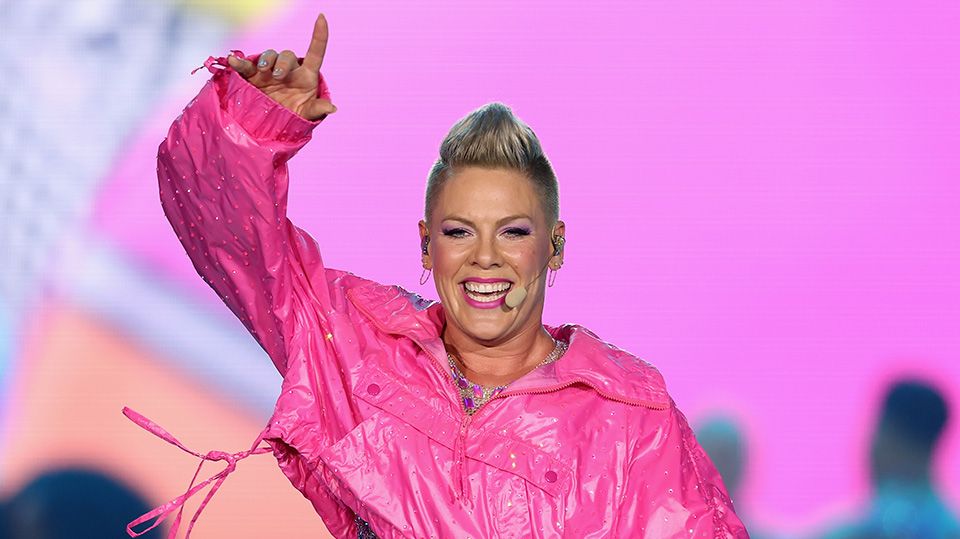
For most of her career, Pink has built a reputation on movement.
She flies. Spins. Drops from impossible heights while singing like gravity doesn’t apply to her. Her performances are designed to overwhelm the senses—to make audiences look up, hold their breath, and wonder how she’s still hitting every note.
At the 2014 Academy Awards, she did something far riskier.
She stood still.
The expectation—and the quiet skepticism
When it was announced that Pink would perform “Somewhere Over the Rainbow” as part of The Wizard of Oz tribute, the reaction wasn’t doubt—it was curiosity.
Could a performer known for power and spectacle step into one of the most delicate, historically protected songs in entertainment?
Because this wasn’t just any performance.
It was a tribute to Judy Garland. To one of the most iconic vocal moments ever captured on film. A song that doesn’t tolerate over-singing, over-styling, or reinvention for its own sake.
This wasn’t a stage to dominate.
It was a moment to honor.
The decision that changed everything: restraint
From the first second, it was clear Pink understood the assignment.
No aerial rigging.
No choreography.
No attempt to modernize the arrangement.
She walked out in a ruby-red gown—a quiet nod to Dorothy—and stayed planted at the microphone.
That choice did more than simplify the performance.
It removed every distraction.
When the voice has nowhere to hide
Without staging, lighting tricks, or movement, the performance had to rely on one thing:
Control.
“Somewhere Over the Rainbow” demands:
- Clean phrasing
- Gentle dynamic shifts
- Emotional precision without exaggeration
It’s deceptively difficult. Sing it too softly, and it disappears. Push too hard, and it loses its innocence.
Pink threaded that line carefully.
Her opening was restrained—almost conversational. Not trying to impress, just establishing tone. As the melody unfolded, she allowed the voice to grow naturally, expanding into the higher notes without forcing them.
It wasn’t a reinvention.
It was alignment.
Why the audience went silent
Inside the Dolby Theatre, filled with some of the most experienced performers and filmmakers in the world, something unusual happened.
They stopped reacting.
No early applause. No murmurs. Just stillness.
That kind of silence isn’t indifference.
It’s focus.
Because when a performance strips everything down to voice and emotion, the audience has no choice but to meet it there.
The moment she made the song her own—without changing it
The challenge with a song like this isn’t technical—it’s interpretive.
How do you sing something so familiar without copying it?
Pink’s answer was subtle.
She didn’t imitate Garland’s phrasing or tone. Instead, she leaned into her own vocal texture—slightly richer, slightly more grounded—while keeping the emotional intention intact.
The result felt respectful, not referential.
You could hear the original in the structure.
But you could hear her in the delivery.
The final note—and what happened after
As the orchestra swelled into the closing lines, she didn’t push for a dramatic finish.
She let the note land.
Clean. Controlled. Complete.
And then—something rare for a room like that—
A pause.
A beat where no one moved.
Then the entire audience stood.
Why that standing ovation mattered
Standing ovations at the Oscars aren’t unusual.
But the way this one happened was.
It wasn’t immediate. It wasn’t prompted. It felt earned in real time—like the room needed a second to process what it had just experienced before responding.
Because what Pink delivered wasn’t just a technically strong vocal.
It was discipline.
The performance that proved something different
Pink didn’t need to show she could sing.
Everyone already knew that.
What she proved that night was something else:
That she could not do everything she’s known for—and still command the room completely.
No spectacle.
No risk of falling.
No visual distractions.
Just control, restraint, and a deep understanding of when less becomes more.
Why this moment still stands out in her career
In a catalog of performances defined by physical daring, this one stands apart because it removed the physical entirely.
And in doing so, it revealed something just as impressive:
Versatility.
The ability to move from explosive, high-risk stagecraft to quiet, classical delivery—without losing identity.
A different kind of bravery
Flying 30 feet in the air while singing live is dangerous.
Standing still, exposed, singing one of the most iconic songs ever written in front of the most critical audience in entertainment?
That’s a different kind of risk.
One that doesn’t rely on strength or stamina.
But on trust—in your voice, your choices, and your restraint.
What the audience really responded to
It wasn’t just the song.
It was the shift.
Seeing an artist known for pushing limits choose to pull back—and still hold complete control over the room.
That contrast is what made the performance memorable.
Because sometimes, the most powerful thing a performer can do…
is nothing extra at all.
The moment that redefined her range
Pink didn’t try to outdo history.
She stood beside it.
And in that space—between respect and individuality—she delivered a performance that didn’t need spectacle to be unforgettable.
Just a voice.
And the discipline to let it speak.