In February 2001, the lights inside the Staples Center glowed with the quiet tension of an industry gathering that felt unusually political. The night was the 43rd Annual Grammy Awards, but the ceremony carried a weight that went beyond music. Outside the arena, protestors gathered with signs and chants. Inside, thousands of artists, executives, and journalists waited to see what would happen next.
At the center of the storm stood Eminem.
The Detroit rapper had spent the previous year dominating the charts with the explosive success of the album The Marshall Mathers LP. The record had broken sales records and turned Eminem into one of the most visible figures in popular culture. Yet the same lyrics that fueled his fame had also ignited fierce criticism. Advocacy groups, including GLAAD, accused his music of promoting homophobia and hostility. The debate quickly expanded beyond hip-hop, becoming a national conversation about artistic freedom and cultural responsibility.
By the time the Grammys arrived, the ceremony felt less like a celebration and more like a crossroads.
No one quite knew how Eminem would address the controversy. His public persona was built on defiance. Apologies did not fit the image he had carefully crafted. Yet ignoring the criticism entirely seemed impossible, given the scale of the backlash.
The answer arrived in a form that few people inside the arena could have predicted.
When Eminem took the stage to perform the haunting narrative track Stan, the performance began as expected. The song had already become one of the most striking pieces in modern hip-hop storytelling. Built around a slow, melancholic piano progression and a haunting chorus originally sung by British artist Dido, the track told the story of an obsessive fan whose admiration spirals into tragedy. It was dark, introspective, and unusually cinematic for a rap single.
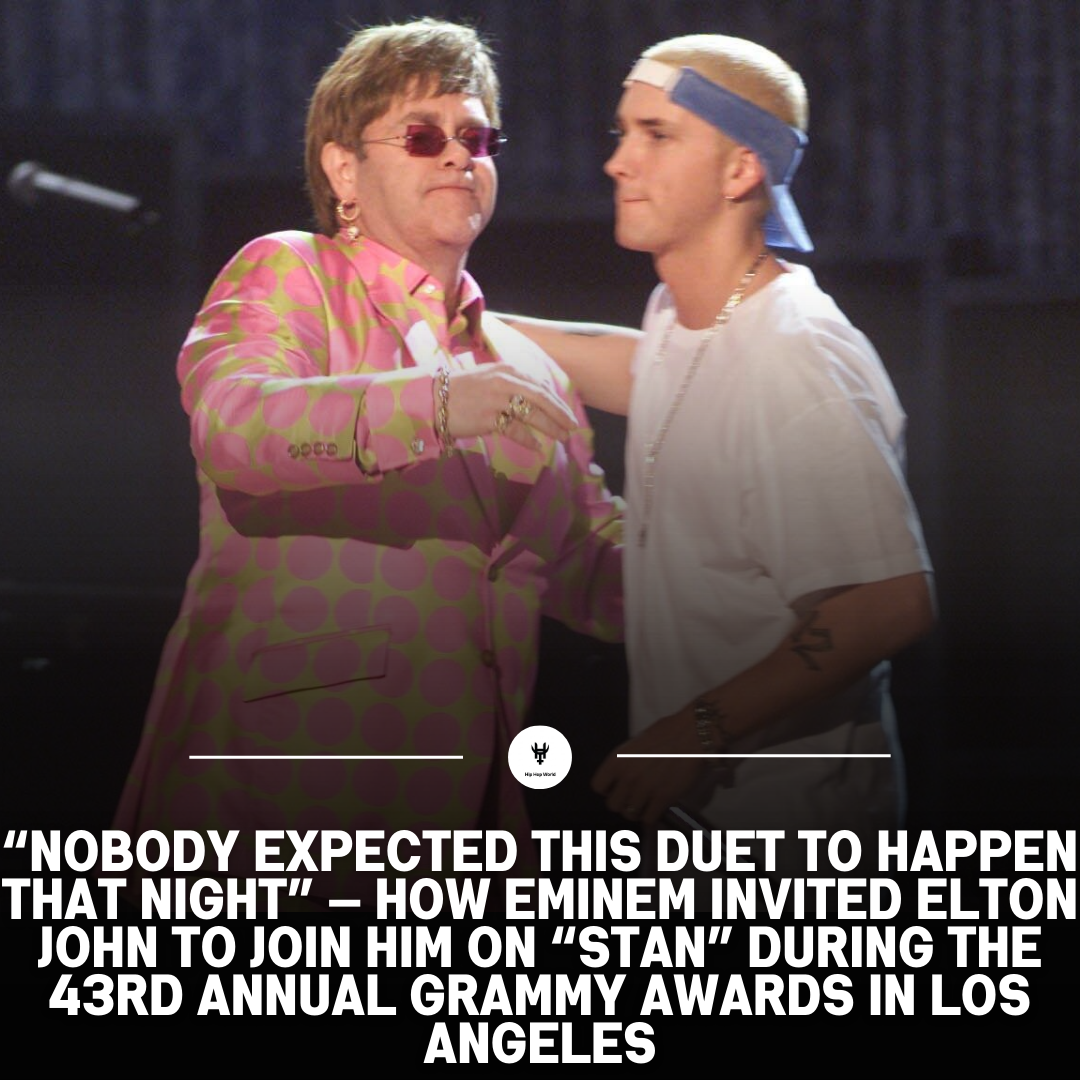
But halfway through the performance, the stage curtains opened to reveal a grand piano — and seated behind it was Elton John.
The sight of the legendary singer instantly shifted the atmosphere in the room. Elton John was not just another guest performer. He was one of the most respected figures in modern music, a global pop and rock icon whose career stretched across decades. He was also openly gay and widely admired for his advocacy within the LGBTQ community.
The collaboration seemed improbable on paper. Eminem represented raw, confrontational hip-hop from Detroit. Elton John embodied the polished grandeur of classic pop songwriting. Yet when John began singing the chorus of “Stan,” the pairing suddenly made sense.
His voice carried the melody with a controlled emotional weight that reframed the entire performance. The song’s vulnerability, already present in the original recording, felt even more exposed in the live arrangement. The piano softened the edges of the moment, pulling the focus toward the narrative rather than the surrounding controversy.
Eminem, meanwhile, remained locked into his verses with sharp intensity. His delivery was calm but precise, each line cutting through the arena with the same tension that had defined the studio recording. The contrast between the two artists created a rare kind of stage chemistry: not harmony in the traditional sense, but a shared focus on the storytelling at the center of the song.
For a few minutes, the noise outside the building seemed to fade.
Fifteen thousand people inside the Staples Center watched a collaboration that few would have imagined only weeks earlier. Cameras moved between the performers and the audience, capturing reactions that ranged from surprise to quiet admiration.
The performance reached its emotional peak as the final chorus echoed across the arena. When the music ended, Eminem and Elton John stepped toward each other and embraced.
The hug lasted only a moment, but its symbolism was immediate.
Within minutes, images of the embrace began circulating across television broadcasts and news coverage of the ceremony. What had started as a night defined by protest suddenly had a new focal point. Instead of headlines about confrontation, much of the attention shifted to the unlikely partnership that had unfolded onstage.
The collaboration did not erase the debates surrounding Eminem’s lyrics. Critics and supporters continued arguing about the boundaries of artistic expression. But the performance complicated the narrative in ways that neither side had fully anticipated.
For Elton John, the decision to appear alongside Eminem reflected a belief that engagement was more productive than distance. By participating in the performance rather than condemning it from afar, he reframed the moment as an opportunity for dialogue within music culture.
For Eminem, the move showed a different kind of strategic awareness. He had not abandoned the confrontational style that defined his work. Instead, he had allowed the music itself to carry the conversation.
In the years that followed, the performance came to be remembered as one of the most unusual collaborations in Grammy history. It represented a moment when two artists from vastly different musical traditions found common ground through storytelling.
Hip-hop had already become a dominant force in global music by the early 2000s, but the 2001 Grammys highlighted something deeper about the genre’s cultural influence. It showed that rap artists could shape conversations far beyond chart success, influencing how the music industry confronted controversy and public debate.
Looking back, the performance of “Stan” that night remains powerful not because it resolved the arguments surrounding Eminem’s work, but because it revealed how complex those arguments really were.
For a few minutes on a brightly lit stage in Los Angeles, a rap provocateur and a pop legend demonstrated that sometimes the most meaningful statements in music are not delivered through speeches or interviews.
They are delivered through performance.