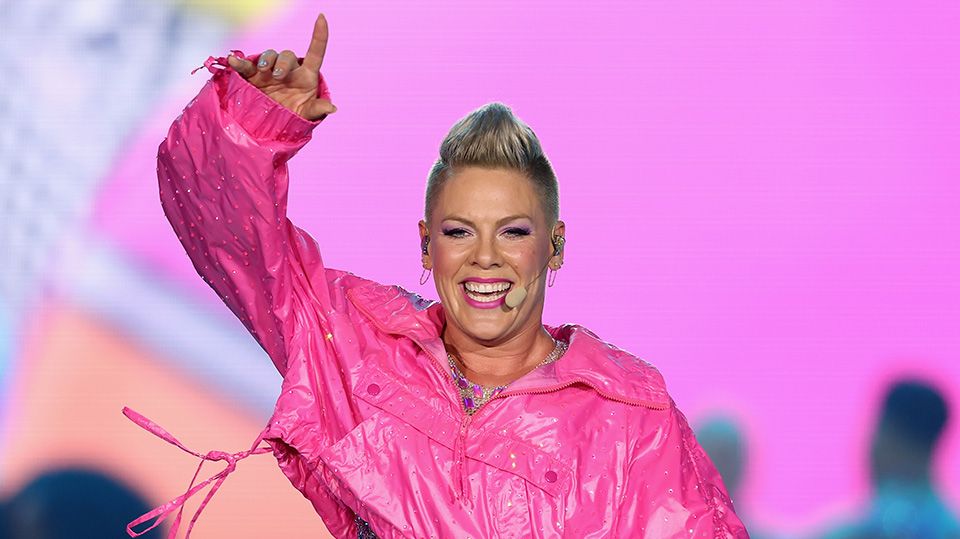
When P!nk enters a new phase of her career, she rarely follows a predictable script. So the idea that she might step into daytime television—potentially in a media capital like New York City—already signals a bold reinvention.
But what makes the rumored move more intriguing isn’t the format. It’s who might be stepping into that spotlight with her: Willow Sage Hart.
And according to those close to the idea, there’s a clear distinction shaping the vision from the start:
Willow wouldn’t be there as a prop, a cameo, or a backup.
She’d be part of the architecture.
Audiences have already seen glimpses of what this dynamic can look like. On tour, Willow hasn’t simply joined her mother for symbolic moments—she’s performed with control, confidence, and a sense of timing that suggests real preparation.
That matters.
Because it shifts perception. What could easily be dismissed as a “celebrity kid moment” starts to feel like something more intentional—an early stage of artistic development happening in real time.
A talk show environment would amplify that shift. Unlike a concert cameo, which is brief and contained, daytime television thrives on repetition, personality, and evolution. It creates space not just to perform, but to grow in public.
Why New York Changes the Equation
If this next chapter does unfold in New York, the location itself becomes part of the strategy.
This isn’t just another media hub—it’s a creative ecosystem. Within a few blocks, you have access to Broadway stages, acting studios, vocal coaches, and a culture that constantly feeds performance and experimentation.
For a young performer, that environment offers something touring can’t: stability with variety.
Instead of moving city to city, Willow would have a consistent base where she can train, explore, and refine her skills while still being exposed to high-level creative work.
It’s less about chasing the spotlight—and more about learning how to stand in it.
The Talk Show as a Living Workshop
Daytime television may seem like an unusual platform for artistic development, but it has a unique advantage: frequency.
A show that airs regularly becomes a kind of laboratory. Segments can evolve. Ideas can be tested. Chemistry can develop organically over time.
If Willow is integrated into that format—through music, conversations, or creative segments—she wouldn’t just be performing. She’d be learning how to engage, adapt, and connect with an audience beyond a scripted song.
That’s a different skill set. And one that many performers only develop much later in their careers.
Redefining What “Family in Entertainment” Looks Like
There’s a long history of families working together in entertainment—but it often comes with complications. Power imbalances, overexposure, and blurred boundaries can turn collaboration into pressure.
What’s notable about P!nk’s approach is the apparent emphasis on structure.
She’s shown, time and again, that access doesn’t equal entitlement. Whether it’s requiring her children to work on tour or treating performances as responsibilities rather than privileges, there’s a consistent philosophy: participation must be earned.
Bringing Willow into a talk show environment under that same framework changes the narrative.
It’s not about showcasing her—it’s about integrating her.
A Partnership, Not a Projection
At 14, identity is still forming. Interests shift. Confidence builds unevenly. The risk, in any public-facing opportunity, is locking someone into a version of themselves too early.
The reported approach here suggests a different intention.
Rather than projecting a finished image onto Willow, the idea seems to allow for movement—letting her try, adjust, and evolve within a controlled environment.
That distinction is critical.
It transforms the experience from exposure into exploration.
There’s also something less obvious happening beneath the surface: stability.
Launching a talk show—especially in a competitive space—comes with pressure. Ratings, النقد, expectations. It’s a different kind of spotlight than performing music.
Having a familiar presence alongside her may not just be a creative decision for P!nk—it may be a grounding one.
And interestingly, the dynamic appears mutual.
Rather than a one-directional support system, there’s a sense that Willow provides balance as much as she receives guidance. That kind of reciprocity is rare, especially in high-profile careers.
Legacy Beyond the Spotlight
In entertainment, “legacy” is often reduced to achievements—albums, awards, milestones.
But legacy can also be built through process.
How you bring someone into the work.
How you teach them to navigate it.
How you create space for them to become something distinct from you.
If this talk show materializes, it may represent a different kind of legacy—one that isn’t about passing down fame, but about sharing a framework.
A way of working. A way of thinking. A way of showing up.
Not Standing Behind—Standing Beside
The most compelling part of this story isn’t the potential show. It’s the positioning.
Willow isn’t being framed as a successor waiting in the wings. She’s not there to echo or support from the background.
She’s being placed alongside—contributing, learning, and gradually defining her own presence within a shared space.
That’s a subtle shift, but a meaningful one.
Because in an industry that often thrives on hierarchy, choosing collaboration over control changes everything.
A New Kind of Stage
If P!nk does step into daytime television, the format itself may become secondary to what it enables.
A stage that isn’t just for performance—but for development.
A spotlight that isn’t just individual—but shared.
A platform that doesn’t just entertain—but evolves.
And at the center of it is a simple but powerful idea:
The next generation doesn’t have to wait backstage.
Sometimes, they’re ready to step forward—on their own terms, with guidance, and without being reduced to anything less than part of the vision.