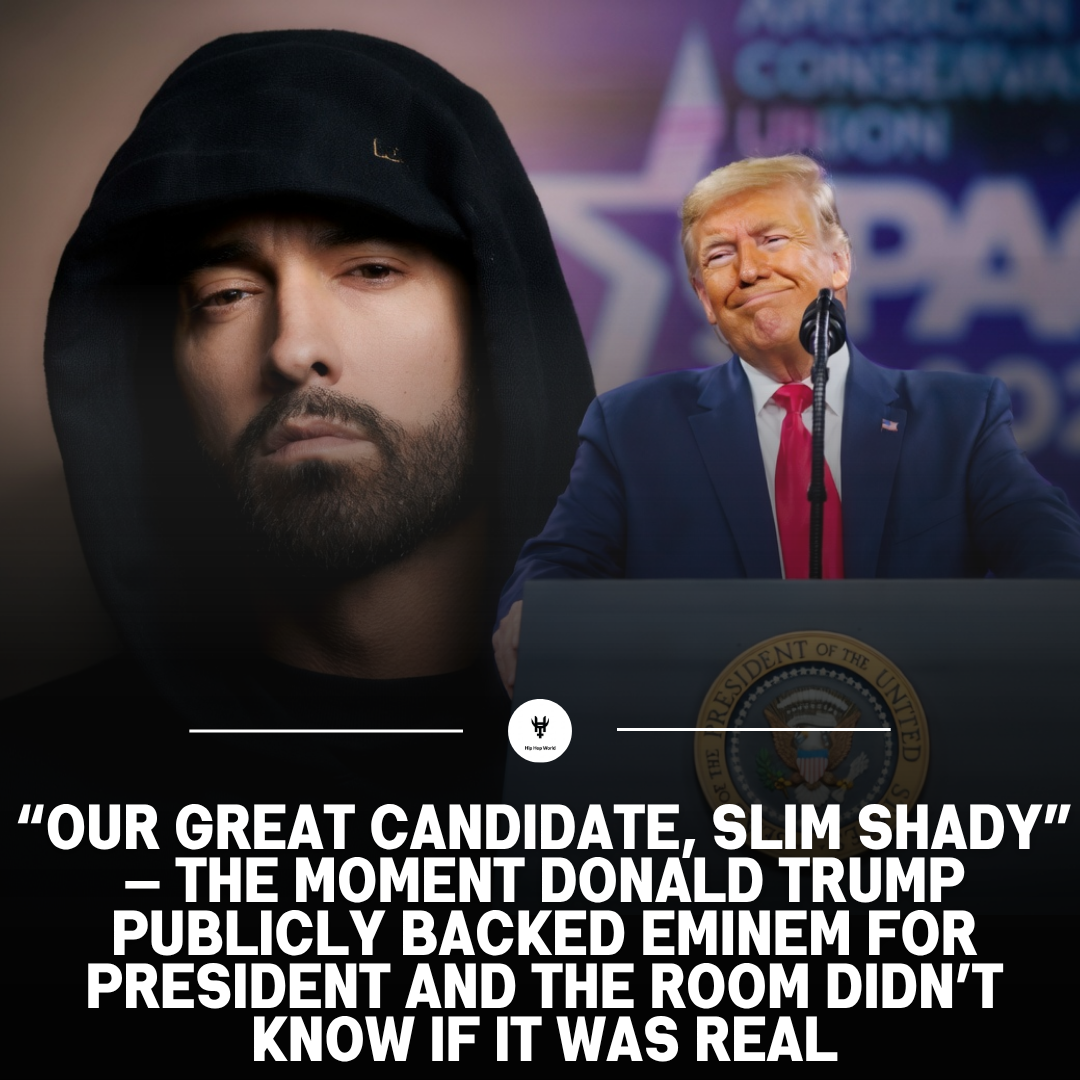
The room at New York’s Roseland Ballroom didn’t feel like a concert venue that night. It felt staged—deliberately theatrical, almost surreal—like something caught between a campaign rally and a rap show. Lights cut through the haze, cameras were already rolling, and the crowd waited for something they couldn’t quite define. Then, suddenly, the illusion sharpened. A figure stepped forward, not from the world of hip-hop, but from a completely different arena of influence.
Donald Trump took the stage.
At the time, it didn’t feel as jarring as it might today. In the early 2000s, Trump occupied a strange cultural space—less a political figure and more a symbol. He was wealth, excess, branding. In hip-hop, those traits translated easily. His name appeared in lyrics not as a statement of ideology, but as shorthand for success. He was, in a way that now feels distant, part of the aesthetic.
That night in 2004, that aesthetic crossed into performance.
The Era When Image Meant Everything
This moment didn’t come out of nowhere. Hip-hop in the late ’90s and early 2000s was deeply invested in the idea of visible success. Luxury wasn’t subtle—it was declared, repeated, celebrated. Trump’s public persona, built on real estate and television appearances, fit seamlessly into that narrative. Whether the wealth was fully understood didn’t matter. What mattered was perception.
And perception, in hip-hop, is currency.
At the same time, Eminem was operating at a peak few artists ever reach. He had already reshaped the genre, broken commercial records, and become one of the most recognizable figures in music. But by 2004, something was shifting. His fifth album, Encore, was approaching release, and the tone around his work was beginning to change.
The sharp edge that once defined him was softening, replaced by something more chaotic, more experimental—and at times, more uneven.
Still, the scale of his influence remained untouched.
The Shady National Convention
To launch Shade 45, a satellite radio station dedicated to uncensored hip-hop, Eminem didn’t choose a traditional rollout. Instead, he constructed a spectacle—a mock political convention that blurred parody with performance.
It was called the Shady National Convention.
The concept was simple in theory: present Eminem as a presidential candidate, complete with speeches, introductions, and staged endorsements. But in execution, it became something stranger. The satire leaned heavy, stretching across long segments that felt less like sharp commentary and more like extended performance art.
And at the center of it was Trump.
Introduced with exaggerated flair, he delivered a speech that mirrored the persona he had built for years—confident, self-promotional, and unwavering in its tone. The message was clear: Slim Shady was a winner. He had the qualities that mattered. And, in that moment, Trump’s endorsement became part of the show’s narrative.
It was meant to be absurd.
But like many moments in culture, its meaning would shift with time.
A Performance That Drifted Between Worlds
When Eminem finally took the stage to speak, the energy shifted again—but not entirely in the way the moment demanded. The satire continued, but its impact felt diluted. The audience, more than anything, was waiting for the music.
And when it came, it carried the weight of Encore—a project that would later be viewed as one of the more divisive points in his career.
The performances moved through tracks from the album, mixed with appearances from D12 and guest artists like Method Man and Busta Rhymes. Their presence added energy, but even then, the night felt fragmented. Comedy, politics, and music collided without fully settling into one identity.
It was ambitious. It was unusual. And at times, it felt uncertain of itself.
The Moment That Aged Into Something Else
Looking back, what stands out isn’t just the performance—it’s the context around it. In 2004, the idea of Donald Trump endorsing Eminem as a fictional presidential candidate existed purely within entertainment. It was exaggerated, detached from reality, and easy to dismiss as a product of its time.
But culture doesn’t stay fixed.
As the years passed, Trump’s role in public life transformed dramatically. What once felt like parody began to resemble something closer to foreshadowing. The distance between spectacle and reality narrowed, and moments like the Shady National Convention took on a different weight.
What was once a joke started to feel like an early glimpse of a larger shift.
Legacy Beyond the Performance
For Eminem, the event sits in a unique place within his career. It represents a period of transition—when creative risks became more unpredictable, and the balance between satire and substance became harder to maintain. Encore would go on to divide audiences, marking a turning point before his eventual reinvention years later.
For hip-hop, the moment reflects something broader. It captures a time when the genre’s relationship with power, wealth, and celebrity was still evolving—when symbols could be borrowed without fully carrying their future implications.
And for Trump, it stands as a reminder of a different kind of influence. Before politics, before campaigns, there was a time when his presence in culture was defined not by policy, but by perception.
That night at Roseland Ballroom didn’t change the world. But it captured something rare—a moment where music, identity, and image overlapped in ways no one fully understood yet.
And years later, it’s no longer remembered for the performance alone—but for how strangely familiar it now feels.