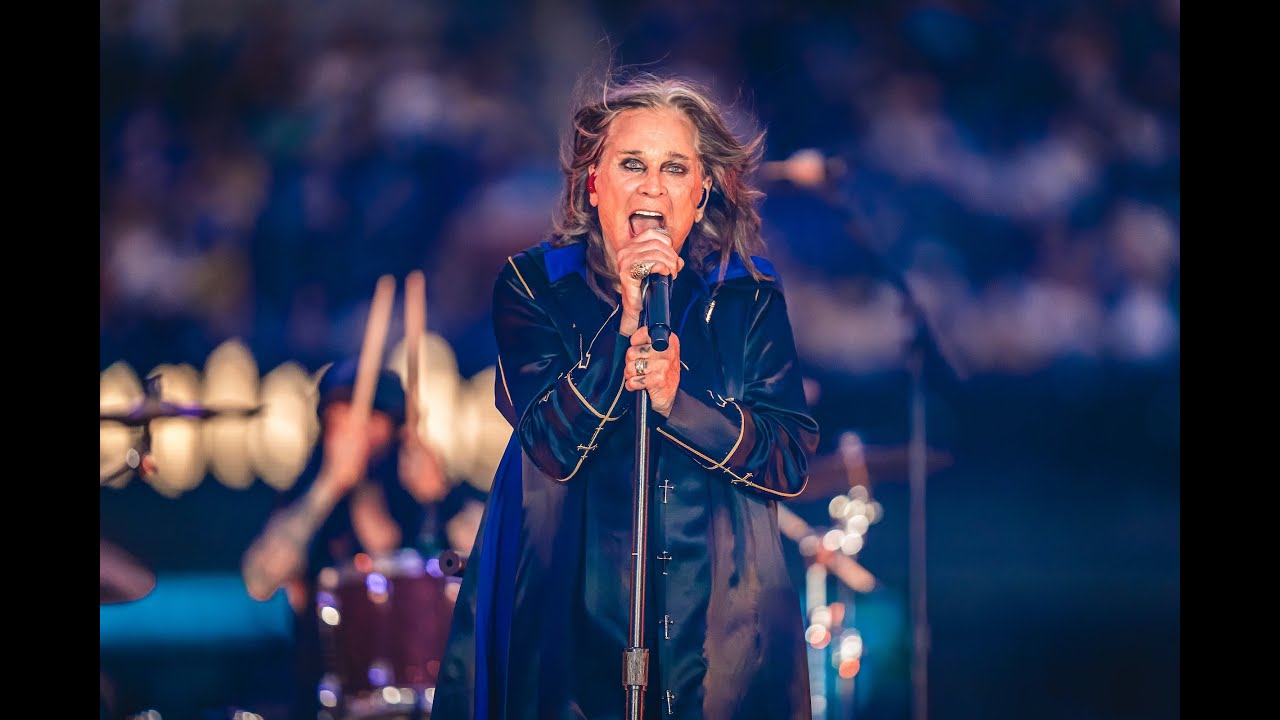
On July 5, 2025, at Birmingham’s Villa Park, Ozzy Osbourne delivered his final performance during the Back to the Beginning concert, a moment that would become his eternal goodbye. In a career marked by chaos, genius, and unwavering devotion to his fans, the frail yet fearless rendition of “Mama, I’m Coming Home” stood as the heart of that night—a melody that carried the weight of a lifetime.
As the opening chords of the 1991 classic rang out, a hush fell over the stadium. Tens of thousands stood still, as captured in newly released wide-angle footage, their eyes fixed on Ozzy, who poured his soul into every trembling note. Originally written as a love letter to his wife, Sharon, the song transformed that night into a universal farewell—to her, to the fans, to the stage that had defined him.
There was no spectacle, no pyrotechnics—just Ozzy, raw and unfiltered, his voice cracking but resolute. Those close to him later revealed he knew his time was limited, yet he gave everything to that performance. His eyes held gratitude, sorrow, and acceptance, mirrored by the crowd’s voices rising in unison, carrying him through the lyrics. It was a shared moment of love and loss, etched into history.
The performance’s impact rippled far beyond Villa Park. Footage of “Mama, I’m Coming Home” spread rapidly, touching fans, musicians, and even casual listeners. Major outlets shared the clip, struck by its raw emotion—a universal need to say goodbye and be heard. In a rare phenomenon, the song re-entered the Billboard Hot 100 in 2025, 33 years after its #28 peak in 1992, driven by 8.7 million streams and 15,000 downloads. It wasn’t just a chart entry; it was a hymn of grief and celebration for a man who turned pain into power.
This wasn’t nostalgia—it was love. Love for Ozzy, who, despite battles with addiction, health struggles, and time itself, never stopped giving to his audience. His farewell was dignified, not dramatic, with the final chorus ringing louder than any encore. At his funeral, the same stillness from that night returned. Fans lined Birmingham’s streets as “Mama, I’m Coming Home” played softly, a final embrace from the world to its Prince of Darkness.
Sharon Osbourne’s subtle gesture during the funeral—a mirrored version of Ozzy’s iconic hand horns—added a piercing layer of heartbreak. It was her farewell not just to a husband, but to a shared life of music and sacrifice. The song, once personal, became a sacred memory, frozen in time.
The moment feels almost fated—the choice of song, the timing, its resurgence. Like Freddie Mercury’s final Queen performances or Johnny Cash’s late recordings, Ozzy’s last bow carried the weight of an era. Fans continue to flood tribute videos and chart announcements with messages of gratitude and grief, from “You saved my life” to “Rest easy, Ozzy.” Each stream feels like a candle lit in his honor.
The song’s chart return is more than a statistic—it’s a cultural milestone. It reminds us that great artists live on in the moments they create. “Mama, I’m Coming Home” now carries a promise kept, sung not in a press release but in a timeless melody that resonates deeper than ever.
Ozzy Osbourne may have left the stage, but his voice endures. For millions who found solace in his music, healed through his chaos, and now mourn him, he didn’t just come home—he became home. The Prince of Darkness is gone, but his light, carried in that final song, burns eternal.