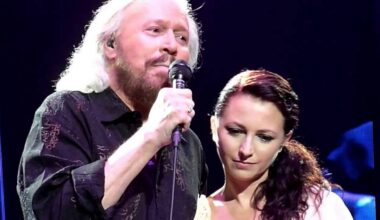
It was supposed to be just another nostalgic night in New York — Paul Simon, now in his eighties, standing under the soft glow of Central Park’s summer lights. The air was heavy with memory. Thousands filled the grass, some with children who only knew the songs secondhand, others with faces lined by decades of listening to them live. When the opening chords of The Sound of Silence began, the audience leaned in like they were leaning into an old prayer.
But halfway through, Paul stopped. His hand hovered above the strings, his lips pressed together, his eyes suddenly scanning the crowd. People thought maybe it was a technical glitch, maybe a forgotten lyric. Then he stepped closer to the mic and said, simply: “Art.”

At first, no one understood. But then heads began to turn toward the side of the park, where, in the quiet glow of the spotlights, sat Art Garfunkel — the other half of a voice that had once defined a generation, and then had disappeared from it.
They hadn’t sung together in years. Their fallout was legendary — creative differences, bitter words, two egos too large to share the same stage. Fans had long given up hope of ever seeing them together again. Yet here they were, one calling the other’s name in the middle of a song about silence.
The crowd erupted. Some cheered, some gasped, others simply froze in disbelief. Garfunkel stood, his hair thinner, his face older, but his presence instantly familiar. Paul extended a hand. It trembled slightly, as if unsure whether it would be accepted. For a long second, Art just looked at him, eyes glistening. Then, slowly, he walked to the stage.
No words were exchanged. No apology, no explanation. Just two men who had shared something larger than themselves. Paul began to strum again, softly. Art leaned in. And together — their voices cracked, aged, imperfect — they sang the final verse of The Sound of Silence.
It was not polished. It was not rehearsed. But it was devastatingly human. People wept openly, strangers holding each other as though to steady themselves through the gravity of the moment.
By the time the last note faded, there was no encore. No grand speech. Garfunkel squeezed Simon’s hand, whispered something the microphones did not catch, and walked back into the crowd. Paul remained still, guitar by his side, eyes wet but steady.
The silence that followed was unlike any silence New York had ever known — not empty, but full. Full of history, of regret, of forgiveness, of music that had always belonged to both of them, and to all of us.
That night, Central Park became more than a concert venue. It became the closing of a chapter that had been left unwritten for decades. And in that brief reunion, Paul and Art reminded everyone of a truth they had sung so many years ago: silence can be deafening, but sometimes, just sometimes, it can also be healed by song.