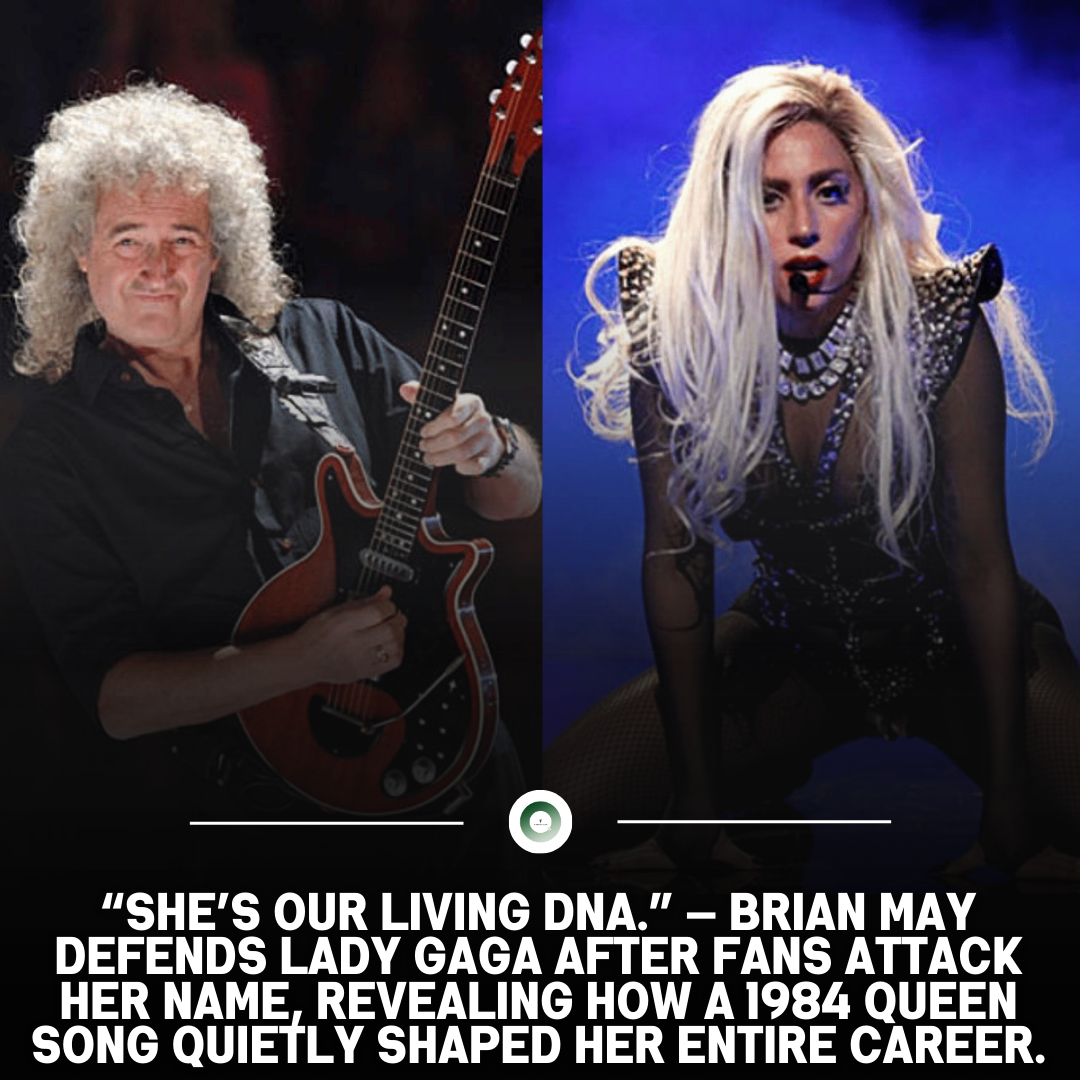
When Lady Gaga first exploded into global consciousness, the reaction wasn’t universally celebratory. Her rise came wrapped in spectacle—towering heels, theatrical performances, and a stage name that sounded strangely familiar to rock loyalists. For many purists, “Lady Gaga” didn’t feel like coincidence. It felt like intrusion. They questioned whether someone from the pop world had borrowed too closely from the sacred language of rock royalty. But while critics sharpened their skepticism, one voice from inside Queen itself stepped forward—not to condemn her, but to protect her.
Brian May understood something the critics didn’t.
He recognized that Gaga’s identity wasn’t imitation. It was homage.
Her name traced directly back to Queen’s 1984 anthem “Radio Ga Ga,” written by Roger Taylor at a time when the music world itself was undergoing transformation. The song had been Queen’s reflection on changing eras—on the evolution of sound, audience, and spectacle. Decades later, that same phrase unexpectedly became the foundation of a new artist’s identity. What began as a studio reference during Gaga’s early development reportedly evolved into something permanent. The accidental shift from “Radio” to “Lady” didn’t dilute the connection. It sealed it.
When Brian May learned that this rising performer had built her name around Queen’s creative legacy, his reaction wasn’t defensive.
It was deeply emotional.
He didn’t see theft. He saw continuity.
At a time when many rock traditionalists dismissed Gaga as artificial, May saw authenticity beneath the spectacle. He saw the same fearless theatrical instinct that had once defined Freddie Mercury. Gaga wasn’t simply performing songs—she was building worlds. Her shows weren’t designed for quiet appreciation. They were built for immersion, for transformation, for the kind of overwhelming emotional experience that had always been Queen’s signature.
May understood that this instinct couldn’t be manufactured.
It had to come from somewhere real.
And he saw it clearly in her.
That recognition didn’t remain theoretical. It became tangible when May stepped directly into Gaga’s creative universe, lending his unmistakable guitar voice to her 2011 track “Yoü and I.” His presence on the song wasn’t symbolic. It was validation. It was Queen’s sound, reborn inside a new generation’s voice. When May later joined her onstage, the moment didn’t feel like a guest appearance. It felt like a bridge between eras.
Their connection grew beyond collaboration. It became mutual trust.
May openly acknowledged what few others would dare to say: Gaga possessed something rare. She had the creative strength, the theatrical instinct, and the emotional command necessary to stand in spaces few performers could survive. The possibility of her fronting Queen wasn’t presented as fantasy. It was presented as reality waiting for the right moment.
For Gaga, the weight of that recognition was overwhelming.
Because this wasn’t approval from critics.
It was acceptance from the source.
Brian May’s defense of Lady Gaga didn’t just silence critics. It reframed the entire conversation. It revealed that Gaga wasn’t borrowing from Queen’s legacy. She was extending it. The name that once triggered suspicion became proof of lineage—a signal that Queen’s influence hadn’t faded, but evolved.
In the end, Gaga didn’t take Queen’s flame.
She carried it forward.