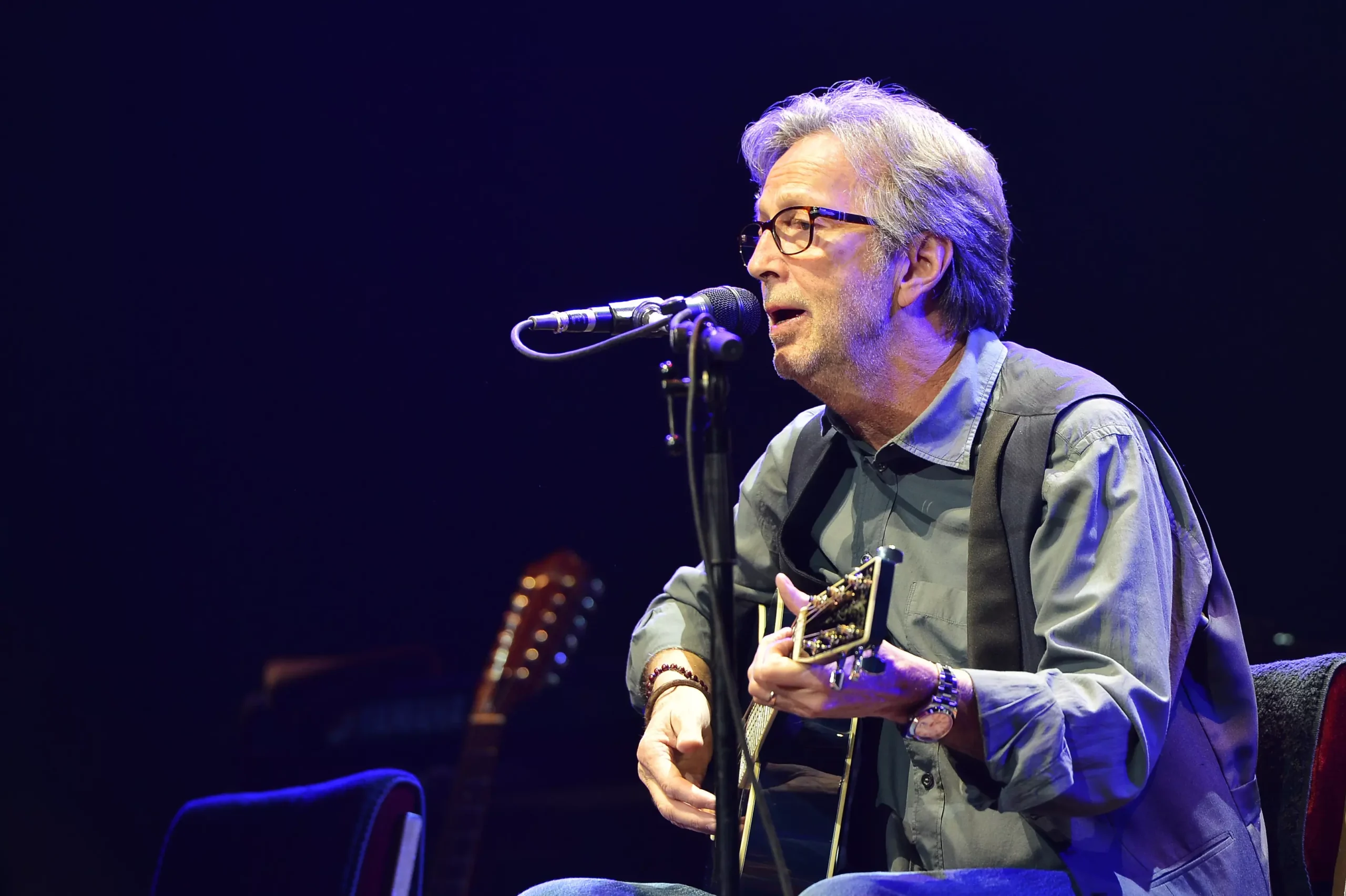
It was supposed to be just another night at the Royal Albert Hall. The lights dimmed, the chatter of the crowd softened into a hush, and Eric Clapton, now in his late seventies but still carrying the aura of a man who had lived through every note he’d ever played, walked toward the stage with his familiar Stratocaster slung across his shoulder.
But before he could take the first step into the spotlight, a commotion near the front row caught his eye. A man, perhaps in his forties, clutched something in his hands with trembling fingers. It wasn’t the usual album sleeve, poster, or glossy photograph. It was a guitar — but not like the polished, perfect instruments Clapton was accustomed to. This one was battered, dulled by time, its wood cracked with age, its strings discolored. It looked like it hadn’t been played in decades.
Security hesitated, but the man pleaded. “I don’t want an autograph. Please,” he whispered hoarsely. “This was my father’s guitar. He passed away last month. He told me once, ‘If you ever meet Clapton… let him touch this guitar, just once.’ He worshiped your music. He never learned to play it right, but he held onto this guitar like it was his life.”
The hall grew eerily silent as the words traveled. Clapton stopped mid-step. Slowly, he walked to the edge of the stage, crouching to listen more closely. “Your father’s guitar?” he asked softly.
The man nodded, tears forming in his eyes. “He bought it after hearing ‘Layla’ back in the seventies. He practiced for years, but his hands never found the right notes. Still, he told me this guitar carried him through every heartbreak, every night alone, every joy. He wanted it to meet you, even if he never could.”

Clapton’s face changed. His eyes, weary yet tender, glistened under the dim stage lights. He reached out, hands gentle, as if afraid the old instrument might disintegrate at his touch. He examined the guitar — not a prized Fender, not a collector’s piece, but a cheap, entry-level model from decades past. Yet it carried something priceless.
Then Clapton looked back at the man. “If you’ll allow me,” he said quietly, his voice almost breaking, “I’d like to borrow it tonight.”
The man’s jaw dropped. The audience gasped. And then the applause erupted — not the thunderous roar of excitement, but the kind of applause soaked in reverence, as though everyone knew they were about to witness something fragile and sacred.
Clapton stepped onto the stage, the battered guitar now strapped across his shoulder. He adjusted the tuning pegs, wincing slightly at the stiff strings. The sound wouldn’t be perfect. It couldn’t be. But that was the point.
He took a deep breath. And then the opening chords of Tears in Heaven rang out.
It wasn’t clean. The notes wavered, the tone cracked. Yet somehow, the imperfections made it more haunting. The audience leaned in, breathless. Clapton closed his eyes as he played, his fingers moving with the tenderness of a man speaking through time. For that moment, it felt as if he wasn’t just performing for thousands — he was sending a message across the veil, playing not for fans, but for a single soul who had once cradled that guitar in the silence of his room.
When Clapton began to sing, his voice broke on the second line. He didn’t try to mask it. He let the cracks in his voice carry the weight of the story. The man who had brought the guitar stood frozen, tears streaming down his cheeks. Around him, strangers reached out, resting hands on his shoulders, holding him upright.
As the final notes faded, Clapton didn’t bow. He simply removed the guitar, held it with both hands, and walked back down to the man. “Keep it,” Clapton said softly, returning it with reverence. “Now your father’s music has been heard. Tonight, he played with me.”
There was no encore. Clapton quietly exited the stage, leaving behind a room filled with stunned silence. The crowd slowly stood, not in roaring applause, but in silent respect — the kind of silence usually reserved for prayer.
For those who were there, it wasn’t a concert anymore. It was a communion between past and present, between a father’s unfulfilled dream and the musician who unknowingly carried it into reality.
As one woman later wrote in a fan forum: “It wasn’t the perfect guitar. It wasn’t the perfect sound. But it was the perfect moment. For three minutes, we all sat in a room with a man, his father’s ghost, and Clapton bridging the distance with six strings that barely held together.”
And just like that, the old guitar returned home. But for one night, it sang.