Some songs are technically difficult. Others are emotionally demanding. And then there are rare pieces that feel almost untouchable—where the weight of the story alone makes interpretation a risk.
“It’s Quiet Uptown” falls firmly into that last category.
When Lin-Manuel Miranda set out to reimagine songs from his landmark musical Hamilton for The Hamilton Mixtape, he invited artists to reinterpret the material through their own lens. Some tracks leaned experimental. Others played with genre.
But one recording didn’t just reinterpret the song—it reshaped how even its creator experienced it.
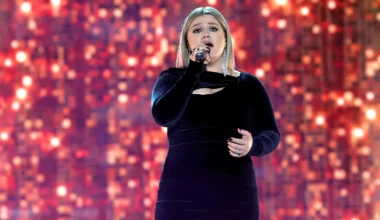
That recording belonged to Kelly Clarkson.
A Song That Carries Grief in Its Bones
Within Hamilton, “It’s Quiet Uptown” marks a devastating turning point. It follows the death of Alexander Hamilton’s son and traces the fragile, nearly wordless process of grief and forgiveness between Hamilton and his wife, Eliza.
Onstage, it’s already one of the most emotionally charged moments in the entire production. There are no flashy visuals, no clever wordplay—just stillness, loss, and the slow, painful attempt to move forward.
Stripped of theatrical context, the challenge becomes even sharper:
Can a voice alone carry that kind of emotional gravity?
The Unexpected Layer: Clarkson’s Real-Life Moment
When Clarkson stepped into the studio, she wasn’t approaching the song from a neutral place.
She was pregnant.
That detail changes everything.
While the lyrics explore the unimaginable loss of a child, Clarkson was living in a state of heightened anticipation—physically connected to new life, acutely aware of the vulnerability and protectiveness that comes with it.
That contrast didn’t dilute the song’s emotion. It intensified it.
Instead of simply portraying grief, she approached it from the other side of the emotional spectrum—where love feels so immediate and instinctive that the idea of loss becomes almost unbearable.
A Performance That Refused to Hide
Unlike many modern recordings, Clarkson’s version doesn’t rely on vocal power as its primary tool.
There are no soaring runs meant to impress. No dramatic flourishes to distance the listener from the pain.
Instead, the performance leans into restraint.
-
Her voice softens rather than swells
-
Phrases feel lived-in rather than performed
-
Silence becomes as important as sound
At moments, her voice carries a slight tremble—not as a technique, but as a byproduct of feeling. And that’s what makes it land.
It doesn’t sound like someone delivering a song.
It sounds like someone processing it in real time.
The Studio Moment That Shifted Everything
According to Miranda, the recording session itself was heavy—emotionally charged in a way that’s difficult to manufacture.
There were pauses. Moments where Clarkson had to stop, regroup, and continue.
Those interruptions didn’t weaken the performance. They became part of its DNA.
Because what ended up on the final track wasn’t just a polished interpretation—it was a document of someone navigating the emotional weight of the material as it unfolded.
When a Creator Hears His Work Differently
For any songwriter, there’s a quiet understanding: once a piece is released, it no longer belongs entirely to its creator.
But it’s rare for a reinterpretation to loop back and fundamentally change how the original artist experiences their own work.
That’s exactly what happened here.
Miranda later admitted that Clarkson’s version altered his relationship with the song—that he couldn’t hear it the same way again. He even described her interpretation as having “elevated” it.
That’s not casual praise. It’s a recognition that something new was revealed—something that wasn’t fully visible in the original version.
Why This Version Resonates Beyond Broadway
Part of what makes Clarkson’s recording so powerful is that it detaches the song from its historical setting.
You don’t need to know anything about Alexander Hamilton. You don’t need context, costumes, or staging.
The themes translate instantly:
-
The shock of loss
-
The difficulty of forgiveness
-
The quiet, almost invisible work of healing
By stripping the song down to its emotional core, Clarkson made it accessible in a new way. It became less about a moment in a musical and more about something universal.
The Subtle Power of Restraint
In an era where vocal performances are often measured by range, volume, and technical complexity, this recording stands out for doing the opposite.
It proves that:
-
Holding back can be more powerful than pushing forward
-
Simplicity can carry more weight than spectacle
-
Vulnerability, when real, doesn’t need amplification
Clarkson didn’t try to outdo the original.
She chose to sit inside it.
A Different Kind of Legacy
The Hamilton Mixtape was designed as a reinterpretation project. But in this case, the reinterpretation became something more—a parallel version of the song that exists alongside the original, equally definitive in its own way.
Clarkson didn’t replace the Broadway performance.
She expanded it.
And in doing so, she demonstrated something that applies far beyond music:
The most powerful interpretations don’t just retell a story—they reveal something new within it.