It looked, at first, like another Pink performance.
The lights dimmed. The music softened. The rigging lifted. And as the audience looked up, there she was—suspended high above the stage, doing what she has done better than almost anyone in modern pop: turning gravity into part of the show.
But this time, there was someone beside her.
Her daughter.
And suddenly, the performance meant something else entirely.
Not a stunt—something far more personal
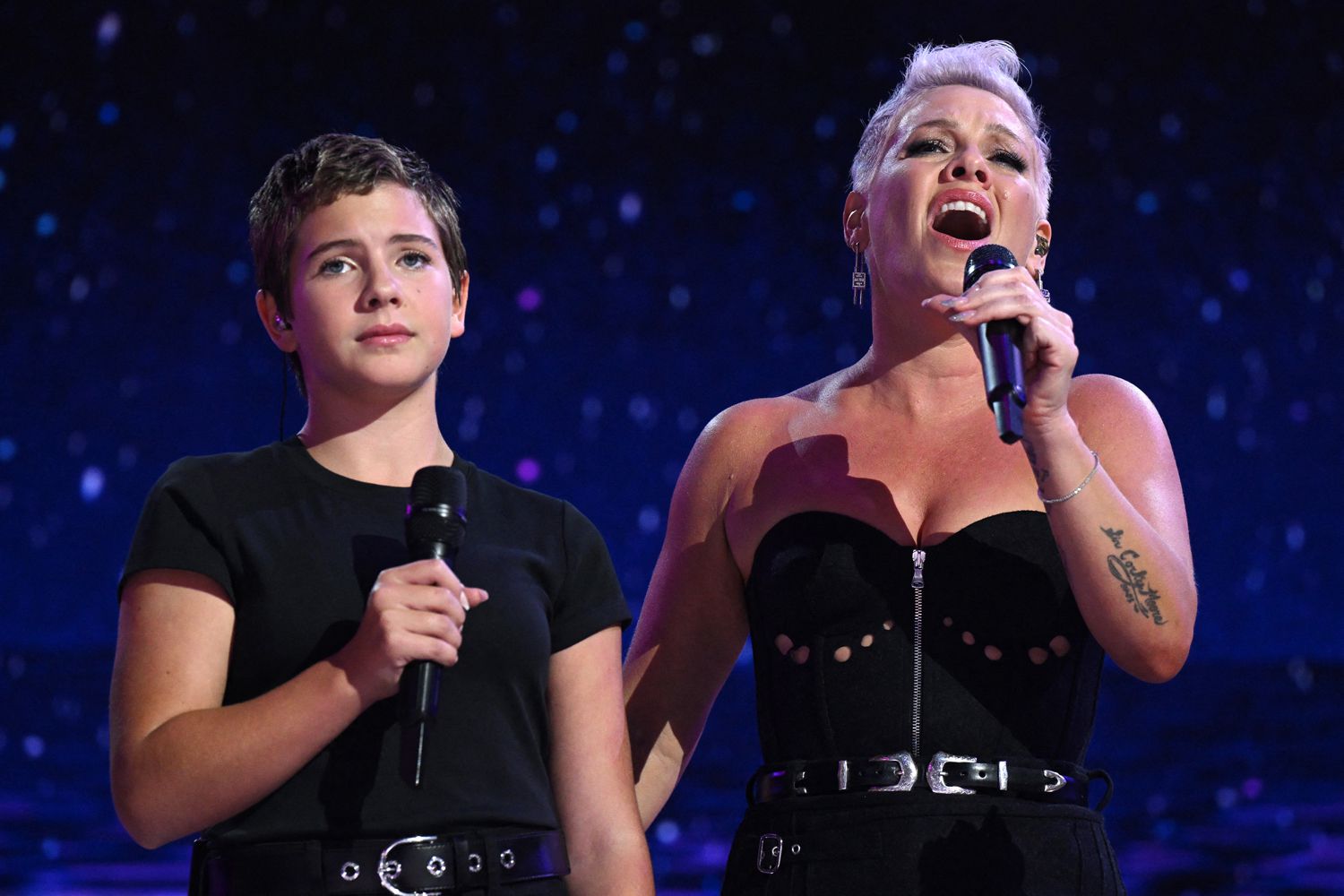
When Pink and her daughter Willow Sage Hart rose into the air together at the Billboard Music Awards, the moment didn’t feel like a celebrity cameo. It felt quieter. More deliberate.
They weren’t racing through choreography. They weren’t chasing spectacle.
They moved slowly. Carefully. In sync.
Set to “Cover Me in Sunshine”—a song already rooted in warmth and reassurance—the performance unfolded like a visual extension of its message. It wasn’t about impressing the audience.
It was about connection.
And that’s what made it powerful.
The illusion of danger—and the reality behind it
In the days that followed, much of the conversation around the performance focused on risk. Headlines and social media posts suggested something far more extreme than what actually occurred—claims of “no safety net,” of a child placed in serious danger mid-air.
That framing misses an important truth.
Pink’s aerial performances are the result of years of professional training, safety engineering, and controlled execution. When she performs—even at height—there are systems in place: harnesses, rigging, rehearsals, and highly trained crews ensuring that every movement is planned and supported.
This performance was no exception.
Willow wasn’t improvising in the air. She was part of a carefully choreographed routine, rehearsed extensively and adapted specifically for her level of experience. The goal wasn’t to test limits.
It was to create a shared moment.
Why the performance resonated so deeply
What audiences responded to wasn’t danger.
It was trust.
Watching a parent and child move together in that environment carries emotional weight, even when you understand the safety behind it. There’s something instinctive about seeing that level of coordination and reliance—two people literally supporting each other in motion.
For Pink, whose career has often balanced strength with vulnerability, this was a natural evolution.
She wasn’t just performing for her daughter.
She was performing with her.
That distinction matters.
A different kind of legacy
Artists often talk about legacy in terms of music, influence, or longevity. But moments like this suggest a different interpretation.
Legacy can also be something lived.
Something shared.
By bringing Willow into her world—not as a prop, not as a spectacle, but as a participant—Pink shifted the focus away from herself. The performance wasn’t about proving she could still do what she’s known for.
It was about letting someone else step into that space, safely and meaningfully.
The discipline behind the beauty
It’s easy to romanticize what happened on stage. The floating movements, the soft lighting, the emotional tone.
But underneath that is discipline.
Aerial work demands strength, control, and repetition. Even simplified routines require physical awareness and training. For a child, that process has to be even more carefully managed—scaled, supervised, and adapted.
Willow didn’t just appear on stage and perform.
She learned.
She practiced.
She was prepared.
That’s what made the moment work—not risk, but readiness.
Why “no safety net” became the wrong story
In an age of viral clips and dramatic headlines, nuance often gets lost.
The idea of a child performing “without a safety net” is attention-grabbing. It creates tension. It invites reaction.
But it also distorts the reality of what professional performances involve.
The truth is less sensational—and more reassuring.
This was a controlled, rehearsed, and supported performance designed to look effortless while being anything but.
And that’s the artistry.
A mother, an artist, and the space between
Pink has built her career on defying expectations—vocally, physically, and emotionally. But this moment revealed something more grounded.
A willingness to share the stage not just as an artist, but as a parent.
That dual role is not always easy to navigate, especially in an industry built on individual spotlight. But here, the balance felt intentional.
She didn’t disappear into the background.
She made space.
What audiences actually witnessed
In the end, the performance wasn’t about risk. It wasn’t about shock value. And it certainly wasn’t about testing limits for the sake of attention.
It was about:
- Trust built through preparation
- Connection expressed through movement
- A parent choosing to include, not protect from a distance
The height added drama. The music added emotion.
But the meaning came from something simpler.
Two people, connected by more than choreography, moving together in a space that required them to rely on each other completely.
The moment after the applause
When they came back down, the transition was almost immediate. The lights shifted. The performance ended. The show moved on.
But the impression lingered.
Not because it was the most dangerous thing anyone had seen.
But because it felt real in a way that most performances don’t.
It wasn’t about proving fearlessness.
It was about showing trust—clearly, quietly, and without exaggeration.
And sometimes, that’s far more powerful than any stunt.