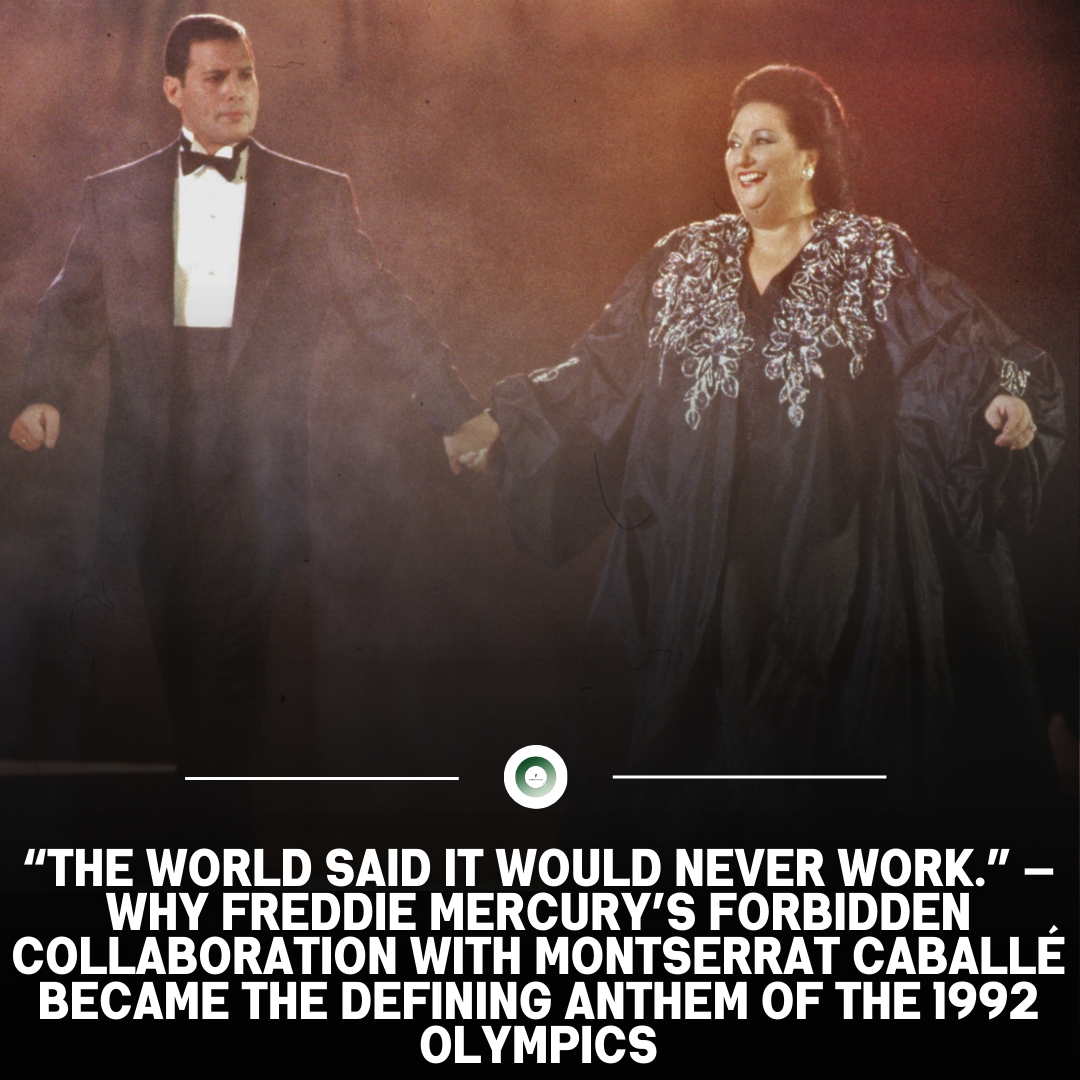
In the late 1980s, Freddie Mercury stood at the absolute peak of rock stardom. His voice had filled stadiums, his presence had defined an era, and his identity was inseparable from the thunder and spectacle of Queen. Yet behind the leather, the defiance, and the arena anthems lived a quieter obsession—opera. It was not a casual admiration. It was reverence. And at the center of that reverence stood one woman: Montserrat Caballé.
To the outside world, the idea made little sense. Rock and opera existed in separate universes, each with its own traditions, its own audience, its own unspoken rules. Crossing that boundary risked ridicule. It risked misunderstanding. It risked failure. But for Freddie Mercury, those risks meant nothing compared to the chance to create something that had never existed before.
He wasn’t chasing a hit. He was chasing a dream.
The Idol Who Shaped His Secret Musical Identity
Freddie Mercury never hid his love for opera. Long before the collaboration was even imagined, opera had already shaped his artistic instincts. Its drama, its scale, its emotional extremity—all of it lived inside his own voice. Songs like “Bohemian Rhapsody” had already hinted at his operatic ambitions, but this was different. This time, he didn’t want to imitate opera. He wanted to stand inside it.
Montserrat Caballé was not just any opera singer. She was one of the greatest sopranos of her generation, known for a voice that could move from fragile intimacy to overwhelming power in a single phrase. To Freddie, she represented the purest form of vocal artistry. She was untouchable.
When the opportunity arose to meet her in Barcelona, he didn’t arrive as Freddie Mercury, global rock icon. He arrived as a fan.
Despite commanding crowds of tens of thousands, he later admitted he felt deeply nervous in her presence. This wasn’t fear of rejection as a collaborator. It was fear of standing in front of someone he had admired for so long.
But the moment they met, something unexpected happened.
They understood each other instantly.
The Song That Shouldn’t Have Worked—but Did
Freddie brought her a simple idea. Not a finished anthem. Not a polished commercial product. Just a vision. A fusion of two worlds that had never fully embraced one another.
When Caballé heard him sing, she didn’t hear a rock star trying to imitate opera. She heard a musician who genuinely understood its emotional language. She agreed to collaborate.
What followed was the creation of “Barcelona.”
The song didn’t compromise either artist’s identity. Caballé’s voice soared with classical purity, untouched by rock conventions. Freddie’s voice remained dramatic, theatrical, unmistakably his own. Around them, orchestral arrangements rose and expanded, not as decoration, but as structure. Neither genre dominated. Neither retreated.
They stood side by side as equals.
It wasn’t rock pretending to be opera. It wasn’t opera diluted into rock. It was something entirely new.
Something neither world had seen before.
A City, A Song, and a Destiny That Came Too Late
When “Barcelona” was released in 1987, its significance extended beyond music. The city of Barcelona was preparing to host the 1992 Summer Olympics, and the song’s grandeur, its sense of ceremony, and its emotional weight made it the perfect representation of the moment. It didn’t just celebrate a city. It celebrated human possibility.
It was eventually chosen as the official anthem of the Games.
But fate intervened in a way no one could control.
Freddie Mercury passed away in November 1991, less than a year before the Olympics began.
He never saw the moment his dream reached its final destination.
He never stood before the world and watched as the city he honored embraced the song he had created.
When the Olympics finally arrived, Montserrat Caballé performed “Barcelona” alone. Freddie was absent physically, but his voice remained. The recording filled the stadium, echoing across millions of listeners worldwide.
It was no longer just a song.
It was a farewell.
The Moment Freddie Mercury Proved His Voice Belonged Everywhere
What made “Barcelona” unforgettable was not just its scale or its Olympic legacy. It was what it revealed about Freddie Mercury himself. He was never confined to rock. He was never defined by genre. He was defined by his refusal to accept limitations.
He didn’t collaborate with Montserrat Caballé to prove he could sing opera.
He did it because he loved it.
Because somewhere inside him, long before the stadium lights and global fame, there was simply a musician who wanted to stand beside his idol and create something beautiful.
And in the end, he did.
“Barcelona” remains more than an Olympic anthem. It remains the sound of a boundary being erased, the sound of two artists trusting their instincts over convention, and the sound of a dream that outlived the man who created it.
Freddie Mercury didn’t just cross genres.
He proved they were never walls to begin with.