“He’s just a karaoke singer.”
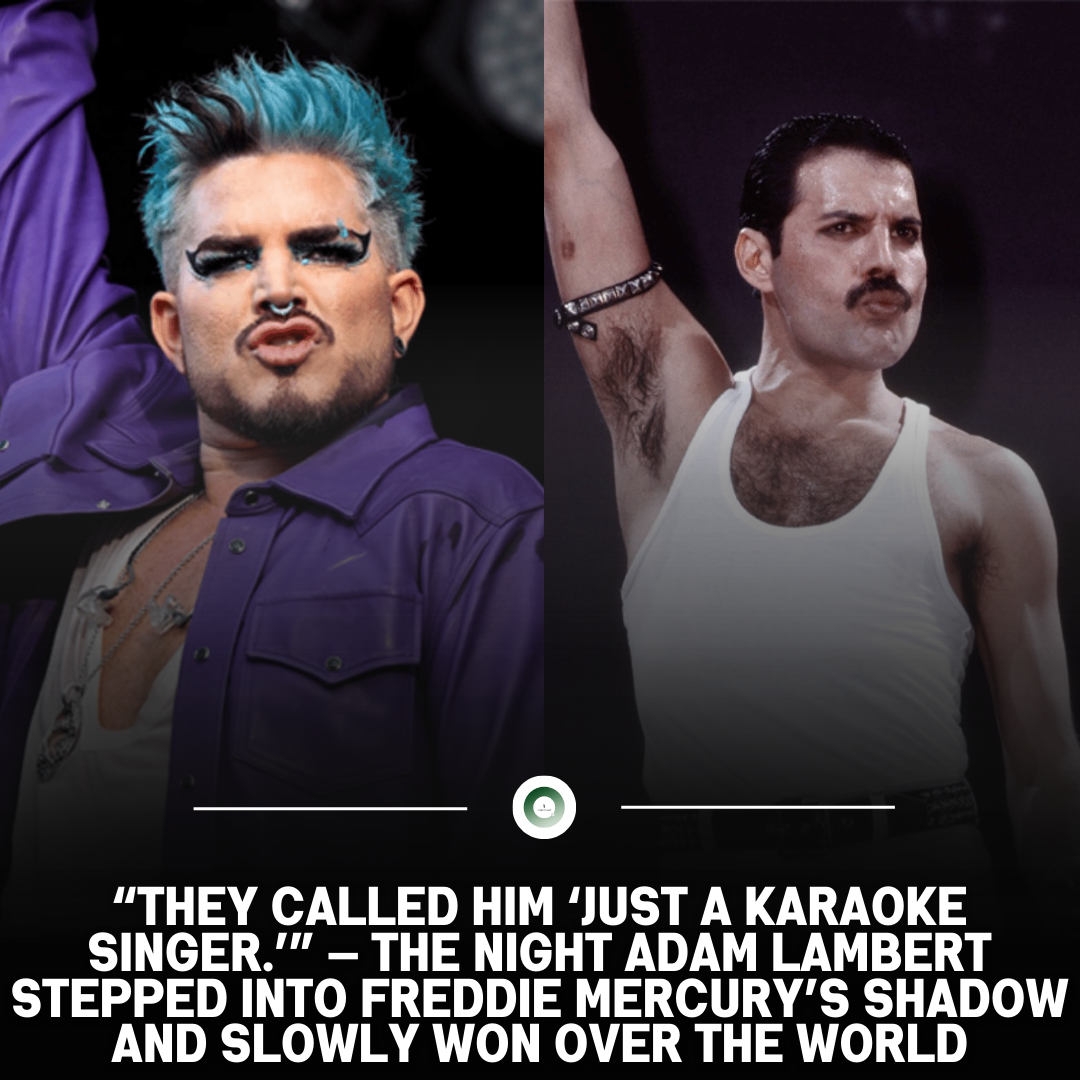
That single, dismissive phrase captured the outrage that erupted when Adam Lambert was announced as the voice stepping onto Queen’s stage. For many fans, the idea felt almost sacrilegious. Freddie Mercury was not merely a singer who could be succeeded — he was a phenomenon, a singular force who defined what it meant to command a stage. The emotional resistance wasn’t just about music. It was about grief. It was about loyalty. And above all, it was about protecting something sacred.
To them, no one had the right to stand where Freddie Mercury once stood.
Yet more than a decade later, history has delivered a very different verdict.
The Weight of an Untouchable Legacy
Freddie Mercury’s shadow was never something that could be escaped — only acknowledged. His voice moved effortlessly from fragile intimacy to explosive power. His presence transformed arenas into places of collective emotion, where tens of thousands felt personally connected to one man.
When Adam Lambert first appeared beside Brian May and Roger Taylor, the reaction was immediate and harsh. Critics accused Queen of becoming their own tribute act. Fans questioned whether Lambert’s theatrical style, shaped through modern pop and television fame, could ever coexist with the authenticity Mercury embodied.
But Lambert understood something crucial from the very beginning. He never claimed to replace Freddie Mercury — because he knew that was impossible. Instead, he approached the role with humility. He wasn’t there to recreate Freddie. He was there to carry the music forward.
That distinction changed everything.
The Moment the Doubt Began to Fade
No interview could convince the skeptics. No explanation could silence the critics. Only performance could do that.
And night after night, Adam Lambert delivered.
On songs like “Somebody to Love,” his voice moved with precision and emotional depth. On “Who Wants to Live Forever,” he balanced restraint and power, honoring the fragility of the original. And on “Don’t Stop Me Now,” he unleashed the kind of fearless energy Queen’s music demands.
What stunned audiences wasn’t imitation. It was authenticity.
Lambert never tried to be Freddie Mercury. He brought his own voice, his own identity — and in doing so, he preserved the integrity of the music rather than reducing it to nostalgia.
Gradually, the conversation began to change. The criticism softened. The resistance weakened. Respect replaced doubt.
The Numbers That Silenced the Insults
Success on this scale cannot be manufactured. It can only be earned.
Queen + Adam Lambert’s global tours became some of the most successful rock tours of the modern era. The Rhapsody Tour, spanning from 2019 to 2023, filled stadiums across continents. Cities sold out within minutes. Night after night, tens of thousands gathered not to witness a tribute — but to experience Queen as a living force.
One of the most symbolic moments came in 2022, when Queen + Adam Lambert opened the Platinum Party at the Palace for Queen Elizabeth II’s Jubilee. Performing outside Buckingham Palace, with millions watching worldwide, Lambert was no longer seen as an outsider.
He had become part of Queen’s present.
Preserving Something That Refused to Die
What Adam Lambert ultimately gave Queen was not replacement, but continuity.
Without him, Queen risked becoming a memory — something preserved in recordings but absent from the present. With him, the band remained alive. Loud. Relevant. Real.
For younger generations, Queen is no longer just history. It is something they can see, hear, and feel.
And that may be Lambert’s greatest achievement.
He never tried to conquer Freddie Mercury’s legacy. He honored it. He protected it. And through humility, endurance, and undeniable talent, he ensured that Queen did not fade into silence.
Today, the insult that once defined him feels almost unrecognizable.
Because Adam Lambert did not replace Freddie Mercury.
He made sure Queen could keep breathing.