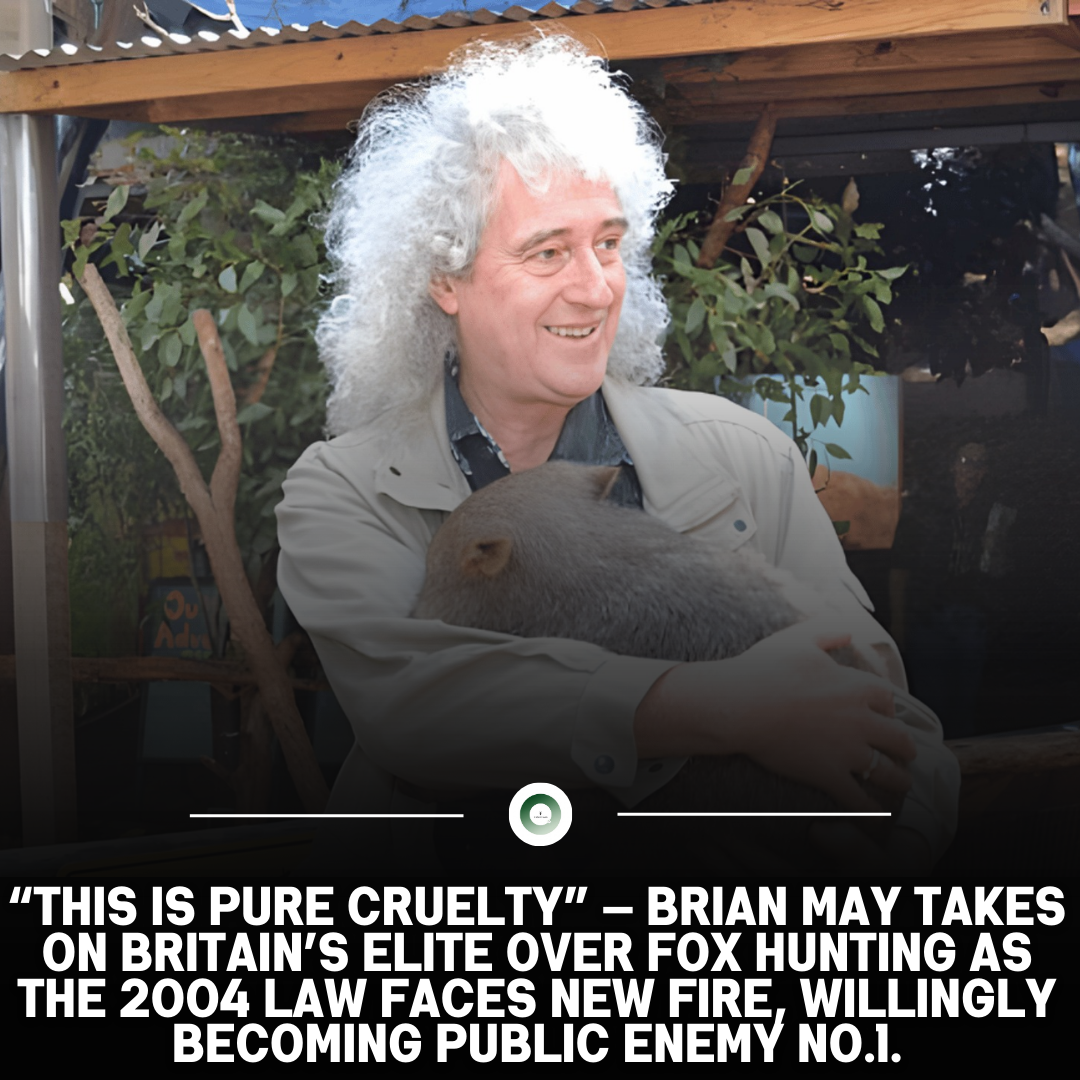
For most of his life, Brian May was known as the sonic architect behind Queen’s immortal sound — the guitarist whose layered harmonies and unmistakable tone helped define songs like “We Will Rock You,” “Save Me,” and countless others that reshaped rock music forever. But in recent decades, May has stepped into a role far removed from stadium lights and amplifiers. He has become one of Britain’s most relentless and outspoken defenders of animal welfare — a man unafraid to confront power, tradition, and privilege in defense of those who cannot speak for themselves.
At the center of his moral stand lies fox hunting, a practice long protected under the banner of rural tradition. To its defenders, it is a symbol of heritage. To May, it represents something far darker. He has spoken with striking clarity on the issue, rejecting any attempt to romanticize what he sees as cruelty. “There is nothing sporty about chasing and tearing a small animal to death,” he said bluntly. “It is pure cruelty of inhumane people.” For May, these words were not symbolic. They were a declaration of principle — a refusal to accept suffering disguised as culture.
His activism intensified during the turbulent years surrounding the Hunting Act of 2004, legislation that banned hunting wild mammals with dogs across England and Wales. When political forces began pushing to weaken or reinterpret the law, May refused to remain silent. In 2010, alongside conservationist Anne Brummer, he co-founded the Save Me Trust — an organization dedicated to protecting wildlife from persecution. Named after Queen’s emotional ballad “Save Me,” the charity became more than a symbolic gesture. It evolved into a frontline force, challenging institutions and exposing what May called the hidden cruelty behind so-called “blood sports.”
That fight brought him directly into conflict with some of the most powerful figures in British society. During a widely publicized 2015 appearance on the BBC’s Newsnight, May openly criticized pro-hunting advocates, including the influential Countryside Alliance. He dismissed their arguments without hesitation, accusing them of disguising cruelty behind sanitized language like “pest control.” His words were direct, unfiltered, and impossible to ignore. At a time when many public figures avoided controversy, May leaned into it, willing to risk his reputation in pursuit of what he believed was morally right.
To May, the issue was never just about foxes. It was about what cruelty reveals about human character. He has often argued that a society’s willingness to tolerate suffering — especially suffering inflicted for pleasure — reflects its deeper moral condition. Compassion, in his view, cannot be selective. It must extend to all life, or it loses its meaning entirely.
The response was swift and often harsh. Tabloids mocked him. Critics dismissed him as a wealthy outsider interfering in rural affairs. Aristocratic voices ridiculed him as a celebrity who didn’t understand their traditions. But May did not retreat. If anything, the resistance strengthened his resolve. He made it clear that public approval was never his goal. His goal was exposure — forcing society to confront uncomfortable truths it had long ignored.
Importantly, May has never condemned rural communities themselves. He has openly supported alternatives like “clean boot” hunting, where riders and hounds follow artificial scent trails instead of living animals. His stance has never been against rural culture — it has been against suffering disguised as sport. In doing so, he has sought not to destroy tradition, but to evolve it.
In 2023, Brian May was knighted for his contributions to music and charity. The title of “Sir” recognized decades of artistic brilliance and humanitarian work. Yet for May, the honor was not a symbol of belonging to the elite structures he often challenges. Instead, it became something else entirely — a platform. A louder voice. A greater reach.
Brian May’s legacy was already secured through music that defined generations. But through his activism, he has revealed another dimension of himself — one grounded not in fame, but in conviction. He has shown that true greatness is not measured only in what one creates, but in what one chooses to defend.
In the end, his message is simple, but powerful: true nobility is not inherited, not protected by tradition, and not granted by titles. It is defined by mercy.