The Moment Before the Explosion
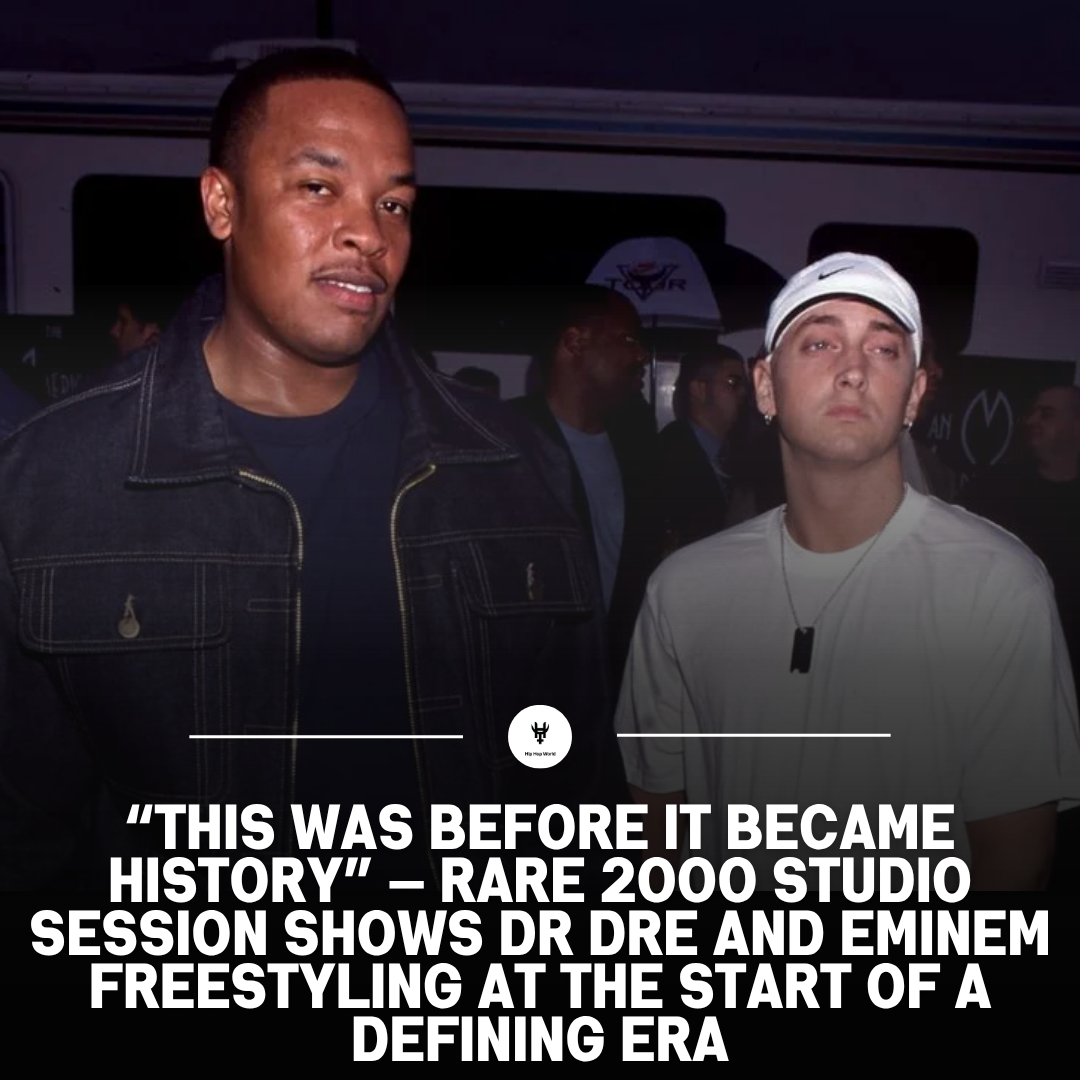
The room is quiet in a way only a recording studio can be—thick with focus, insulated from everything outside. Wires run across the floor, a beat hums faintly through the speakers, and two figures sit in the middle of it all, completely at ease. There’s no spectacle here, no crowd, no pressure. Just Dr. Dre and a young rapper from Detroit, passing time the way they know best—testing lines, trading energy, letting instinct take over.
What makes the footage from that moment so compelling isn’t what’s being said—it’s what’s already understood. By the year 2000, the world knew Eminem. But in that room, you can still see the early chemistry forming, the raw connection that would soon redefine the sound of mainstream hip-hop.
This wasn’t just collaboration. It was alignment.
A Tape That Traveled Further Than Expected
Long before that studio session, Eminem was still a name circulating in smaller, more competitive spaces—battle circuits, underground tapes, rooms where reputation was built line by line. His appearance at the 1997 Rap Olympics didn’t end with a win, but it didn’t need to. What mattered was who was listening.
Somewhere in that crowd, an intern from Interscope Records heard something different. Not just technical ability, but urgency. A voice that sounded like it had something to prove—and no patience left to wait.
That tape made its way up the chain. Jimmy Iovine, already deeply embedded in the industry and known for trusting instinct as much as strategy, recognized it immediately. There was something in the delivery that couldn’t be replicated or polished. It didn’t need refinement—it needed the right platform.
And more importantly, it needed the right producer.
The Meeting That Changed the Trajectory
When the tape reached Dr. Dre, he wasn’t actively searching for a moment like this—but he understood one when he heard it. The reaction was simple, almost understated. No long deliberation, no drawn-out evaluation. Just a decision.
Bring him in.
What followed wasn’t instant mythology. It was work. Studio time, experimentation, adjustment. But what quickly became clear was that Eminem wasn’t trying to fit into an existing mold. He was building something that didn’t quite exist yet—combining sharp lyricism with an offbeat, almost theatrical sensibility that made every verse feel unpredictable.
Dre recognized the value in that unpredictability. Instead of smoothing it out, he amplified it.
That choice would define everything that came next.
Inside the Studio: Where the Energy Lived
The footage from those early sessions reveals something often lost in the final product. There’s a looseness to it. Moments of laughter, pauses between lines, spontaneous bursts of freestyle that don’t feel rehearsed or calculated.
Eminem moves through words quickly, almost as if they’re arriving faster than he can organize them. Dre, calm and observant, listens more than he speaks—stepping in only when necessary, shaping the sound without interrupting its natural flow.
There’s no sense of hierarchy in those moments. No visible divide between established legend and emerging artist. Instead, it feels like two creators meeting at the exact point where their styles intersect.
That balance—precision from Dre, volatility from Eminem—became the foundation.
The Turning Point: From Potential to Presence
By the time their work reached the public, it didn’t feel like a debut. It felt like an arrival. Eminem didn’t ease into mainstream recognition—he broke into it with a presence that was impossible to ignore.
What made the transition so effective wasn’t just skill. It was clarity. The identity was already formed before the spotlight arrived. The anger, the humor, the unpredictability—it wasn’t shaped for the audience. It was presented to them, fully intact.
Dre’s production gave that identity structure. It grounded the chaos just enough to make it accessible without diluting its edge. Together, they created records that sounded both controlled and completely unrestrained at the same time.
That balance is rare. And when it works, it reshapes the landscape.
Beyond the Studio: A Cultural Shift
What followed was more than commercial success. It was a shift in perception—of who could exist in hip-hop, of what voices could be amplified, of how far authenticity could reach when paired with the right backing.
Eminem didn’t just enter the mainstream—he forced it to expand. And Dre didn’t just produce another successful artist—he helped introduce a figure who would challenge the boundaries of the genre itself.
Their partnership became a reference point. Not just for sound, but for timing. For what happens when opportunity meets readiness at exactly the right moment.
The Legacy of That Early Energy
Looking back at that quiet studio footage now, it feels almost understated compared to what came after. There are no headlines in that room. No sense of history being written.
But that’s exactly where it was happening.
In the pauses between verses. In the way ideas were tested without pressure. In the trust that formed before the world started watching.
What you’re seeing isn’t fame—it’s formation.
And in that space, before everything changed, two artists found a rhythm that would go on to shape an era.