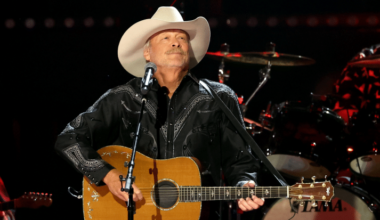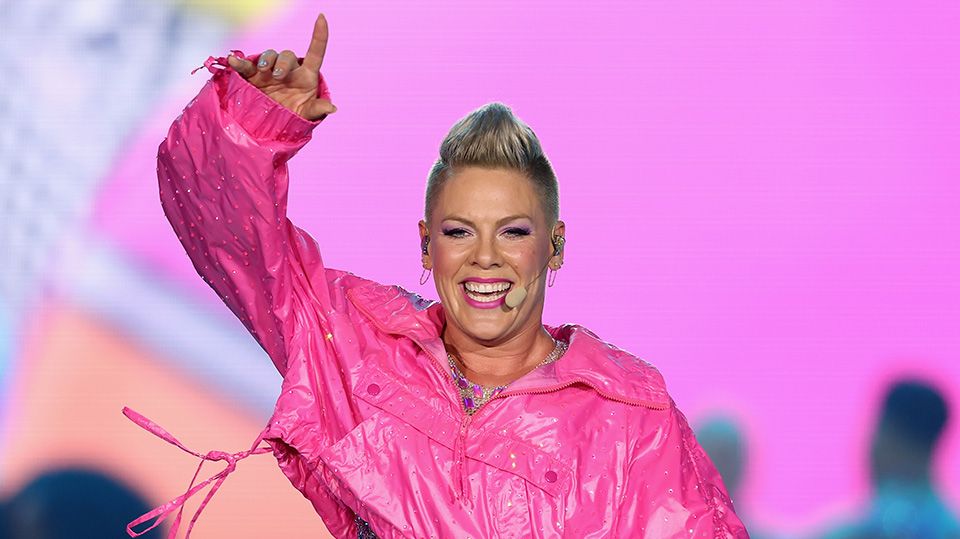
When P!nk teamed up with Kenny Chesney in 2016, the collaboration didn’t just spark curiosity—it triggered skepticism.
Country music, especially in circles tied to Nashville, has an unspoken rule: you don’t borrow the sound unless you understand the soul behind it. It’s a genre that can spot imitation instantly and reject it just as fast.
So when a pop-rock powerhouse known for aerial performances and arena anthems stepped into that space, the question wasn’t whether she could sing.
It was whether anyone would believe her.
The Song That Changed the Conversation
That answer arrived with Setting the World on Fire—a duet that didn’t try to impress with novelty or genre fusion. Instead, it did something far more difficult: it stayed honest.
The track leans into familiar country themes—young love, fleeting moments, emotional risk—but avoids melodrama. It feels lived-in rather than performed, like a memory unfolding rather than a story being told for effect.
And that’s where P!nk made her impact.
She didn’t approach the song like a guest artist crossing into unfamiliar territory. She approached it like someone who understood the emotional weight of the narrative—and trusted that to carry the performance.
Why Country Music Is Harder Than It Sounds
From the outside, country music can seem deceptively simple. The melodies are accessible. The structures are familiar.
But beneath that simplicity is a strict standard: emotional credibility.
Listeners aren’t just hearing a voice—they’re evaluating whether the singer means it. Whether the phrasing feels natural. Whether the emotion sounds earned or borrowed.
It’s why technically strong vocalists sometimes struggle in the genre. Precision isn’t enough. Authenticity is the currency.
And authenticity can’t be faked.
Restraint Over Power
P!nk’s career has often been defined by intensity—big vocals, physical performances, high energy. But in this duet, she does something unexpected.
She pulls back.
Her delivery is measured, almost conversational. Lines don’t feel pushed; they unfold. There’s space in her phrasing, a kind of quiet confidence that allows the story to breathe.
That restraint is what makes the performance convincing.
Instead of dominating the track, she meets it where it lives—somewhere between nostalgia and vulnerability.
Chemistry That Feels Unscripted
Duets often struggle with balance. One voice can overpower the other, or the interaction can feel staged.
Here, the dynamic between P!nk and Chesney feels natural—less like two artists trading lines and more like two perspectives sharing the same memory.
There’s no competition in the performance. No attempt to outshine.
Just alignment.
That subtlety is part of what made the song resonate so strongly with country audiences. It didn’t feel engineered. It felt real.
Winning Over the Toughest Audience
Country fans are famously protective of their genre. Crossovers are often met with caution, if not outright resistance.
But “Setting the World on Fire” didn’t just perform well—it dominated. The song climbed to the top of major country charts, proving that acceptance wasn’t limited to curiosity or novelty.
It was earned.
Even more telling was the critical response. Industry recognition, including a Grammy Awards nomination, reinforced what listeners were already signaling: this wasn’t a stunt.
It was a legitimate contribution.
The Voice Behind the Performance
What stood out most to collaborators—and listeners—wasn’t technique. It was texture.
There’s a slight edge in P!nk’s voice, a kind of lived-in quality that carries emotional weight. It’s not polished to perfection, and that’s exactly why it works in this context.
Country music often values that imperfection. The sense that the voice has been shaped by experience, not just training.
In this case, that quality became the bridge between genres.
Breaking the “Outsider” Label
Cross-genre collaborations usually fall into one of two categories: novelty or transformation.
This one did neither.
P!nk didn’t reinvent herself as a country artist. She didn’t adopt a new persona or lean into stylistic clichés. Instead, she brought her existing emotional honesty into a different musical framework.
And it translated.
That distinction matters. It shows that authenticity isn’t tied to genre—it’s tied to delivery.
What This Moment Really Proved
The success of “Setting the World on Fire” wasn’t just about chart positions or awards. It challenged a deeper assumption—that genre boundaries are rigid and guarded by style alone.
In reality, they’re guarded by truth.
If a performance feels real, audiences will follow it anywhere.
That’s what happened here. The song didn’t ask listeners to accept a crossover. It gave them something they already valued—honest storytelling—and let everything else fall into place.
Beyond the Labels
In the end, the conversation shifted.
It wasn’t about whether P!nk “belonged” in country music. It was about whether the performance connected.
And it did.
Not because it tried to blend genres or chase trends—but because it respected what makes country music resonate in the first place: emotion that feels lived, not performed.
That’s a standard no genre owns—and one that, on this track, she met without compromise.