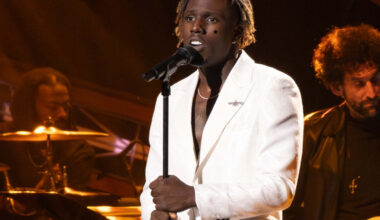
For nearly four decades, The Phantom of the Opera has lived many lives. It has filled theaters, echoed through cast recordings, and been carried by millions of voices who know every rise and fall of its melody by heart. But when Hauser takes on The Phantom of the Opera, something shifts. This isn’t revival. It’s transformation.
Hauser doesn’t approach the piece as a showstopper. He treats it like a secret. The opening notes don’t announce themselves—they creep in. The cello speaks low, almost cautiously, as if testing the room. There’s space between the phrases. Silence matters here. You feel it press against the sound, making every note heavier, darker, more personal.
What makes his interpretation unsettling—in the best way—is how human it feels. Without lyrics, the story becomes emotional instead of theatrical. The familiar melody no longer points toward chandeliers and masks. It points inward. Long, drawn-out notes stretch like unanswered questions. Sudden surges feel less like drama and more like restrained anger finally surfacing.
Hauser’s bow control is key. One moment it glides, smooth and patient. The next, it bites into the strings with sharp precision. It’s not aggressive for the sake of spectacle. It feels deliberate, like he knows exactly how much tension the listener can handle before pulling back again. That push and pull mirrors the Phantom himself—torn between tenderness and obsession.
There’s also something deeply cinematic about the performance. You can picture the light without seeing it. Dim. Narrow. Focused on the instrument rather than the performer. The cello becomes the voice of a character who was never fully understood. No chorus. No grand finale. Just a slow, haunting unraveling that refuses to let you stay comfortable.
What’s striking is how timeless the piece suddenly feels again. A song first heard in 1986 shouldn’t sound this dangerous, this intimate. Yet here it is, stripped of its spectacle and rebuilt as a quiet confrontation. It reminds you why the melody lasted so long in the first place—not because of the production, but because of the emotion buried underneath.
By the final note, there’s no urge to clap immediately. There’s a pause. A breath. The kind you take when something familiar has been shown to you from a completely different angle. Hauser doesn’t replace the Phantom we know. He simply shows us the part that’s been hiding in the dark all along.