Some covers try to honor the original.
Others try to outdo it.
Kelly Clarkson did something more interesting—she reinterpreted the emotional engine of the song itself.
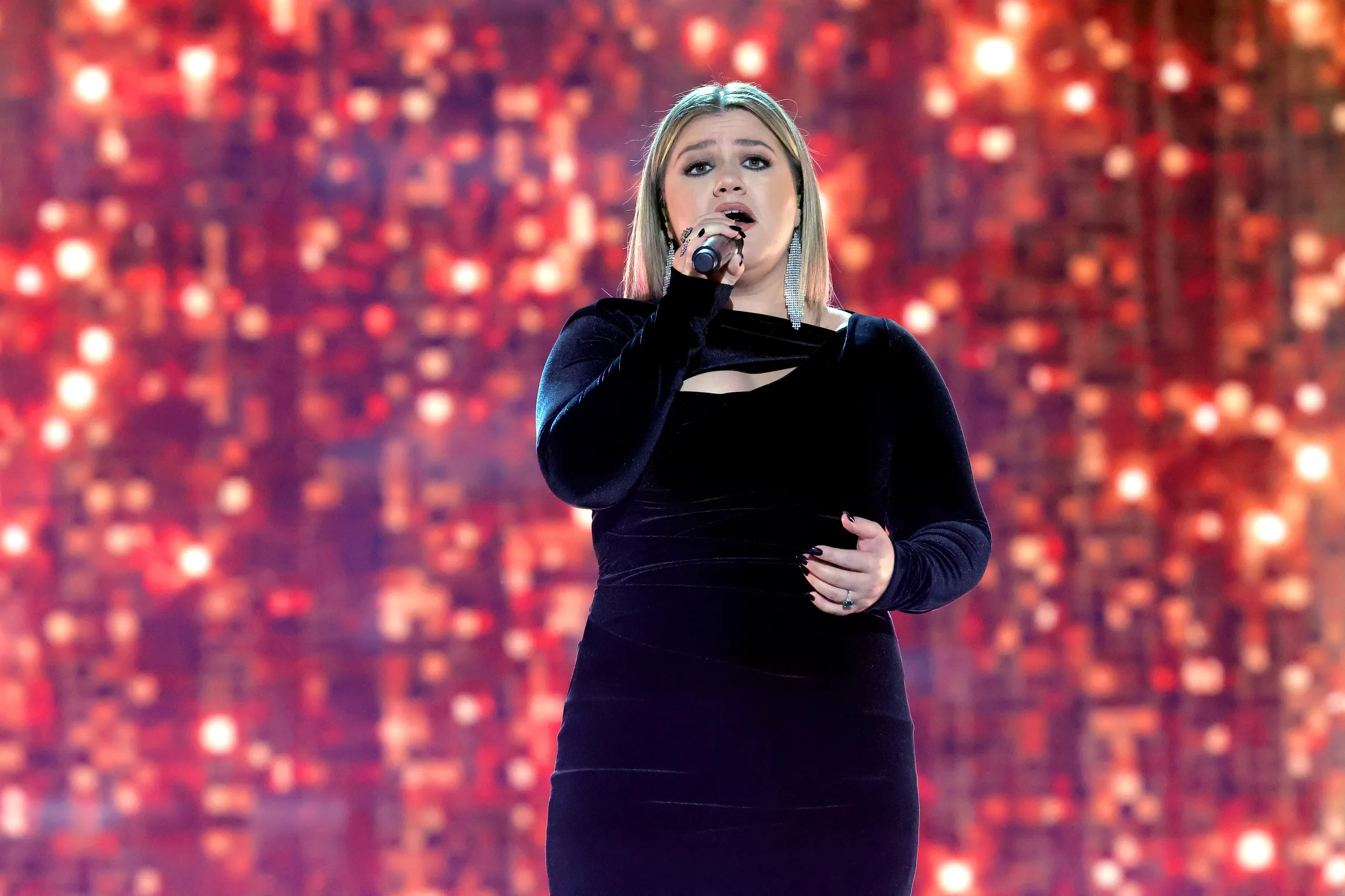
When she took on Billie Eilish’s “Happier Than Ever” during Kellyoke, she wasn’t just shifting genres. She was asking a deeper question:
What if quiet frustration didn’t stay quiet?
The risk of touching a song built on restraint
“Happier Than Ever” is not an easy song to cover—not because of its range, but because of its control.
Billie Eilish’s version thrives on tension. The first half barely raises its voice. It sits in discomfort. It lingers. It resists release.
That restraint is the point.
For Clarkson, a vocalist known for power, that creates a paradox.
She doesn’t need to prove she can sing big.
She has to prove she can hold back.
And for a singer with that kind of instrument, restraint can be harder than release.
Starting smaller than expected
Clarkson didn’t rush to transform the song.
She began where the original lives—in stillness.
The phrasing was softer than her usual style. The delivery more conversational. There was space between lines, room for the emotion to settle rather than surge.
But if you listened closely, something was building.
Not louder.
Heavier.
The band knew what was coming
Behind her, the band wasn’t just accompanying—they were waiting.
This kind of arrangement demands precision. The shift from quiet to explosive only works if everyone moves together, at exactly the right moment.
Too early, and the emotion feels forced.
Too late, and the impact disappears.
So they layered in slowly:
- A thicker guitar tone
- A slightly more insistent rhythm
- A sense of pressure beneath the calm
It wasn’t obvious.
Until it was.
The pivot: from control to combustion
Where Eilish’s version turns inward, Clarkson turned outward.
The second half didn’t just escalate—it erupted.
Guitars pushed forward. Drums hit harder. The tempo felt sharper, more aggressive. The song stopped sounding like a private conversation and started feeling like a confrontation.
And Clarkson met that shift head-on.
Her voice opened up—fully.
Not just louder, but more forceful. More defiant. Less contained.
The emotion didn’t simmer anymore.
It broke.
Why it nearly cost her the ending
After the performance, Clarkson joked that she needed “three takes to breathe.”
It sounded light.
It wasn’t.
Because what she was attempting in that final section is physically demanding in a very specific way.
To deliver a belt like that, you need:
- Full breath support
- Controlled airflow
- Stability through the core
Now add:
- Emotional intensity
- Continuous phrasing
- Minimal recovery time between lines
That combination is taxing—even for elite vocalists.
She wasn’t just hitting notes.
She was sustaining pressure.
And that pressure has a cost.
The difference between sounding powerful and being powerful
What made this performance stand out wasn’t just the volume or the range.
It was the commitment to the arc.
Clarkson didn’t treat the loud section as a showcase moment. She treated it as the inevitable outcome of everything that came before.
That’s why it worked.
The explosion felt earned.
Not inserted.
A genre shift that respected the original
It’s easy to turn a soft song into a loud one.
It’s harder to do it without losing what made the song work in the first place.
Clarkson didn’t try to replicate Billie Eilish’s intimacy.
She translated it.
In the original, the frustration is internal—quiet, controlled, almost detached.
In Clarkson’s version, that same frustration becomes external—direct, confrontational, impossible to ignore.
Different delivery.
Same emotional core.
Why the band looked like they’d just run a race
By the end of the performance, there was a noticeable shift—not just in sound, but in energy.
The band wasn’t just playing.
They were navigating.
Transitions like that require full attention. Everyone has to feel the timing, not just follow it. There’s no autopilot in a performance that moves between restraint and release that quickly.
That’s why they looked exhilarated.
And slightly stunned.
Because they had just pulled off something that could have easily fallen apart.
What this says about great songs
One of the most revealing things about this performance has nothing to do with Clarkson.
It’s what it says about the song itself.
A well-written song can survive reinterpretation.
It can shift genres, tempos, dynamics—and still hold together.
“Happier Than Ever” proved that.
Stripped down, it’s a structure strong enough to support:
- Minimalist tension
- Or full-scale rock catharsis
That flexibility is rare.
What Clarkson proved—again
Kelly Clarkson has built a reputation on covers that don’t feel like copies.
This one reinforced why.
She doesn’t ask, “How do I sing this song?”
She asks, “What else could this song be?”
And then she builds toward that answer—carefully, deliberately, and sometimes at the edge of her own limits.
The moment that stayed with people
It wasn’t just the final note.
It was the journey to get there.
The restraint at the beginning.
The pressure building underneath.
The release that felt almost physical when it arrived.
And then, at the end, a performer catching her breath—not as a flourish, but because she genuinely needed it.
That’s what made it feel real.
Not perfect.
But lived-in.
And in live music, that’s the difference people remember.