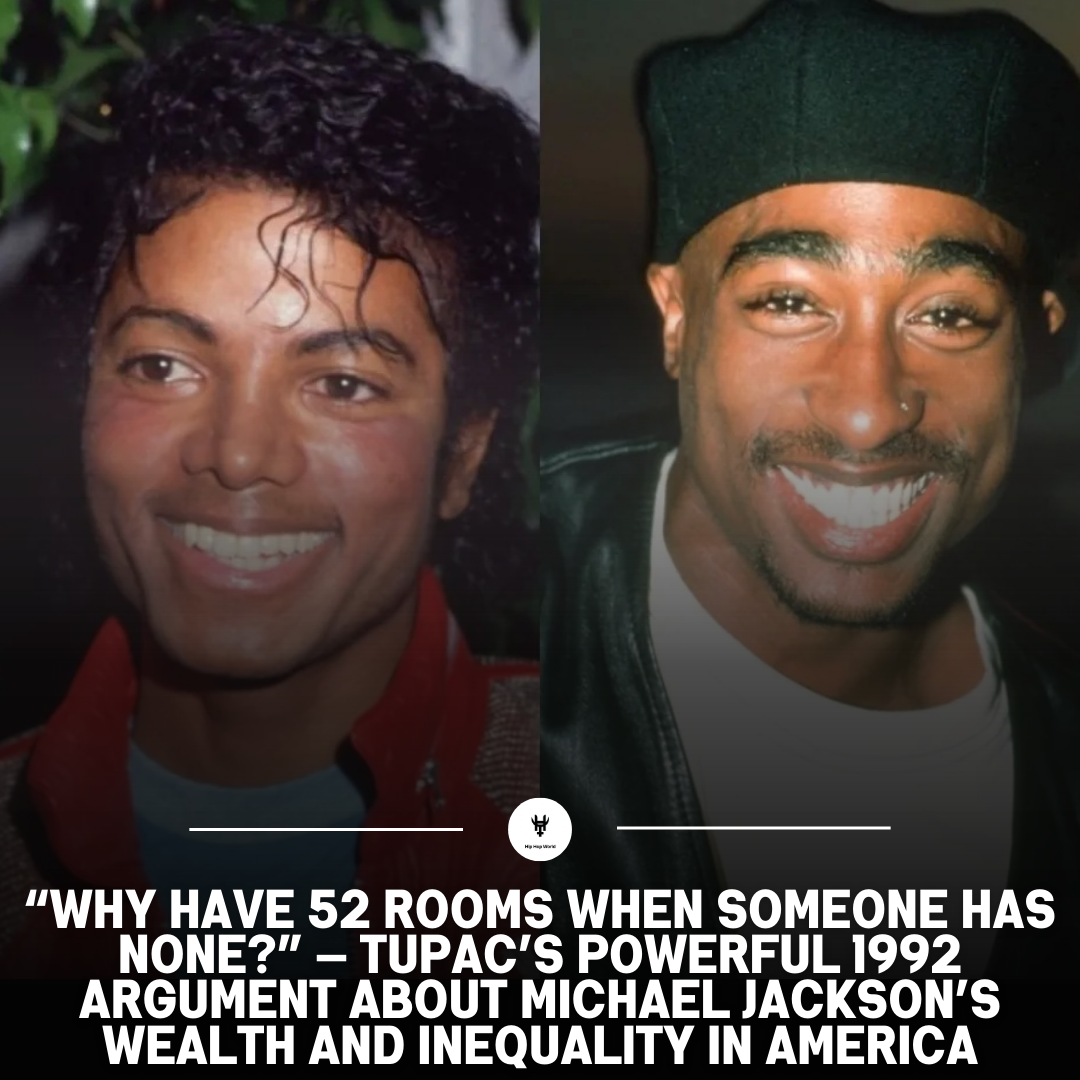
Few artists in modern music history have left a cultural impact as deep as Michael Jackson. His sound, style, and artistic ambition helped shape pop music for decades, influencing countless performers across genres — including many within hip-hop.
Even Tupac Shakur, one of rap’s most influential voices, would eventually have music connected to Jackson’s catalogue. Songs such as Letter 2 My Unborn and Thug Nature, both released after Tupac’s death, famously sampled Jackson’s music. The former drew from “Liberian Girl” from Jackson’s Bad album, while the latter used the iconic melody of “Human Nature” from Thriller.
Those musical connections make one thing clear: Tupac did not have an issue with Michael Jackson’s artistry.
But during the early years of his career, Tupac did speak publicly about something else connected to the pop superstar — the extraordinary level of wealth that surrounded global celebrities.
And in a candid interview from 1992, he used Jackson as an example while discussing a much larger issue he believed America was ignoring.
A Voice Shaped By Social Awareness
Long before Tupac became associated with the more glamorous and controversial side of hip-hop culture, he built his reputation as a socially conscious artist.
His early music addressed subjects that many rappers avoided — poverty, racism, inequality, and the struggles facing marginalized communities in the United States.
Songs like Brenda’s Got a Baby and Trapped reflected a young artist deeply concerned about the conditions he saw around him. Tupac often spoke about the responsibility he felt to use his voice to highlight those realities.
It was within that mindset that he appeared in an MTV interview in 1992, speaking openly about wealth inequality.
And while discussing the enormous gap between the richest celebrities and the poorest citizens, Tupac pointed to Michael Jackson as a symbol of that imbalance.
The Frustration Behind His Words
During the interview, Tupac did not criticize Jackson’s music or talent. Instead, he used the pop icon as an example to illustrate what he saw as a deeper problem.
“There’s no way that Michael Jackson or whoever Jackson should have a million thousand droople billion dollars, and then there’s people starving,” Tupac said.
“There’s no way!”
For Tupac, the issue was not personal — it was philosophical.
He questioned a society where extreme wealth existed alongside widespread poverty. The contrast between celebrity luxury and everyday hardship seemed impossible for him to accept.
“There’s no way that these people should own planes and there people don’t have houses,” he continued. “Apartments. Shacks. Drawers. Pants!”
His frustration reflected a broader critique of the economic system that allowed such disparities to exist.
A Critique Of Excess
Tupac went even further in the interview, arguing that extreme wealth often led to unnecessary extravagance.
“I know you’re rich,” he said when speaking about celebrities and billionaires. “I know you got $40 billion, but can you just keep it to one house?”
The question was rhetorical, but the message was clear.
For Tupac, the idea of owning dozens of rooms or multiple luxury homes made little sense when many people had no place to sleep.
“If you only got two kids, can you just keep it to two rooms?” he asked. “Why have 52 rooms and you know there’s somebody with no room?”
To Tupac, the contradiction represented a society built around accumulation rather than compassion.
“It just don’t make sense to me,” he said. “It don’t.”
The Broader Criticism Of American Success
During the same interview, Tupac also spoke about the culture of ambition and competition he believed dominated American society.
He argued that from school to business, people were often taught to prioritize success at any cost.
At one point in the conversation, he referenced Donald Trump as an example of the kind of aggressive wealth-focused mindset he believed society celebrated.
“This world is such a gimme, gimme, gimme place,” Tupac said.
He described a mentality driven by constant pursuit — pushing forward, stepping over others, and chasing success through accumulation and power.
For Tupac, this attitude represented something deeply troubling about modern culture.
The Contradictions Of Tupac’s Legacy
Of course, Tupac’s own life would eventually reflect some of the contradictions he once criticized.
As his career progressed, his music began embracing elements of the gangsta rap aesthetic — luxury, success, and the symbols of wealth that often accompanied fame in hip-hop.
Some critics later pointed to this shift as evidence that Tupac’s early political ideals had softened.
But others argue that his contradictions were part of what made him such a compelling figure.
Tupac was never a simple artist with a single message. Instead, he represented a generation wrestling with complicated realities — poverty and ambition, activism and fame, struggle and success.
His voice captured those tensions in ways that still resonate today.
A Message That Still Echoes
Decades later, Tupac Shakur remains one of the most influential figures hip-hop has ever produced.
His music continues to inspire new artists, while his interviews reveal the depth of his thinking about the world around him.
The 1992 conversation about wealth inequality may have used Michael Jackson as an example, but the real target of Tupac’s frustration was something much larger.
It was a system where unimaginable wealth and desperate poverty could exist side by side.
And for Tupac, that contradiction was something he believed the world needed to confront — whether people were ready to hear it or not.