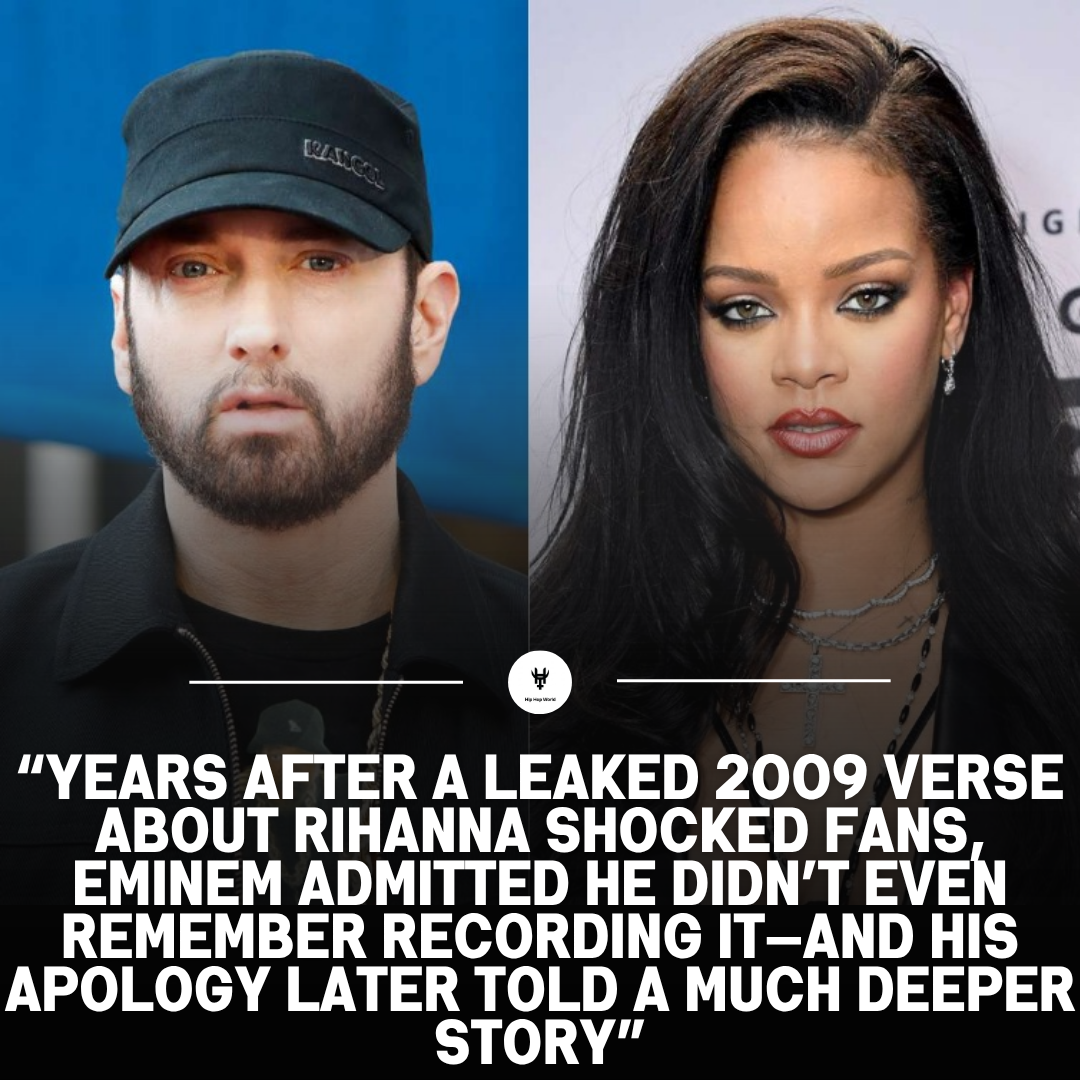
There are moments in music that don’t begin with a release—but with something resurfacing. A lyric, a recording, a fragment from another time that suddenly finds its way back into the present, carrying a different weight than it once did.
For Eminem, that moment arrived when a previously unreleased verse from 2009 began circulating years later. It wasn’t part of an official project. It wasn’t something he had chosen to revisit. But once it was out, it couldn’t be separated from who he had become.
And this time, the focus wasn’t on technique or storytelling.
It was on the words themselves.
A Different Era, A Different Mindset
The verse traced back to the period surrounding Relapse, a time when Eminem has openly described himself as rebuilding—not just his life after addiction, but his approach to music.
Looking back, he explained that his process during that era was different. Less reflective, more instinctive. Lines were sometimes driven by structure and rhyme rather than intention.
He later admitted that hearing the lyric again felt unfamiliar, even to him.
“I didn’t know how somebody got it… I have no recollection of even remembering doing that,” he said, describing his reaction when the verse resurfaced. “I was caught off guard too.”
But the distance in time didn’t change the responsibility.
“I said it and I was wrong for saying that,” he acknowledged. “It was… stupid.”
It wasn’t framed as an excuse.
Just context.
The Weight Of Context
What made the moment more complex was who the lyric referenced. By the time it surfaced, Eminem had already built a creative relationship with Rihanna—one that had produced some of the most impactful collaborations of his later career.
Those songs had explored difficult emotional spaces—conflict, vulnerability, consequence—often in ways that resonated deeply with listeners.
That made the resurfaced lyric feel out of place.
Not because it was shocking in isolation, but because it conflicted with a different narrative that had already been established through his work.
It created a contrast between past and present that couldn’t be ignored.
The Turning Point: Owning The Moment
Eminem chose to address it directly.
On Zeus, a track from Music to Be Murdered By – Side B, he offered an apology in his own way—through the same medium where the original line had existed.
He didn’t avoid it. He didn’t deflect it.
He acknowledged it.
The apology wasn’t extended, but it was clear. It placed responsibility where it belonged and recognized that intent doesn’t erase impact.
That decision mattered.
Because in hip-hop, where authenticity is often tied to consistency, moments like this test how an artist responds when those two things don’t align.
Growth, Reflection, And What Remains
Looking back, Eminem’s explanation adds another layer to the story—not as justification, but as insight into how artists evolve over time.
The version of himself who recorded that verse existed in a different place, both personally and creatively. But growth doesn’t erase what was said. It only defines how it is handled afterward.
And in this case, he chose to confront it.
Not loudly.
But directly.
More Than Just A Lyric
What this moment ultimately reflects is something larger than a single line or a single apology.
It shows how music can preserve pieces of a person that no longer fully represent who they are—and how those pieces can return, years later, demanding recognition.
For listeners, it becomes a reminder that artists are not fixed in time. They change, they reassess, and sometimes, they revisit parts of their past with a different understanding.
And for Eminem, this wasn’t about rewriting history.
It was about responding to it.
Because sometimes, the most important part of a song isn’t when it’s written.
It’s what happens when it’s heard again.