By the early 2000s, Eminem had already become impossible to ignore. His music stirred debate, his image provoked reaction, and his presence carried a kind of unpredictability that extended far beyond the studio. But what set him apart was not just what he said in his songs—it was how he chose to present himself to the world. At one pivotal moment, he transformed a live performance into something far more symbolic than entertainment.
Inside Radio City Music Hall, the atmosphere initially felt familiar, almost routine. That sense of normalcy didn’t last long. Without warning, the venue’s doors swung open, breaking the expected rhythm of the night. What followed was not a simple entrance, but a carefully staged disruption that immediately shifted the audience’s attention.
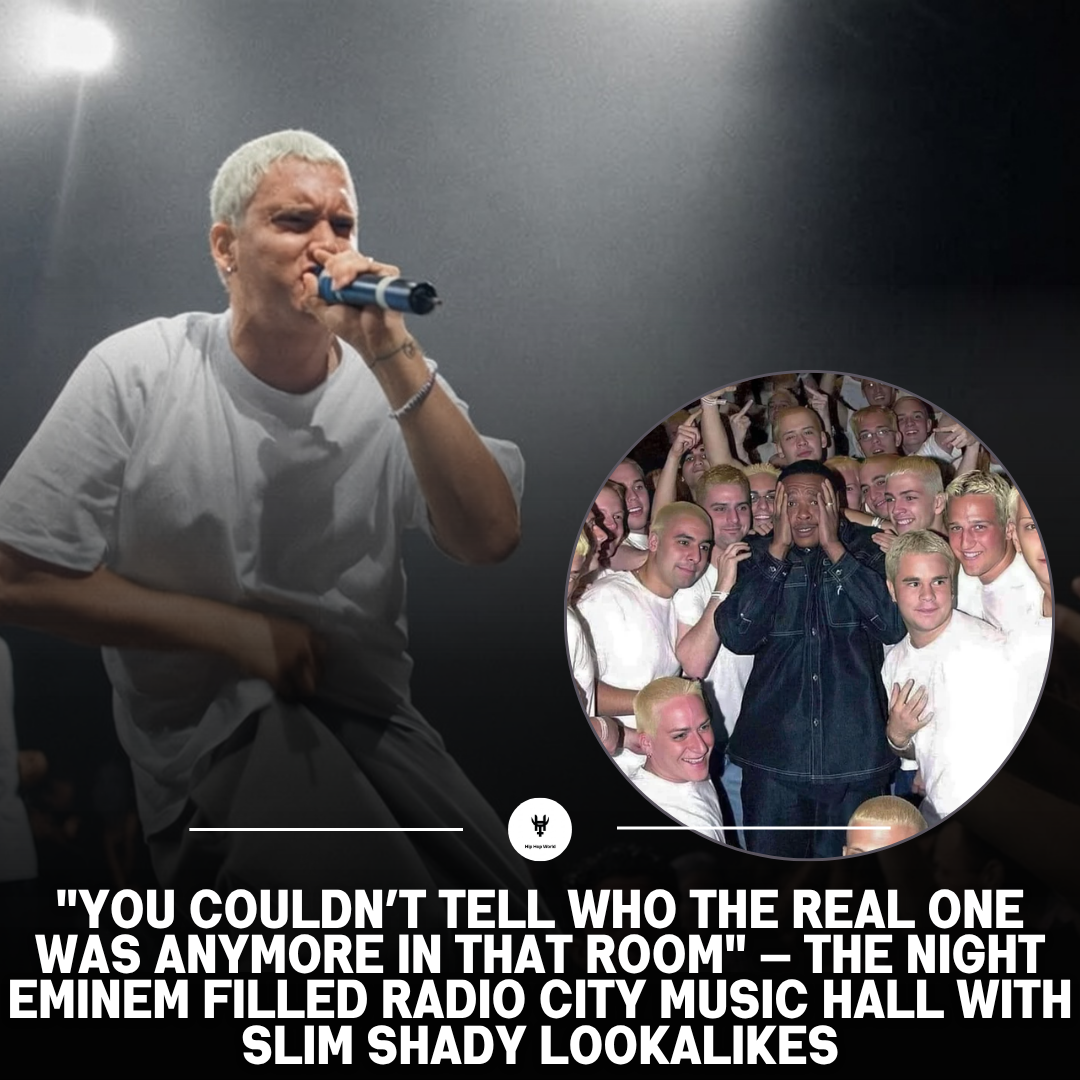
From the aisles came a procession that felt both deliberate and disorienting. One by one, young men dressed in identical fashion moved toward the stage—bleached hair, white shirts, and the unmistakable posture tied to Eminem’s public persona. As their numbers grew, the repetition became impossible to ignore. The performance had not yet fully begun, yet the message was already taking shape.
When the beat of “The Real Slim Shady” filled the room, the visual and the music locked into place. The lookalikes continued forward, surrounding the stage as the energy intensified. Audience members, including well-known figures in attendance, reacted with a mix of surprise and curiosity, trying to make sense of what was unfolding in front of them. It no longer felt like a typical awards-show moment—it felt staged to provoke.
Then Eminem himself stepped into view.
Positioned at the center of the scene, he delivered the track with precision and force, his presence anchoring the chaos around him. Behind him, the identical figures formed a striking backdrop, turning a lyrical concept into something tangible. The performance mirrored the song’s central idea—that his identity had become so widespread it could no longer be contained to one individual.
What made the moment resonate was not just its visual impact, but its clarity. Without saying anything beyond the lyrics, the performance illustrated how quickly his influence had spread through culture. His style, his attitude, even his appearance had been replicated, echoed, and adopted far beyond his own control.
The audience’s response reflected that realization. There was amusement, confusion, and a quiet acknowledgment that something different was taking place. It was a performance designed not only to entertain, but to make a point—and it succeeded in doing both.
In that single moment, Eminem demonstrated a deeper understanding of his position in the cultural landscape. He wasn’t just performing a song; he was presenting a reflection of what he had become. And as the stage filled with versions of himself, it became clear that his influence was no longer singular—it had already multiplied.