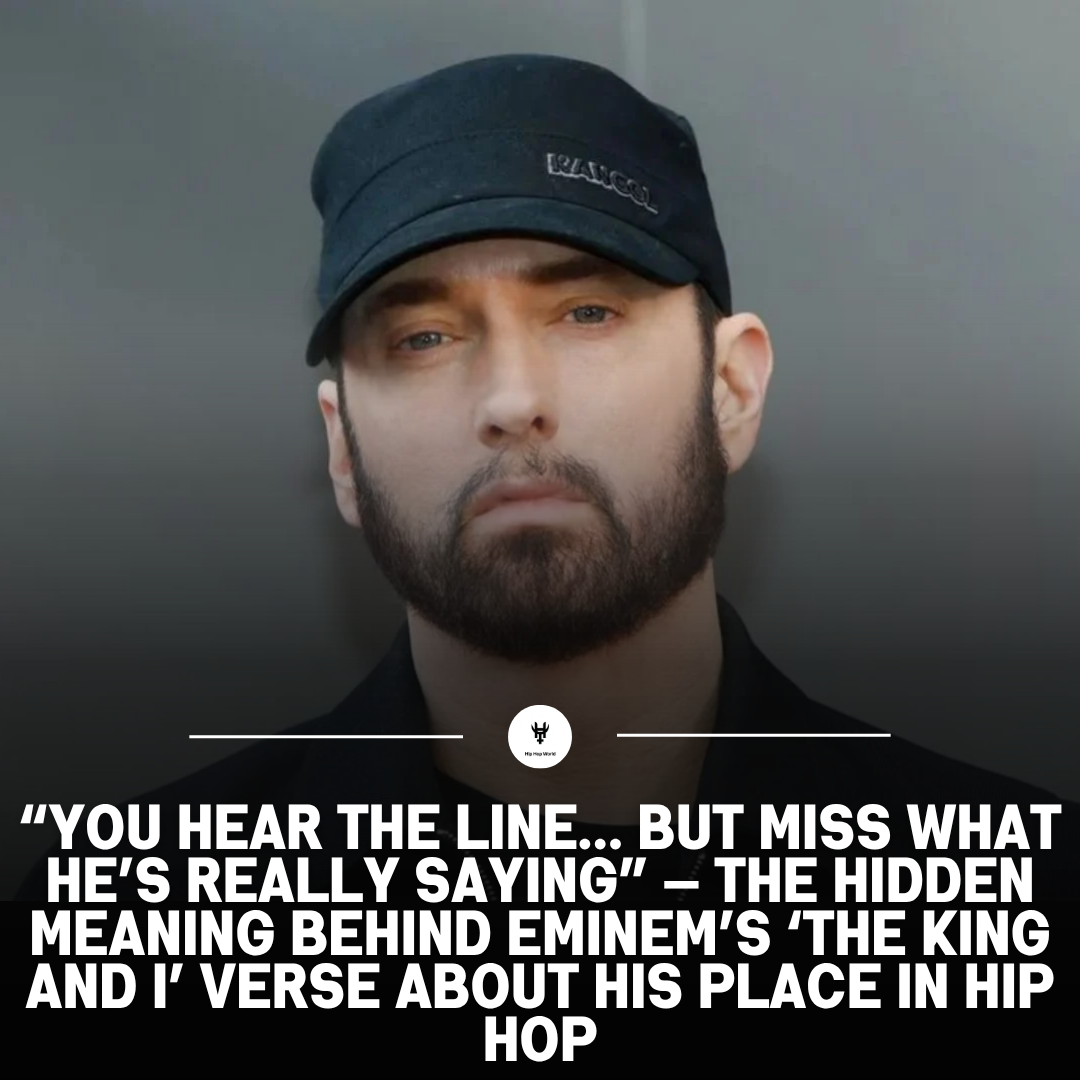
The beat moves forward, steady and deliberate, as Eminem steps into a verse that feels less like performance and more like confrontation. There’s no attempt to soften what’s coming, no effort to reframe it into something more comfortable. The words land plainly, almost disarmingly direct.
“I stole black music, yeah true.”
It’s not a denial. It’s not a debate. It’s an acknowledgment—one delivered in a space where most artists would instinctively protect themselves.
And that’s what makes it different.
A Career Built Inside A Conversation
For as long as Eminem has been visible, the conversation has followed him. Not just about his lyrics, his delivery, or his place in the industry—but about what it means for a white artist to exist at the highest level of a genre rooted in Black culture.
From the beginning, his rise wasn’t separated from that question. It moved alongside it.
What set Eminem apart wasn’t that he avoided it. It was that he never pretended it didn’t exist.
He built his career with a clear understanding of where hip hop came from—and where he stood within it.
The Parallel That Was Always There
On “The King and I,” created for Elvis, Eminem doesn’t just address the criticism—he expands it. He places himself next to Elvis Presley, another figure whose success has long been tied to similar debates.
The comparison isn’t subtle. Both artists reached massive audiences. Both became symbols of their genres in ways that extended beyond the music itself. And both were, at different times, accused of benefiting from a culture they didn’t originate.
But Eminem’s approach isn’t to separate himself from that history.
It’s to acknowledge that he exists within it.
Elvis, decades earlier, had publicly recognized the same reality—speaking openly about the Black musicians who shaped the sound that defined his career. Eminem’s reflection follows a similar path, grounded not in denial, but in awareness.
Turning Point: From Criticism To Clarity
What makes this moment stand out isn’t just the lyric—it’s the position behind it. Eminem isn’t responding from uncertainty. He’s speaking from a place of long-established identity, one that has already absorbed years of scrutiny.
In past interviews and writings, he has described himself as a “guest” in hip hop. Not as a figure outside of it, but as someone who understands the space he occupies within it.
That perspective reframes the conversation. It shifts it away from defensiveness and toward recognition. Not of ownership, but of influence. Not of entitlement, but of lineage.
And in doing so, it removes the need to argue.
Because the acknowledgment itself becomes the answer.
The Meaning Behind The Admission
For some, the line may feel provocative. For others, it may feel overdue. But within the context of Eminem’s career, it aligns with something he has maintained consistently—the idea that his success is inseparable from the artists who came before him.
He has never claimed to have created the foundation he stands on.
He has only built upon it.
That distinction matters. Not because it resolves the conversation entirely, but because it defines how he chooses to exist within it.
What Remains After The Debate
The discussion around race, influence, and ownership in music doesn’t end with one lyric. It continues, evolving with each generation, each artist, each moment that forces it back into focus.
But moments like this reveal something deeper than the debate itself.
They show how an artist chooses to respond once the noise becomes constant.
For Eminem, the answer wasn’t silence. It wasn’t deflection.
It was recognition.
And in a genre where authenticity carries weight beyond everything else, that choice may say more than any defense ever could.