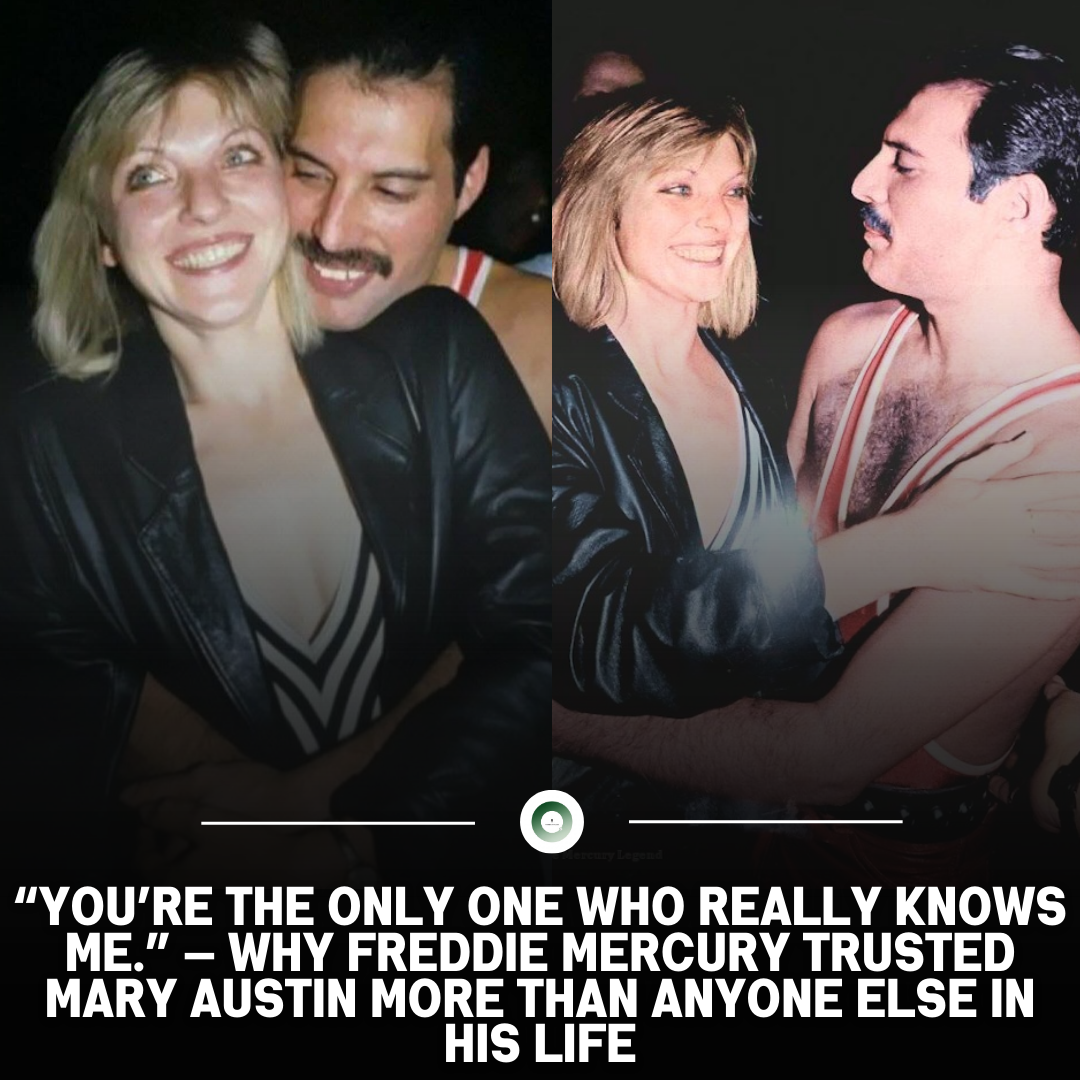
Before the fame, before the stadiums, and before the world knew his name, Freddie Mercury was just a young man trying to find his place. And beside him, quietly witnessing everything, was Mary Austin. Their relationship began long before Queen became a global force, at a time when Freddie had nothing to offer but dreams. Mary didn’t fall in love with a legend. She fell in love with a person who hadn’t yet proven himself.
They met in the early 1970s through Brian May, when Freddie was still struggling financially and artistically. He wasn’t the untouchable frontman people would later see. He was uncertain, ambitious, and searching. Mary saw that version of him—the version without the spotlight—and she stayed.
Their relationship quickly became serious. Freddie trusted her with his fears, his hopes, and the parts of himself he didn’t show anyone else. At one point, he even proposed to her. But as Freddie began to understand himself more deeply, he realized his identity was more complex than he had allowed himself to admit. He eventually told Mary the truth about his sexuality, a moment that could have ended everything between them.
Instead, it changed their relationship—but it didn’t break it.
Mary didn’t leave. She remained, not as his fiancée, but as something even more permanent. Freddie later said she was the only person who truly understood him. While the world saw Freddie Mercury, Mary saw Freddie—the person behind the persona.
As Queen’s success grew, Freddie’s life became larger, louder, and more chaotic. Fame brought attention, pressure, and countless people into his orbit. But through all of it, Mary remained his constant. She wasn’t drawn to his fame. She wasn’t intimidated by his power. She simply stayed grounded, offering him a sense of stability he couldn’t find anywhere else.
Freddie trusted her in ways he trusted no one else. He bought her a home near his own, ensuring she would always be close. He spoke to her daily. Even as his life became more complicated, Mary remained at the center of his personal world.
That trust was ultimately revealed in his final decisions.
When Freddie Mercury died in 1991, he left the majority of his estate—including his beloved home, Garden Lodge—to Mary Austin. It wasn’t a symbolic gesture. It was a declaration. Out of everyone in his life, she was the person he believed would protect what mattered most.
Freddie once described her with simple honesty: she wasn’t just someone he loved. She was his only true friend.
Mary Austin didn’t just witness Freddie Mercury’s rise. She witnessed his truth. And in a life surrounded by millions of fans, endless noise, and constant attention, she was the one person he trusted enough to leave everything behind.
Because she knew him before he became immortal.