It is difficult to isolate any single component of Queen without immediately sensing the presence of the others. The band did not function as a hierarchy. It functioned as a balance. Freddie Mercury’s voice could command attention, but it was Brian May’s guitar that often gave that voice its terrain. John Deacon’s bass did not compete for dominance, yet it quietly determined how the music moved. Roger Taylor’s drums did not simply keep time; they defined the emotional pace. Remove any one of them, and the structure remained, but the meaning shifted.
This balance, however, came at a psychological cost. Because in a band where every part mattered, no part belonged entirely to the person who created it.
Brian May understood this more than most. He was not only Queen’s guitarist but one of its principal architects, shaping the band’s sonic identity through tone, structure, and instinct. His guitar did not decorate Queen’s songs. It anchored them. Yet even as his work became inseparable from the band’s legacy, May remained unusually cautious about his own contributions. He did not assume their inevitability. He questioned their legitimacy.
This hesitation surfaced clearly in the creation of “Tie Your Mother Down,” a song that would eventually become one of Queen’s most direct statements of rock intent.
The riff itself arrived with certainty. It carried the kind of muscular clarity that did not require explanation. It did not evolve gradually. It asserted itself immediately. But the authority of the music did not eliminate May’s doubt. Because in his mind, the music was only part of the equation. The title, the framing, the identity of the song—these remained unresolved.
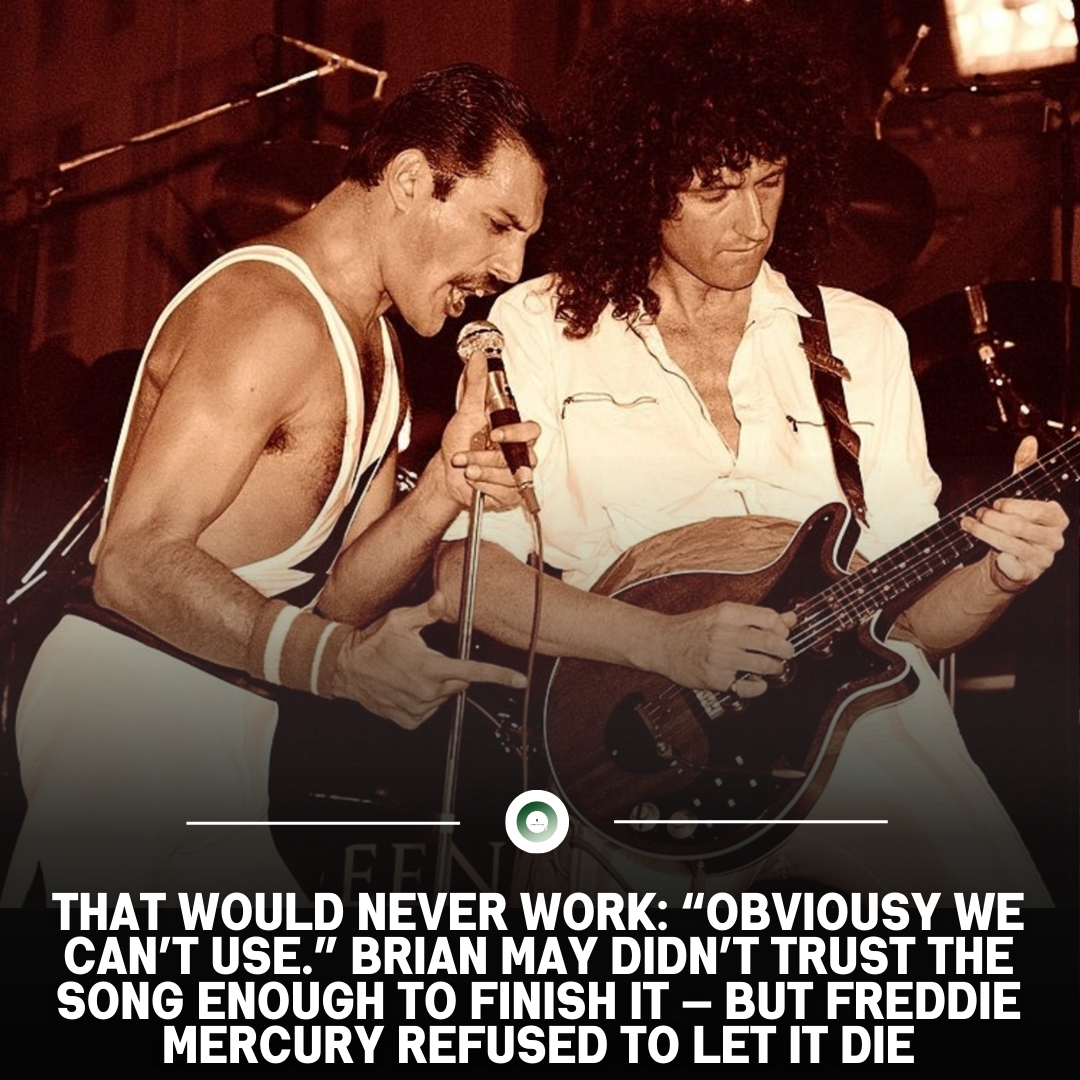
He remembered the moment with unusual clarity. Returning to the band, he presented the riff with confidence but hesitated when it came to its name. “[I] got back with the band and I remember this as clear as day as well – I said to Freddie, ‘Look, I’ve got this really great riff; what do you think?’ ‘That’s really, really cool’. And I said, ‘I don’t have any words; all I have is that ‘tie your mother down,’ which obviously we can’t use.’ He went, ‘Yeah you can!’”
Mercury’s response was not analytical. It was decisive. Where May saw limitation, Mercury saw permission.
This difference reflected something deeper than creative preference. It reflected their opposing relationships with risk. May approached songwriting as construction. Every component had to justify its presence. Mercury approached songwriting as declaration. If something felt right, it earned its place through conviction alone.
This distinction shaped the identity of Queen. It was not simply a band of collaborators. It was a system of internal opposition. May’s restraint balanced Mercury’s instinct. Mercury’s certainty disrupted May’s hesitation. Neither operated in isolation. Each relied on the other to resolve what they could not resolve alone.
“Tie Your Mother Down” exists because of this tension.
Without Mercury, the song may have remained unfinished, trapped in May’s internal process of refinement. Without May, Mercury would have had nothing to validate. The song did not emerge from agreement. It emerged from negotiation.
This dynamic defined much of Queen’s creative output. Their most enduring work did not reflect individual confidence. It reflected collective permission.
What makes May’s hesitation significant is not the quality of the song itself but what it reveals about his relationship with authorship. May did not treat his ideas as automatically deserving of permanence. He treated them as proposals, subject to examination. Even when the music carried force, he remained aware of its vulnerability.
This mindset separated him from many of his contemporaries. Rock music often rewarded assertion. It rewarded artists who imposed their identity without hesitation. May operated differently. His authority did not come from certainty. It came from scrutiny.
This is partly why his guitar work feels inseparable from Queen’s identity. It was never imposed casually. It was integrated deliberately.
“Tie Your Mother Down” may not carry the structural complexity of “Bohemian Rhapsody” or the emotional gravity of “Somebody to Love,” but it occupies a different kind of significance. It represents a moment when May allowed instinct to survive his own analysis. It represents a moment when Mercury’s confidence interrupted May’s instinct to retreat.
The song’s eventual release did not resolve May’s underlying caution. It did not transform him into a more impulsive writer. If anything, it reinforced his reliance on the band as a stabilizing force. Queen did not eliminate doubt. It redistributed it. Where one member hesitated, another provided direction.
This is what allowed Queen to function as more than a collection of individual talents. It allowed them to function as a system capable of correcting its own internal resistance.
The public often experiences bands through their finished output, as if the songs emerged fully formed and inevitable. The internal reality is less stable. Every song exists first as uncertainty. Every decision carries the possibility of disappearance. The songs that survive do not do so because they were flawless. They survive because someone chose not to abandon them.
In this case, that decision belonged to Mercury. But the hesitation belonged to May.
And that hesitation never fully disappeared. Even as Queen’s legacy solidified, May remained aware of the fragile process behind its construction. He understood that the permanence listeners experienced was built on moments that could easily have resolved differently.
“Tie Your Mother Down” is not simply a rock song. It is evidence of a private threshold. A moment when instinct and restraint confronted each other, and restraint stepped aside—not because it disappeared, but because someone else recognized what restraint could not yet accept.
The riff had always been there. The certainty had not.
And Queen existed, in part, to close that distance.