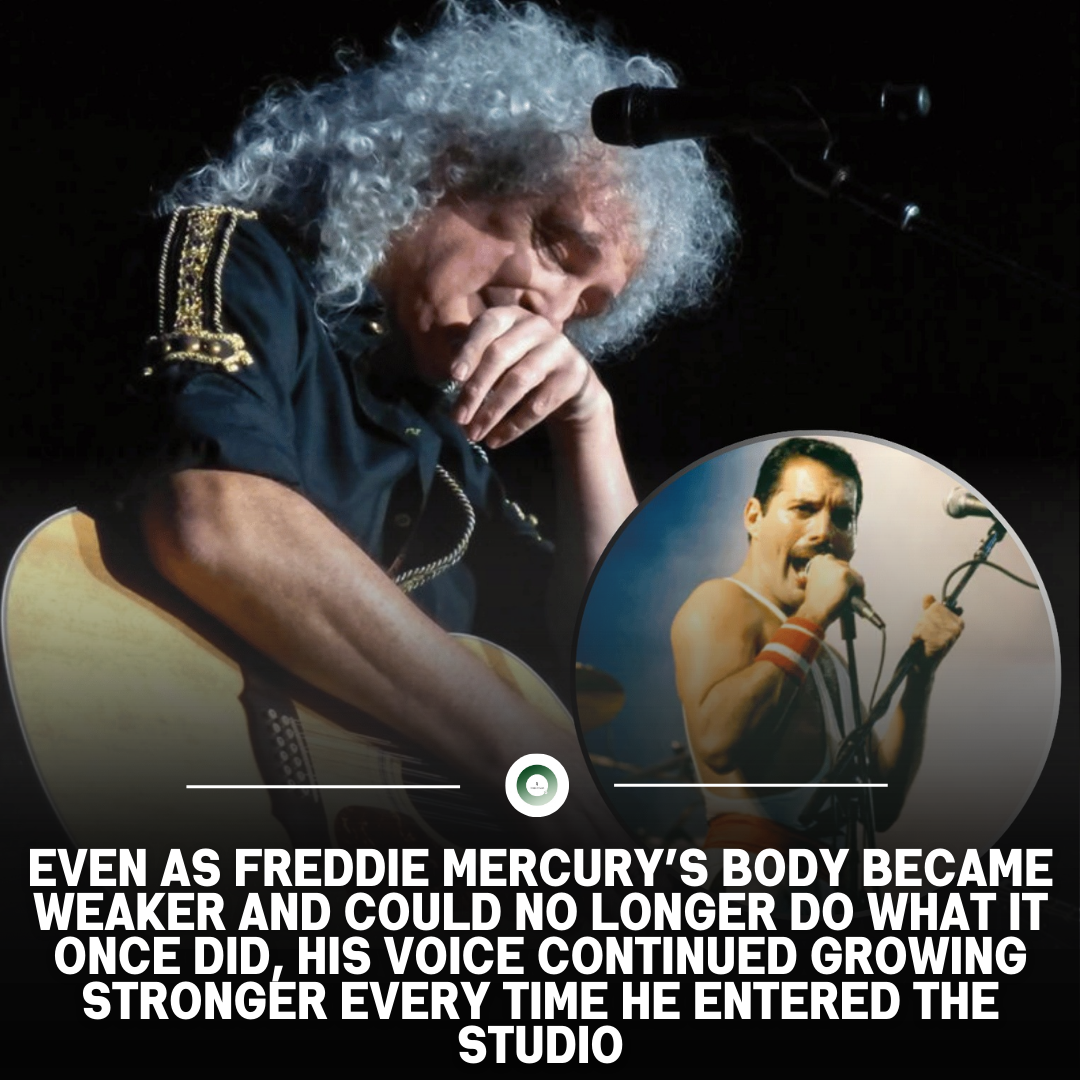
By the early 1990s, silence had begun to surround Freddie Mercury in ways the world could not yet understand. Publicly, Queen still existed. The music still appeared. The voice was still there. But privately, inside the studio walls, something had changed.
Freddie was no longer fighting for performance.
He was fighting for time.
Brian May saw it before anyone else could fully accept it.
Freddie never made announcements. He never asked for sympathy. He never allowed weakness to become part of his identity. Instead, he did what he had always done—he walked into the studio and stood in front of the microphone.
But now, the distance between breaths was slightly longer. The pauses between takes were quieter. And the moments between words carried a weight Brian had never heard before.
There was one night Brian would never forget.
A Session That Was No Longer About Music
Freddie had come in despite being visibly exhausted. His body was thinner. His movements slower. But his eyes still held the same clarity of purpose. He didn’t want discussion. He didn’t want concern.
He wanted the music finished.
Brian understood without needing to ask.
That night wasn’t about perfection.
It was about preservation.
Freddie would step up, deliver a line, and step back—not dramatically, not visibly struggling—but just enough for Brian to understand the cost behind each note. The room adjusted around him. Everything slowed. No one rushed him. No one acknowledged the obvious truth they were all quietly witnessing.
Brian stayed close, not just as a guitarist, not just as a bandmate—
but as a protector of something far more fragile than a recording session.
Freddie wasn’t trying to sound strong.
He was trying to remain present.
The Voice That Refused to Leave
And somehow, when the red recording light turned on, the voice didn’t sound weaker. It sounded larger.
Fuller. More certain.
It carried something new—not power born from physical strength, but power born from urgency. Every word felt deliberate. Every note felt final.
Brian would later realize that Freddie wasn’t just recording songs.
He was leaving behind evidence that he had been here.
There were moments when Freddie would quietly sit between takes, conserving energy. He never complained. He never asked to stop. Instead, he would look toward Brian, sometimes with nothing more than a small nod—an unspoken signal that he was ready again.
Brian responded the only way he could. He made the environment safe. He removed pressure. He made sure nothing interfered with Freddie’s ability to continue, no matter how slowly the process had to move.
Because Brian understood something that no one said aloud.
This was no longer about making an album.
This was about helping Freddie finish what he had started.
The Unspoken Agreement Between Two Brothers
What made those nights unbearable wasn’t fear.
It was clarity.
Brian could see the reality Freddie refused to speak. He could see the physical cost behind every moment Freddie chose to remain standing. But he also saw something else—something stronger than illness, stronger than exhaustion.
Freddie’s refusal to let his voice disappear before he did.
There was no dramatic goodbye. No final announcement inside that room. Just quiet cooperation between two people who had built something together over decades and now understood, without words, what needed to be protected.
Freddie wasn’t asking Brian to save him.
He was asking Brian to help him finish.
And Brian did.
He stayed. He watched. He adjusted. He carried the technical weight so Freddie could carry the emotional one.
What Brian May Heard Long After Freddie Was Gone
Years later, when Brian listened back to those recordings, he no longer heard just performances.
He heard decisions.
He heard effort. He heard endurance. He heard the sound of someone choosing to remain present long enough to leave something permanent behind.
The world would eventually hear those songs and recognize Freddie Mercury’s voice as immortal.
But Brian would always remember the truth behind it.
Immortality wasn’t given to Freddie Mercury.
He recorded it himself—one breath at a time.