The Night Hip-Hop Seemed to Bend Time
The desert air was still warm as the crowd gathered under the vast night sky of the Coachella Valley Music and Arts Festival. It was April 2012, and nearly one hundred thousand fans had packed the festival grounds expecting a celebration of West Coast hip-hop. The headliners—Dr. Dre and Snoop Dogg—represented decades of influence, a lineage of sound that had helped define an entire era of music.
The set had already delivered the energy the audience came for. Classic records echoed across the desert. Guests appeared. The crowd moved as one massive wave of nostalgia and adrenaline.
Then, without warning, the stage went dark.
Thick smoke began to rise slowly from the floor, spreading across the performance platform like a curtain forming in real time. The music softened into a tense pause. Thousands of phones lifted into the air as fans tried to understand what was happening.
Within the haze, a figure began to appear.
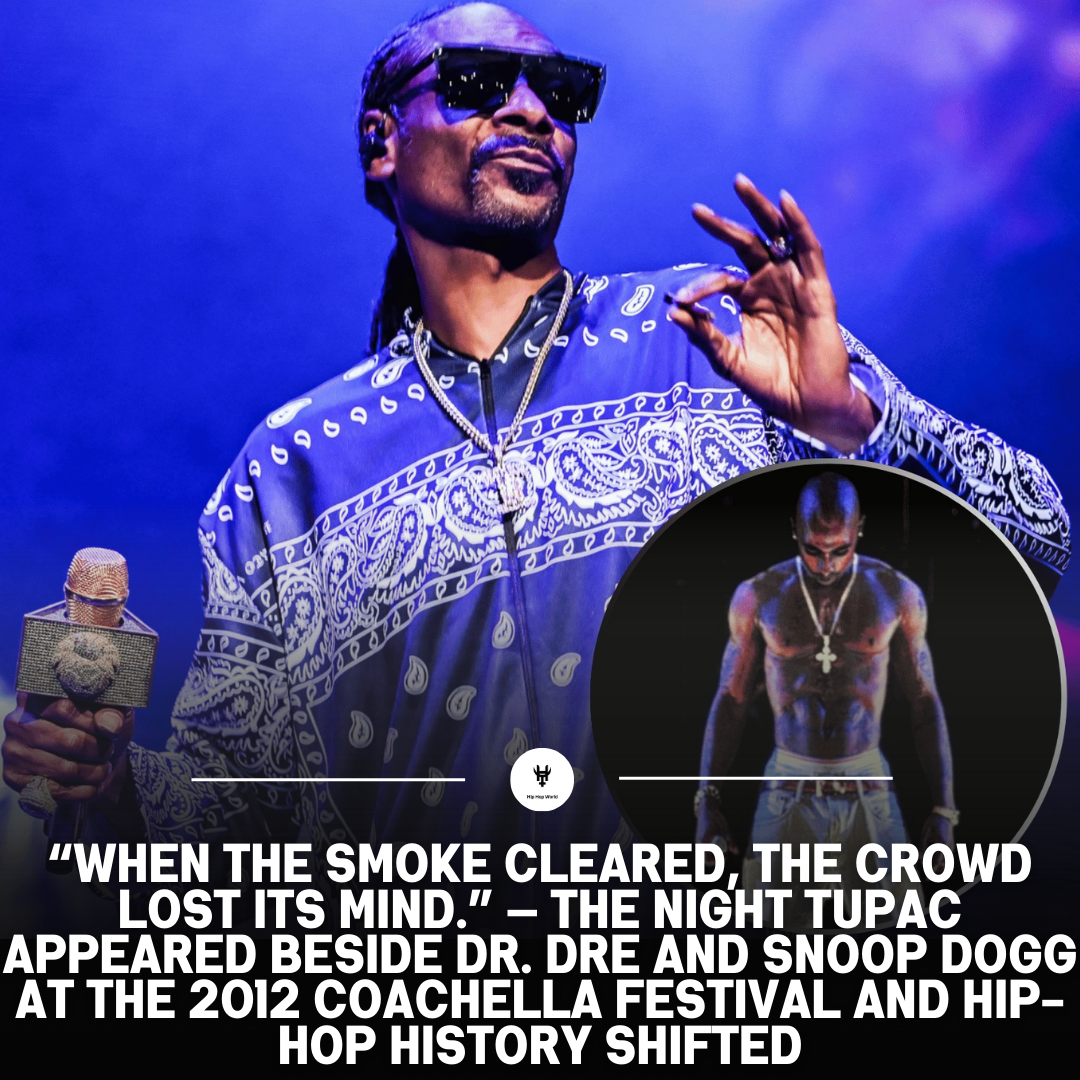
At first it looked like a shadow forming inside the smoke. Then the outline sharpened. The posture, the stance, the bandana tied around the head—suddenly the identity became unmistakable.
Standing on stage was Tupac Shakur.
For a few seconds, the crowd did not react at all. The scale of the moment seemed to freeze the entire field in silence. Tupac had died in 1996, yet here he appeared again, life-sized and moving across the stage as if he had stepped out of another era and into the present.
When the figure began performing “Hail Mary,” the illusion became undeniable. The projection walked the stage with the same commanding presence that had once electrified arenas during Tupac’s lifetime. His gestures felt familiar to anyone who had watched his performances years earlier.
The shock gave way to an explosion of cheers.
What the audience was witnessing was not a resurrection, but one of the most ambitious stage illusions ever attempted in modern live music.
Technology Meets Legacy
The moment quickly became known around the world as the “Tupac hologram,” though the effect was not technically a hologram. The production team behind the performance used a sophisticated variation of a classic theatrical technique known as Pepper’s Ghost. By projecting a digitally rendered image onto a reflective surface on stage, the illusion created the appearance of a three-dimensional performer interacting with the live show.
The technology itself was impressive, but its power came from something deeper. It allowed the past to appear inside the present, collapsing years of absence into a single moment that felt strangely real.
For fans who had grown up with Tupac’s music, the performance carried an emotional weight that technology alone could never create.
A Tribute from Old Friends
For Dr. Dre and Snoop Dogg, the moment was not designed as a spectacle for spectacle’s sake. Both artists shared long histories with Tupac, and the Coachella performance served as a tribute to someone whose influence had shaped the sound of West Coast hip-hop.
When Snoop Dogg joined the stage beside the projection, the illusion became even more surreal. The living and the digital stood side by side, performing as if time itself had bent to allow the reunion.
The audience responded with a roar that rolled across the festival grounds.
Tupac’s career had been brief but explosive. Albums like All Eyez on Me had helped define the sound and attitude of an entire generation of hip-hop listeners. His music combined political commentary, street storytelling, and emotional vulnerability in a way that few artists had achieved before him.
Even after his death, his voice remained a constant presence in the culture.
The Coachella moment simply made that presence visible again.
A Moment That Spread Across the Internet
Within minutes of the performance ending, video clips began spreading online. Fans uploaded footage from every angle they had captured. Social media feeds filled with stunned reactions as people who had not attended the festival tried to understand what they were seeing.
For many viewers watching through their screens, the illusion looked almost unbelievable.
Some described the moment as groundbreaking. Others debated whether recreating a deceased artist on stage raised ethical questions. The conversation quickly expanded beyond the festival itself, touching on the future of live performance and the role technology might play in preserving musical legacies.
Regardless of the debate, one fact remained clear.
People could not stop talking about it.
The performance lasted only about five minutes, yet it instantly became one of the defining moments in the history of modern concerts.
The Enduring Image
As the performance reached its conclusion, the projected figure delivered its final lines and slowly faded back into the smoke. The stage lights shifted, and the illusion disappeared as suddenly as it had appeared.
The crowd erupted again, this time with a sense that they had witnessed something impossible to replicate.
In the years that followed, the Tupac Coachella appearance would be referenced whenever discussions turned to the intersection of music and technology. The performance demonstrated how digital tools could transform concerts into immersive experiences that felt closer to storytelling than traditional shows.
More importantly, it reminded the world of the enduring power of Tupac’s presence in hip-hop.
Even decades after his death, the reaction of that Coachella crowd proved something difficult to measure but easy to recognize.
When Tupac’s voice returned to the stage that night, the silence before the cheers revealed just how deeply his legacy still lived inside the culture.