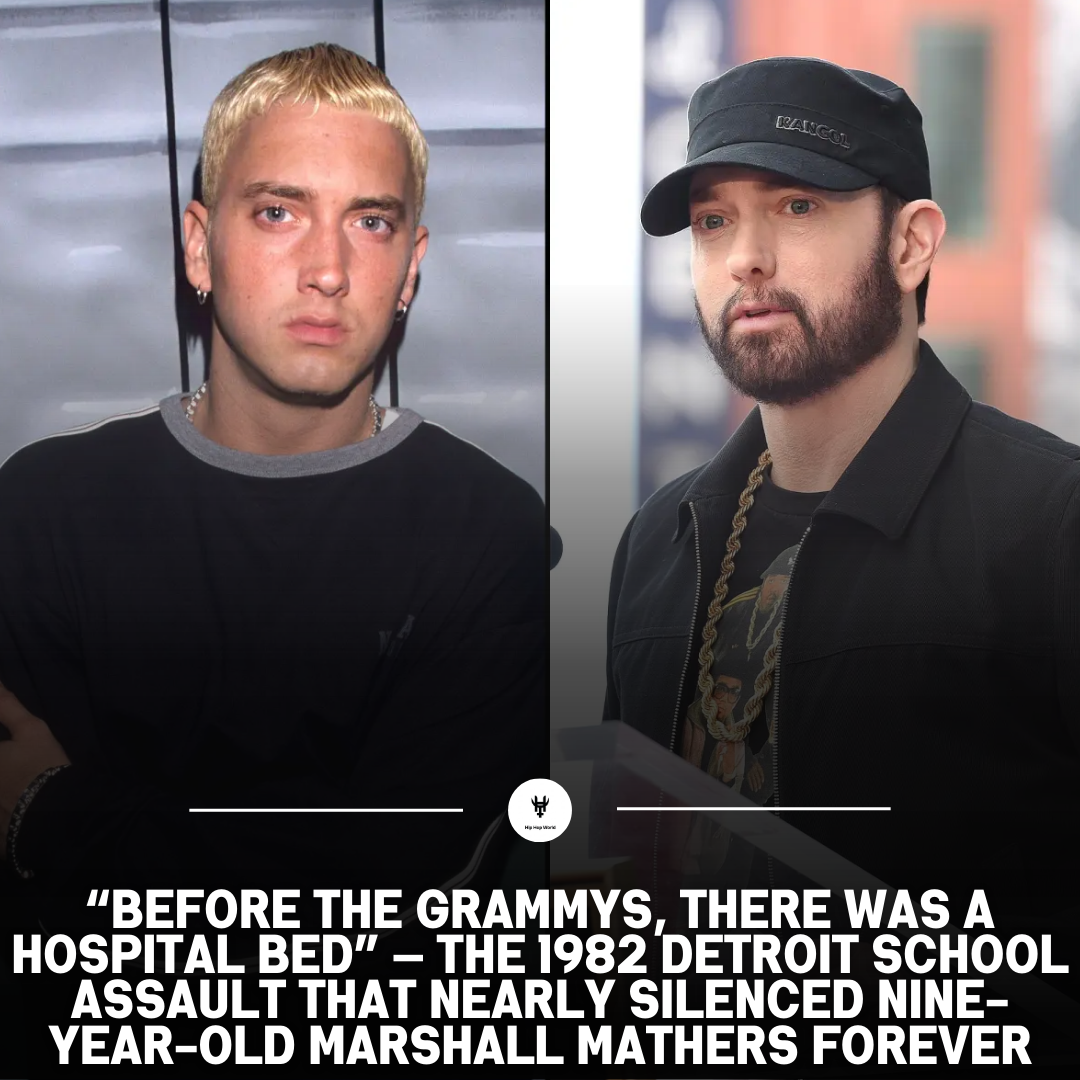
In the early 1980s, long before arenas chanted his name and long before the title “Rap God” would follow him across continents, Marshall Bruce Mathers III was just another kid trying to survive childhood in Detroit.
He wasn’t famous.
He wasn’t feared.
And he certainly wasn’t the sharp-tongued cultural lightning rod the world would later know as Eminem.
He was quiet, skinny, and painfully easy to target.
In the hallways of school, Marshall learned quickly that standing out wasn’t a choice—it was something forced upon him. Moving constantly between neighborhoods and schools, often the only white kid in his classes, he lived with a sense of isolation that few children could fully understand.
But one winter morning in 1982, that isolation turned into something far more dangerous.
The Assault at Cherry Hill Elementary
The incident happened at Cherry Hill Elementary School in Michigan.
Marshall was just nine years old.
What began as the kind of bullying that had become routine for him suddenly escalated into violence. A classmate named D’Angelo Bailey attacked him during school hours. The assault left Marshall with severe head injuries.
It was not a typical schoolyard fight.
The damage was so serious that Marshall collapsed shortly afterward. His brain began to swell, and he was rushed to the hospital. Doctors soon realized the situation was critical.
For days, the boy who would later redefine hip-hop lay unconscious.
His mother, Debbie Mathers, stayed by his side while doctors monitored the swelling in his brain. For nearly a week, Marshall drifted in and out of a coma-like state.
At that moment, the story of Eminem—the artist who would later dominate rap—nearly ended before it even began.
A Childhood Marked by Survival
Marshall eventually regained consciousness, but the incident left a lasting mark on his life.
The physical wounds healed.
The psychological ones stayed.
Growing up in Detroit during the 1980s was already difficult for many families dealing with poverty and instability. For Marshall and his mother, life was particularly chaotic. They moved frequently, struggled financially, and often lived on the edge of eviction.
School never felt like a safe place.
Instead, it became another arena where Marshall had to defend himself—not with fists, but eventually with words.
Those words would become his weapon.
Finding a Voice in Hip-Hop
During his early teens, Marshall discovered hip-hop. The music spoke to something inside him that nothing else had.
Rap gave him structure.
Rhythm gave him control.
And rhyme gave him power.
In a world where he often felt powerless, writing lyrics allowed him to take command of his own story.
He studied rhyme patterns obsessively, filling notebooks with verses and experimenting with complicated internal rhyme schemes. Detroit’s underground rap scene became both a classroom and a proving ground.
Battle rap, in particular, sharpened his skills. It was brutal, fast, and unforgiving—but Marshall thrived in that environment.
Every insult he had endured growing up became raw material for his art.
Turning Pain Into Music
Years later, Marshall would revisit the childhood assault in one of his songs.
The track Brain Damage from The Slim Shady LP recounts the experience of being bullied by D’Angelo Bailey. Like much of Eminem’s work, the song mixes dark humor with painful reality, transforming trauma into storytelling.
For listeners, it offered a glimpse into the experiences that shaped his perspective.
For Marshall, it was something else entirely.
It was reclamation.
By putting the story into music, he took control of a moment that once left him powerless.
From Detroit’s Struggles to Global Impact
By the late 1990s, the quiet kid from Detroit had transformed himself into one of the most technically skilled rappers in the world.
His breakthrough came when Dr. Dre discovered him and helped launch his major-label career through The Slim Shady LP in 1999.
From there, the rise was explosive.
Albums like The Marshall Mathers LP and The Eminem Show reshaped the sound and reach of hip-hop, turning Eminem into a global figure. His music pushed boundaries, sparked controversy, and attracted both intense criticism and passionate loyalty.
Yet beneath the shock value and aggressive persona was something more personal.
Much of Eminem’s work has always been rooted in survival—surviving poverty, surviving addiction, and surviving a childhood filled with instability and bullying.
A Legacy Built From Adversity
Today, Eminem stands as one of the most influential rappers in history. His technical skill, storytelling ability, and willingness to expose personal pain have helped define modern hip-hop.
But when you trace the arc of his story back to its earliest chapters, the contrast is striking.
The same child who once lay unconscious in a hospital bed would eventually stand on stages around the world, performing for millions.
The quiet boy who struggled to defend himself in school halls would grow into an artist whose words could command an entire generation’s attention.
In many ways, Eminem’s story is not just about fame or success.
It is about transformation.
The violence that once threatened to silence Marshall Mathers became the spark that fueled his voice. And through that voice, he turned a painful childhood moment into something far larger than himself—a legacy of resilience that continues to echo far beyond Detroit.