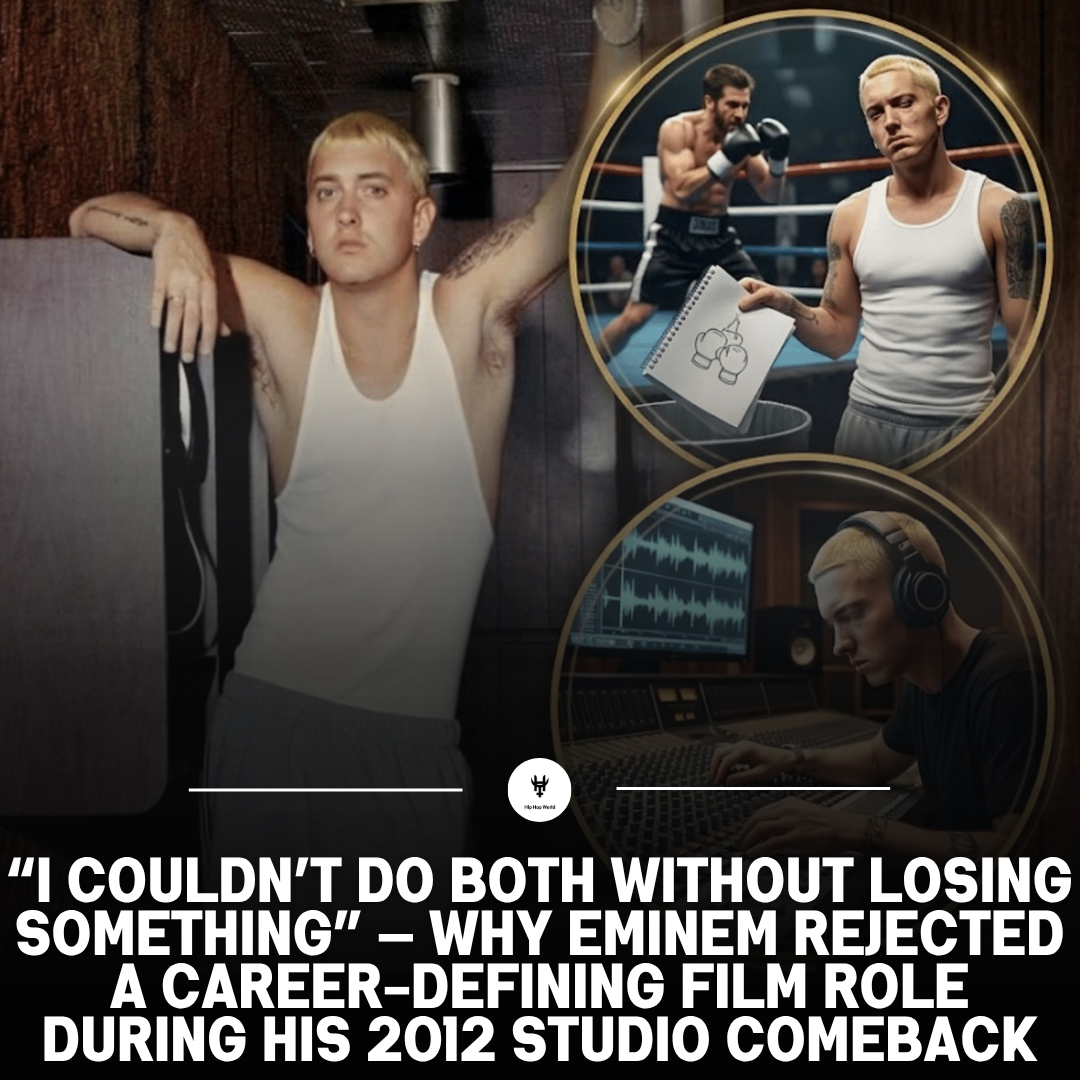
The opportunity didn’t arrive quietly. It came with weight, expectation, and a sense of inevitability—the kind of role Hollywood circles around for years before finally placing it in the hands of someone who seems almost destined for it. A gritty boxing film. A story rooted in struggle, loss, and redemption. A character fighting his way back from collapse.
For many, it felt like a continuation of something unfinished.
By the early 2010s, Eminem had already blurred the line between music and cinema once before. 8 Mile wasn’t just a film—it was an extension of his identity, a story that carried the same raw urgency as his lyrics. It earned critical respect, cultural permanence, and even an Academy Award. So when Southpaw began taking shape, it didn’t take long for industry voices to align around one assumption.
This was his role.
A Story That Felt Too Familiar to Ignore
On paper, the parallels were impossible to miss. Southpaw centered on a fighter navigating personal collapse, grief, and the long, punishing road back to stability. It was a narrative built on endurance—on the kind of internal war that had defined much of Eminem’s own life and artistry.
The project itself carried the tone of something deeply personal. It wasn’t just another sports film. It was designed to feel intimate, grounded, and emotionally heavy. The early vision positioned it as a spiritual successor to 8 Mile, not in setting, but in emotional weight.
Hollywood saw alignment.
But Eminem saw something else.
The Moment the Decision Became Clear
By 2012, Marshall Mathers was standing at a different kind of crossroads—one that didn’t involve scripts or casting calls, but sound, structure, and the quiet intensity of the studio. He was working on The Marshall Mathers LP 2, a project that demanded more than attention. It required immersion.
At the same time, Southpaw wasn’t asking for a casual commitment. The role would have required months of physical transformation, disciplined training, and a complete shift in focus. It wasn’t something that could be approached halfway.
And for Eminem, that was the problem.
There has never been a version of his career built on division. His process has always been singular—total, consuming, and exacting. Taking on the film while building an album of that scale would have meant splitting that focus.
That was not an option.
So he stepped away.
Choosing Absence Over Compromise
The decision surprised many, but it followed a logic that has defined his career for decades. Eminem didn’t walk away because the role lacked meaning. He walked away because it required everything—and at that moment, everything was already being given to the music.
There is a difference between opportunity and alignment.
For artists operating at his level, the challenge isn’t finding doors to walk through. It’s deciding which ones deserve the time, energy, and identity required to do them properly. And in this case, the cost of doing both would have been dilution.
Rather than risk that, he chose absence.
A Different Fighter Steps In
The role eventually found its way to Jake Gyllenhaal, who approached it with the same level of commitment it demanded. The transformation was physical, emotional, and widely recognized. When the film released, it carried its own weight and found its audience.
But the conversation around it never fully separated from the question of what might have been.
Not because the performance lacked strength, but because the original connection between the role and Eminem had felt so natural that it lingered in the background of every discussion.
What the Decision Really Meant
Looking back, the choice doesn’t feel surprising. It feels inevitable.
Eminem has never treated acting as a secondary lane to explore freely. 8 Mile worked because it was inseparable from his own story—because it didn’t require him to become someone else. It asked him to reveal himself more fully.
Southpaw was different. It required transformation, distance, and a kind of time investment that would have pulled him away from the core of what he does.
And for an artist whose identity is built on precision and control, that trade was never going to make sense.
The Legacy of Saying No
In an industry where visibility is often treated as currency, saying no can feel like stepping back. But in Eminem’s case, it became something else entirely.
It became reinforcement.
Reinforcement of a principle that has shaped his career from the beginning: if something cannot be done with full commitment, it should not be done at all.
By turning down Southpaw, he didn’t just pass on a role. He clarified a boundary. One that places music—not opportunity, not expansion, not expectation—at the center of everything.
And in doing so, he preserved the one thing that has never been negotiable.
His standard.