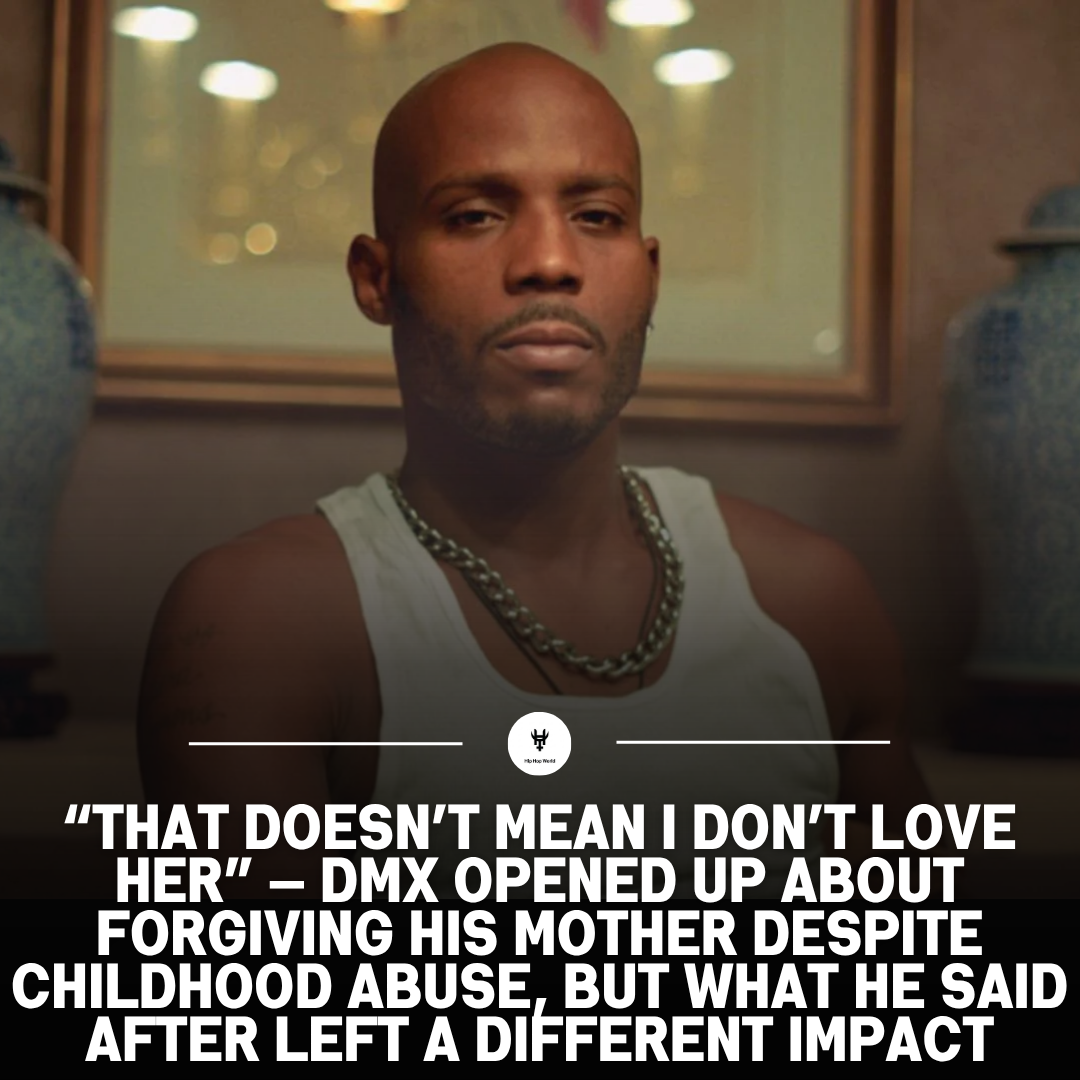
For DMX, some of the most defining moments of his life didn’t come from music or fame—they came from childhood. Long before the world knew his voice, there were experiences that shaped how he saw people, pain, and ultimately, forgiveness.
One moment stayed with him.
As a young boy, he came across his mother’s notebook and noticed a mistake she had written. Thinking he was helping, he erased it. What followed wasn’t confusion or conversation—it was violence.
“I don’t know what she thought I was doing,” he reflected. “I don’t know if she thought I was trying to sabotage her or whatever. I don’t know what she thought. But she beat two teeth out of my fucking mouth with a broom.”
It was one of many incidents that marked a childhood defined by instability and fear.
A Childhood Shaped By Pain
From an early age, DMX was exposed to physical abuse at home. The environment he grew up in made it difficult to find any sense of stability, and that impact carried into other parts of his life. By the time he was ten, he had already been expelled from school.
What followed was a path that felt almost inevitable.
As he entered his teenage years, he became involved in petty crime—a direction that reflected not just rebellion, but the absence of guidance and safety. His struggles weren’t isolated moments. They were part of a pattern that began long before he had the chance to understand it.
A Different Perspective On The Past
Despite everything, DMX didn’t carry his story with simple anger. When he spoke about his mother years later, there was something more complicated in his words.
“That doesn’t mean I don’t love her,” he said, acknowledging the abuse without denying the connection.
He didn’t excuse what happened. But he tried to understand it.
Pointing to how young his mother had been when she had children, he said that “children don’t come with a fucking instruction manual.” It wasn’t a defense—it was an attempt to see the situation from a distance, to make sense of something that never fully made sense.
He questioned whether she had simply been too young to know “what to do.”
The Turning Point: Choosing Forgiveness
The most defining shift in DMX’s story didn’t come from success or recognition. It came from a decision.
Forgiveness.
“I think a lot of people struggle with forgiving their parents,” he said. “In fact, I personally struggle with forgiving my parents. But until you learn how to forgive others, you can’t forgive yourself. You can’t forgive yourself if you don’t know how to forgive.”
It wasn’t a simple resolution. It was something he admitted he continued to work through. But it became central to how he approached his past.
His faith played a role in that process. As a born-again Christian, DMX leaned heavily into spirituality, reading the Bible regularly and trying to live by its principles. Forgiveness wasn’t just an idea—it was something he actively tried to practice, even in situations that most people would never be able to accept.
What His Story Really Reveals
DMX’s life was often described through the lens of his struggles—legal issues, personal battles, and the weight of his past. But beneath all of that was something less visible and far more difficult.
He didn’t just survive what happened to him.
He tried to understand it.
And more than that, he tried to move beyond it in a way that required confronting it directly.
His story isn’t defined only by what he went through, but by what he chose to do with it.