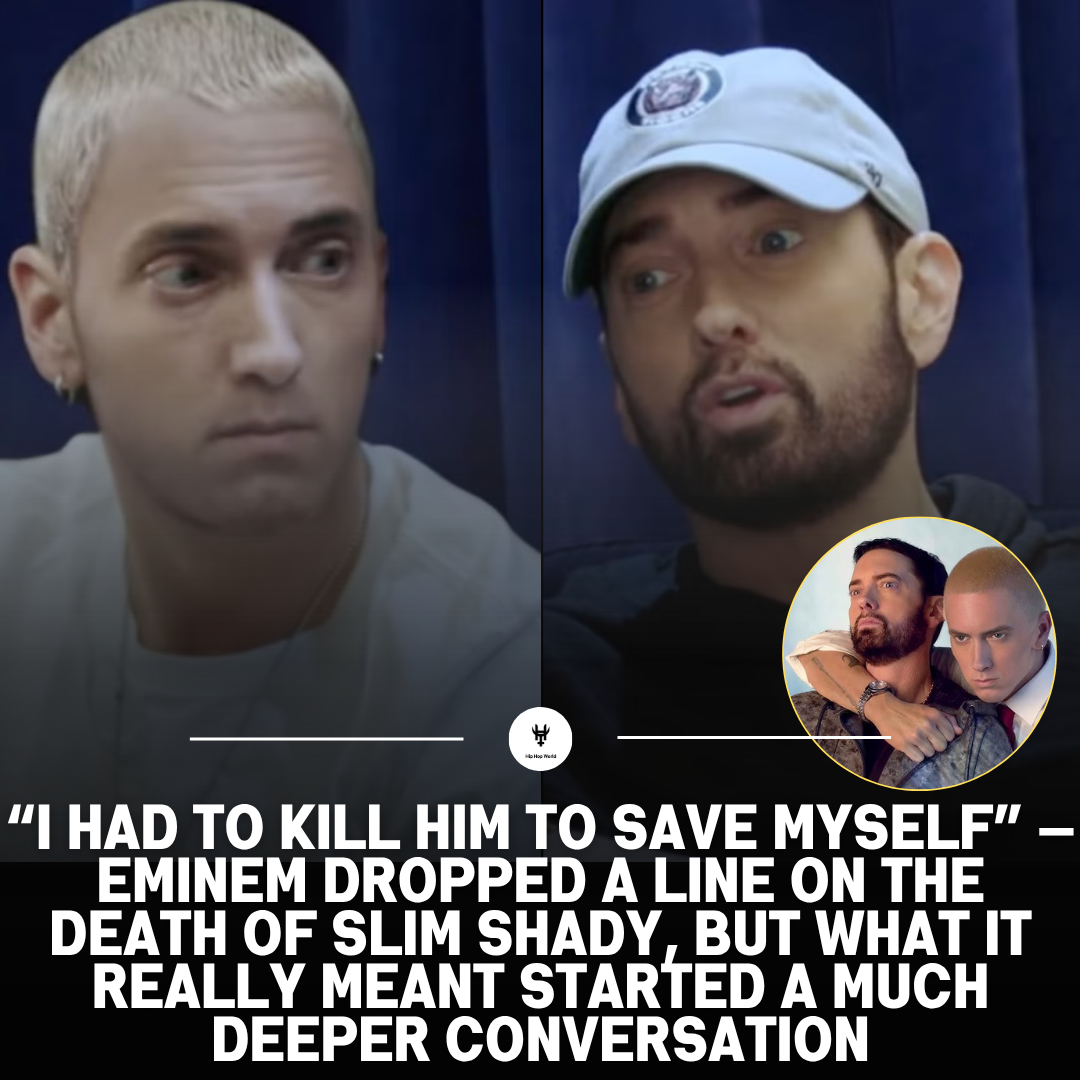
When Eminem introduced The Death of Slim Shady (Coup de Grâce), it didn’t feel like a typical album rollout. It felt like stepping into the middle of something unresolved—an internal moment that had been building for years. For decades, the world had known Marshall Mathers not just as himself, but through the unpredictable force of Slim Shady, a persona that shaped his rise and redefined the edges of hip-hop.
The Identity That Built Everything
Slim Shady was never just an alter ego. He was a tool—sharp, fearless, and deliberately confrontational. Through that voice, Eminem found a way to process chaos, turning anger, trauma, and addiction into something that connected on a global scale. It shocked audiences, dominated charts, and pushed boundaries few artists were willing to approach.
But that same intensity came at a cost. The energy that made Slim Shady so powerful required constant return to a darker version of himself. It wasn’t just performance—it was a mindset, one that demanded conflict, volatility, and emotional extremes. Over time, it became harder to separate the character from the person behind it.
A Breaking Point, Not a Rebrand
That’s what makes this album feel different. This wasn’t a reinvention or a stylistic shift. It was a confrontation. By framing the project as a “death,” Eminem turned his own legacy into a narrative—one where he doesn’t walk away from Slim Shady, but faces him directly.
The line “I had to kill him to save myself” carries that weight. It doesn’t come across as shock value. It feels like something closer to admission. A realization that what once protected him had started to define him in ways he could no longer carry.
Letting Go Without Erasing the Past
What makes this moment stand out is the way Eminem handles his past. There’s no rejection of what Slim Shady represented. That persona was essential—without it, there is no rise, no cultural impact, no lasting influence. But acknowledging that truth doesn’t mean staying tied to it forever.
Instead, this feels like separation. Not denial, but distance. A decision to move forward without erasing what came before.
A Shift in What Power Looks Like
In an industry that often expects artists to remain fixed in the version of themselves that first captured attention, this move stands apart. Rather than repeating a formula, Eminem leans into change. The chaos that once fueled his work is no longer the center of it.
And yet, nothing feels diminished. If anything, it sharpens the focus. The intensity is still there—but it’s coming from a different place now. Less about survival, more about awareness.
A Chapter Closing, Not Ending
The Death of Slim Shady doesn’t feel like an ending in the traditional sense. It feels like a closing chapter—one that allows something else to exist without being overshadowed by what came before.
For listeners, it’s a rare moment of clarity from an artist who built his identity on unpredictability. And for Eminem, it reads as something more personal than any chart position or critical response.
Not a victory over the industry.
But over a version of himself he no longer needed to be.