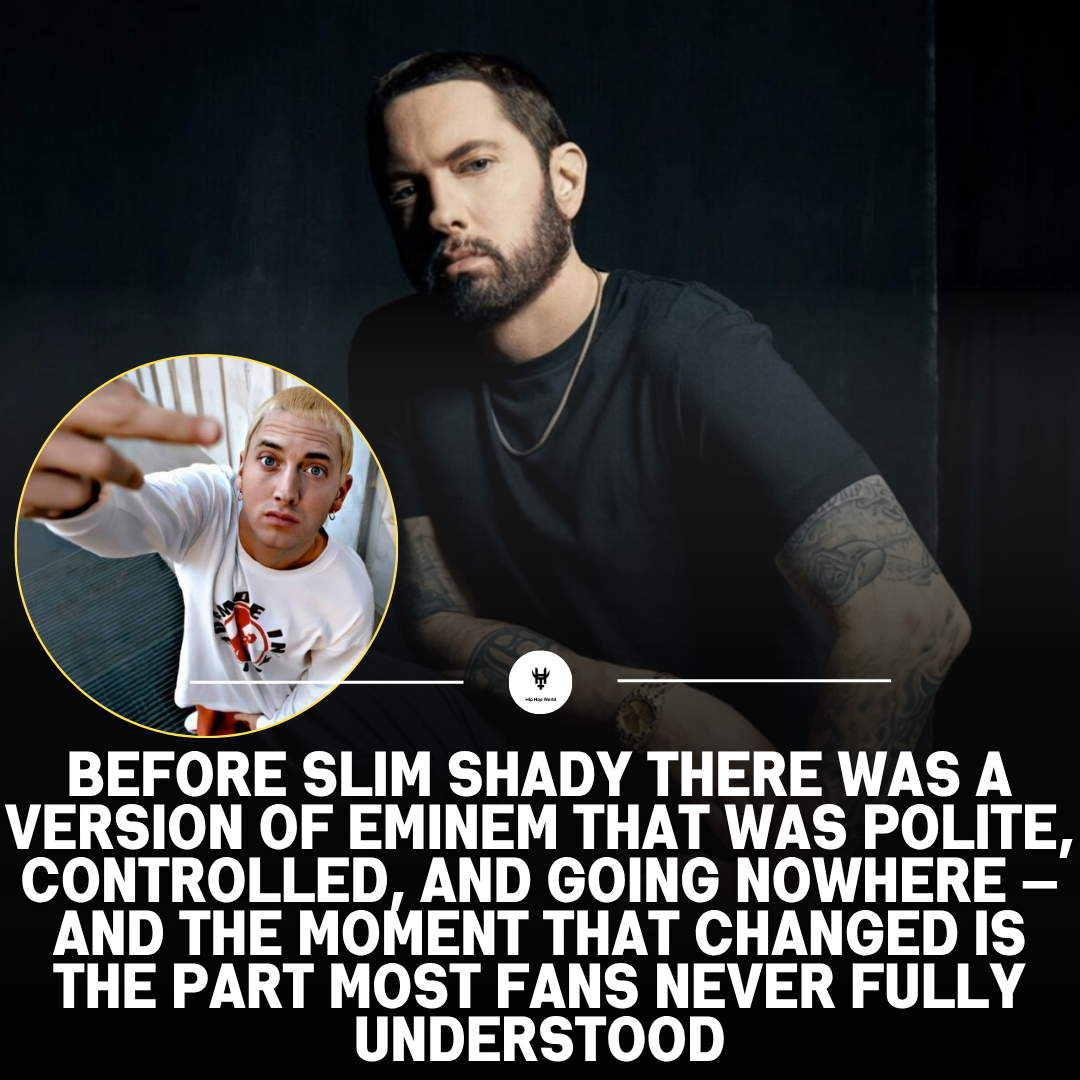
In 1996, Eminem was still trying to find his place. His debut album, Infinite, arrived without much noise—and left even less behind. It wasn’t bad, but it wasn’t unforgettable either. The style was controlled, almost cautious. The kind of rap that fit in, rather than stood out.
There was no chaos in it. No unpredictability. No voice that felt dangerous.
And that was the problem.
Criticism That Hit Deeper Than Expected
The reaction to Infinite didn’t just fade away—it lingered. People didn’t just dismiss it; they compared him. Said he sounded like someone else. Said it was too soft.
That part stuck.
As Kuniva later explained, looking back on that version of Eminem: “That was the pinnacle of him being polite and cool,” Em’s D12 bandmate, Kuniva, recalled of his underdeveloped style on Infinite, speaking to Billboard in 2015, “He was really a straight-up cool cat, but the frustration came out when he started getting the criticism about the Infinite shit, like, ‘It’s kind of soft. You sound like this person [or] that person’.”
It wasn’t just feedback. It was a challenge to his identity.
The Experiment That Changed Everything
Around that same time, a group was forming in Detroit—D12. Six rappers, each agreeing to step outside themselves. Each one creating an alter ego. A different version. A darker version. A version that didn’t have to follow rules.
The concept was simple, but it unlocked something.
“Basically, the whole thing of D12 is everybody has an alter ego,” Kuniva explained, “so try to be the villain, a person completely different from who you are. That’s when he took the name, Slim Shady”.
That wasn’t just a nickname.
It was a shift.
When Slim Shady Took Over
Slim Shady wasn’t polite. He wasn’t controlled. He didn’t care about fitting in. He said things Marshall Mathers wouldn’t. Took risks the earlier version of Eminem avoided.
And suddenly, the music changed.
The frustration that built up after Infinite had somewhere to go—and it came out sharper, louder, and impossible to ignore. When The Slim Shady EP dropped in 1997, it didn’t just introduce a new sound. It introduced a new identity.
One that people couldn’t compare to anyone else.
Because there was nothing like it.
The Moment the Industry Paid Attention
That shift didn’t go unnoticed. Jimmy Iovine heard it. Dr. Dre heard it.
And more importantly—they understood it.
Slim Shady wasn’t just a gimmick. It was clarity. A voice that cut through everything else happening at the time. When Dre brought Eminem into Aftermath Entertainment, it wasn’t because of what he had been doing before.
It was because of what he had just become.
What Actually Changed
Looking back, the difference between Infinite and everything that followed isn’t just style—it’s permission. Before Slim Shady, Eminem was trying to be accepted. After Slim Shady, he didn’t ask for it.
He forced it.
That alter ego started as an experiment inside D12. But it didn’t stay there. It grew beyond the group, beyond the idea, and eventually beyond control.
And in the process, it turned a struggling rapper into something much harder to ignore.
Because once Slim Shady showed up, there was no going back to being “polite and cool” again.