Joe Henley had never performed a professional music gig before appearing on The Voice, but that didn’t stop the 19-year-old Alabama singer from winning over two coaches and earning a place in Season 30’s Top 13. Now, as the competition moves into its Live Shows, one of Team Riley Green’s most promising contestants faces a challenge that years of singing in church could never fully prepare him for.
He must prove that his natural talent can withstand the pressure of performing on national television while millions of viewers decide his future.
What makes Henley’s journey particularly fascinating is not simply his lack of professional experience. It is where he learned to sing in the first place.
Long before stepping onto The Voice stage, Henley was performing in the back room of a truck stop connected to a ministry operated by his grandparents.
The family has maintained that ministry for more than 40 years, creating an environment where music, faith, and community became closely connected.
For Henley, those experiences were the foundation of his musical development.

During his Blind Audition, he explained that he had grown up singing and leading worship at the truck stop ministry, in church, and around family campfires.
Those settings are dramatically different from the professional recording studios and large concert venues associated with established country performers.
Yet they may also explain something about the qualities that have attracted attention to his voice.
In a church or family gathering, the purpose of singing is often less about impressing an audience and more about communicating emotion, sharing an experience, or bringing people together.
That kind of musical upbringing can encourage performers to focus on the meaning of a song rather than treating every performance as an opportunity to demonstrate vocal power.
Henley’s background does not automatically make him a better singer than contestants with formal training or professional experience.
But it gives him a distinctive starting point.
He arrived on The Voice without the career history many aspiring artists spend years building, yet he already possessed a strong connection to the music he wanted to perform.
And that connection became apparent during his audition.
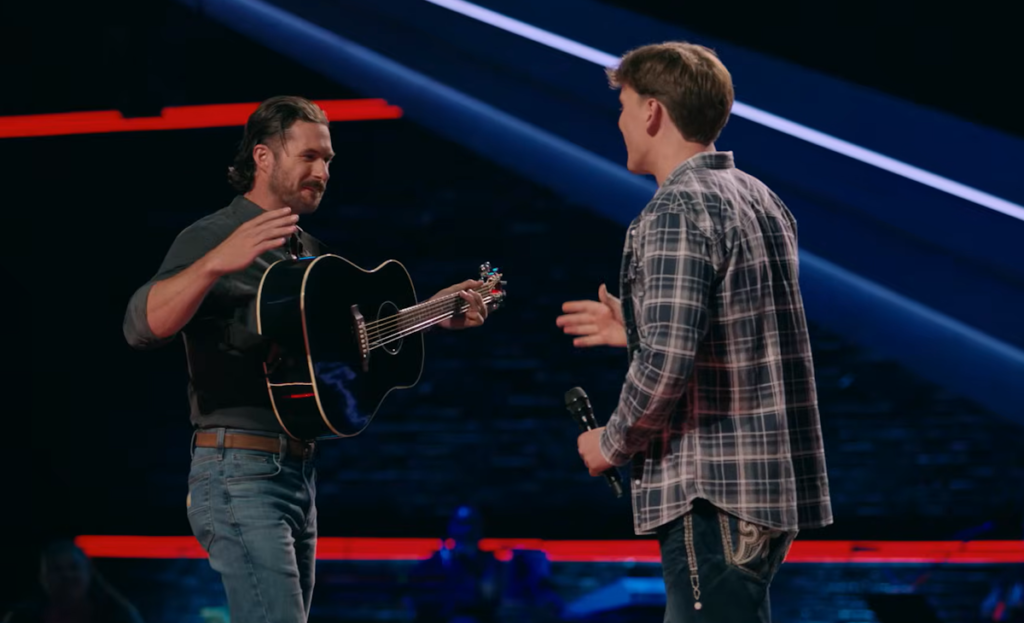
Henley chose Travis Tritt’s “Anymore,” introducing himself through a country song associated with emotional storytelling and traditional vocal delivery.
The performance earned chair turns from Kelly Clarkson and Riley Green.
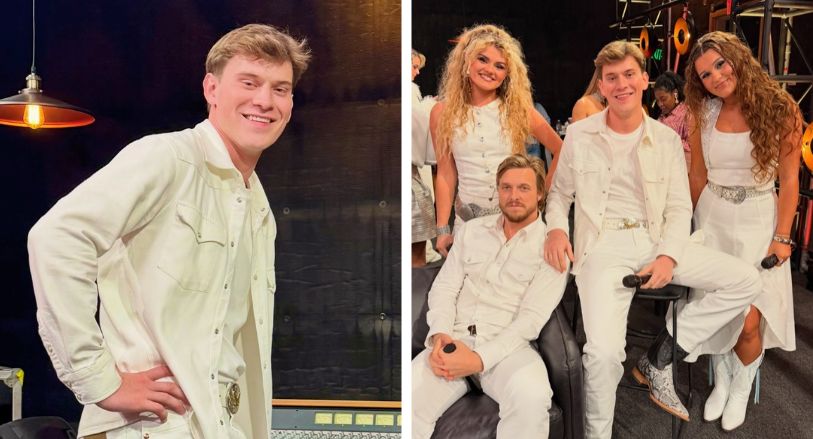
For someone who had never performed professionally, attracting the attention of two established recording artists was a significant achievement.
It also created an important decision.
Clarkson has extensive experience across pop and country music, while Green’s career is rooted more directly in contemporary country.
Henley ultimately selected Green, another Alabama native, as his coach.
Their shared connection to the state provided an immediate point of familiarity, but their musical interests were arguably even more important.
Henley has identified Travis Tritt, Keith Whitley, and George Strait among his influences.
Those artists represent different aspects of country music, from traditional storytelling and expressive vocals to the polished sound of mainstream country recordings.
Green’s own background gave Henley an opportunity to work with someone familiar with the musical traditions that had shaped his interests.
The partnership has already produced results.
Henley progressed through the competition’s early stages and secured a place in the Top 13 after Green selected him to advance from Cut Week.
That decision was especially meaningful because the coach had several talented singers competing for limited places.
Among those who did not receive Green’s direct selection was 15-year-old Allie Rae, another country performer who had impressed the coaches throughout the season.
Rae later missed out on the additional place available through America’s Save, which went to Team Kelly’s Kyle Davis.
Henley’s advancement therefore came during a particularly competitive stage of the programme.
Green had to decide which performer he believed offered the strongest opportunity moving forward, and Henley received his backing.
For a singer who had previously performed primarily in informal settings, the endorsement marked another major step.
But there is a fascinating contrast between the musical world Henley came from and the one he is now entering.
At his grandparents’ ministry, he could sing without worrying about television voting, national exposure, or the expectations that accompany a high-profile competition.
On The Voice, every performance is part of a much larger production.
Contestants must work with professional musicians, rehearse within production schedules, perform under studio lighting, and respond to feedback from coaches whose careers have taken them to major stages.
They must also develop a relationship with an audience that knows them primarily through brief television appearances.
That last challenge becomes especially important during the Live Shows.
The viewers who enjoy Henley’s voice must now decide whether they want to keep hearing him as the competition approaches its finale.
His musical ability helped him reach this stage, but audience support will become increasingly important to his chances of remaining in the competition.
There is another element that makes his story unusual.
Until recently, Henley appeared to have a very different career in mind.
Standing 6-foot-5, he played varsity basketball at Cottage Hill Christian Academy in Alabama, graduating in 2026.
His sporting ambitions were serious enough that he considered playing college basketball or potentially pursuing opportunities overseas.
Music was part of his life, but basketball offered another possible direction for his future.
The Voice has now introduced an entirely different possibility.
Instead of concentrating exclusively on his next step in basketball, Henley is performing for a national audience and receiving professional guidance from a country music star.
That does not mean he has permanently abandoned the sport or committed to a particular music career.
But it demonstrates how quickly opportunities can change for a young person still deciding what direction to pursue.
His personal life also reflects the importance of the community around him.

Henley is in a relationship with Abby Billante, who also grew up in Alabama and shares his commitment to faith.
Billante publicly shared a photograph with Henley in May 2026, although the couple has not disclosed precisely when their relationship began.
Alongside his family and grandparents, that relationship forms part of the personal world Henley is navigating while his public profile grows.
For a 19-year-old who was recently attending school and playing basketball, the transition into national television is considerable.
Suddenly, people who have never met him are discussing his performances, following his progress, and forming expectations about his future.
That attention can be exciting, but it also introduces challenges.
A contestant who performs well during the Blind Auditions may face pressure to produce an even more memorable moment in every subsequent round.
And for someone whose appeal is connected to a natural, traditional country sound, there is always the question of how much to experiment.
Should Henley continue selecting songs that emphasize the influences he already knows well?
Or should he use The Voice to demonstrate that he can perform convincingly outside his musical comfort zone?
The competition’s themed Live Shows make that question particularly relevant.
Season 30 has introduced Y2K-themed performances, with Team Riley and Team Kelly scheduled to perform during the November 16 episode.
The theme creates an opportunity for contestants to reinterpret music associated with the turn of the millennium.
For Henley, the challenge will be finding material that suits his voice while also meeting the expectations of the themed format.
An effective performance could demonstrate that his traditional country influences are flexible enough to work with different musical selections.
But an arrangement that feels disconnected from his natural style could make it harder for viewers to recognize the qualities that initially attracted them to him.
This is where Green’s guidance may become particularly valuable.
As an established country performer, Green understands the importance of building an artistic identity that listeners can recognize.
He can help Henley explore different material without necessarily losing the qualities that distinguish his voice.
That balance could matter more than any single dramatic vocal moment.
Henley has already shown that he can attract attention without relying on a long professional résumé.
What remains uncertain is whether he can turn that initial connection into sustained support throughout the competition.
My view is that the most interesting part of Henley’s story is the contrast between his modest musical beginnings and the increasingly ambitious stage on which he now performs.
A young man who learned to sing through his grandparents’ truck stop ministry is suddenly being evaluated alongside performers with very different backgrounds and levels of experience.
He has not followed the conventional path of building a professional performance career before seeking national exposure.
Instead, the television competition itself has become one of his first major opportunities to discover what a professional music career might involve.
That creates an unusual kind of pressure, but also an extraordinary opportunity.
Even if Henley does not ultimately win Season 30, the experience could help him understand the expectations of professional performance, develop new musical relationships, and reach listeners far beyond his home state.
For now, however, his immediate goal is much simpler.
He needs to deliver another performance strong enough to keep him in the competition.
With Team Riley preparing for the November 16 Live Show, the young singer’s future remains open.
Basketball may once have seemed like the more obvious career path, but country music has suddenly become a serious possibility.
And the remarkable thing is that it all began with a teenager singing in the back room of a truck stop.
Do you think Joe Henley’s lack of professional experience makes his performances more authentic, or will contestants with more time onstage have an advantage as The Voice moves closer to its finale?