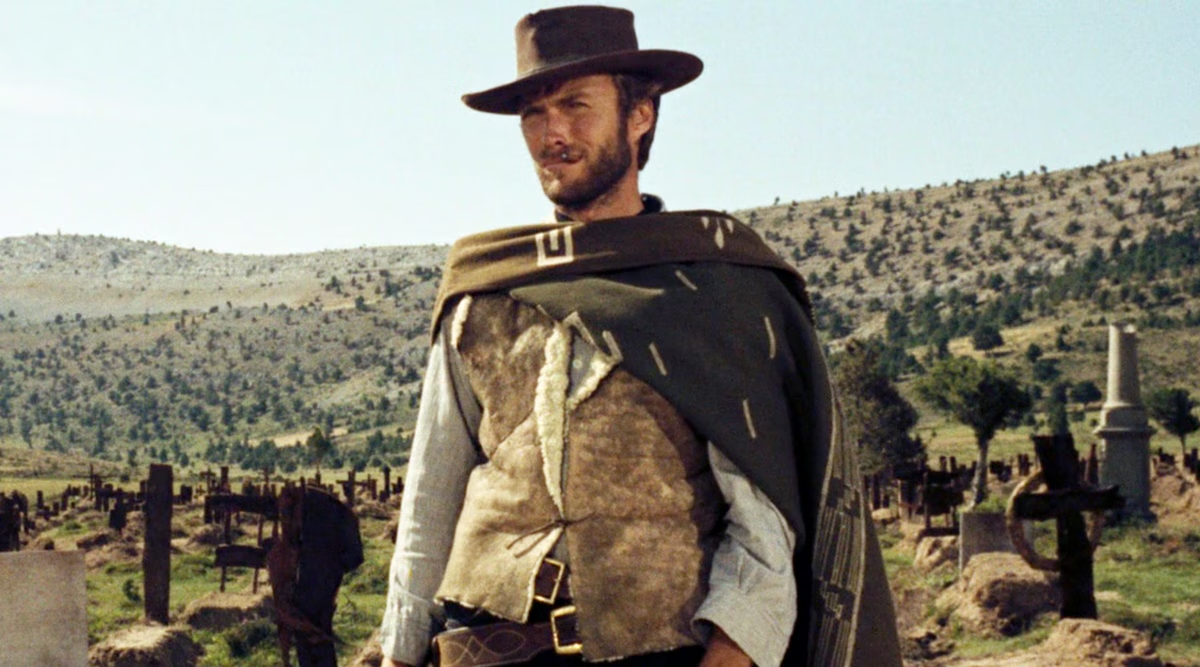
When Clint Eastwood made his mark in Hollywood, he quickly became the epitome of the rugged leading man—handsome yet gritty, a hero with a complex edge. His breakout role in Sergio Leone’s iconic Dollars trilogy cemented his star power, leading him to a flourishing career in both acting and directing, earning numerous accolades along the way.
A New Kind of Western Hero
Eastwood emerged as the new face of the American cowboy, stepping into the space once dominated by John Wayne. However, his vision of America was markedly different—darker and less idealistically patriotic. Though both actors shared conservative political views, Eastwood’s films often painted a bleaker portrait of American justice and heroism, influenced in part by his early work with the Italian director Leone.
The Impact of Dirty Harry
In 1971, Eastwood starred in Dirty Harry, directed by Don Siegel, a film that redefined the police thriller genre. Playing the hard-nosed Harry Callahan, Eastwood’s character exuded disdain for authority and bureaucracy, enforcing his own brand of justice. However, the film’s portrayal of law enforcement and Callahan’s controversial remarks, including a racial slur towards his rookie partner, Chico Gonzalez, sparked debate. Callahan epitomized the archetype of the tough, no-nonsense white American male, leading to mixed reactions from audiences and critics alike.
While some saw Harry as a flawed but compelling antihero, others found his overtly racist and homophobic attitudes disturbing. A YouTube clip featuring his first encounter with Chico includes nostalgic comments from viewers reminiscing about a time before political correctness, showcasing the divided reception of the film’s themes.
Pauline Kael’s Scathing Critique
Noted New Yorker critic Pauline Kael delivered a scathing review of Dirty Harry, labeling it outright “fascist.” She expressed deep distrust in the film’s portrayal of law enforcement, recalling her own upbringing in San Francisco. “One of the soundest pieces of folk wisdom my mother gave me was, ‘If you’re ever in trouble, don’t go to the cops,’” she wrote, pointing to long-standing corruption within the police force—an issue the film ignored entirely.
Kael acknowledged that Dirty Harry was well-crafted but took issue with its underlying message. “When you’re making a picture with Clint Eastwood, you naturally want things to be simple. The battle between good and evil is as basic as you can get. It gives the film a primal, almost mythological quality,” she observed. “But this genre has always had a fascist edge, and now that element has fully emerged.”
Recalling her experience in the theater, Kael noted, “On the way out, a pink-cheeked little girl was saying, ‘That was a good picture’ to her father. Of course; the dragon had been slain. But Dirty Harry is more than just a genre film—it is a deeply immoral movie.”
Eastwood’s Response
Eastwood didn’t take kindly to Kael’s critique. In an interview with Robert Ward, he dismissed her comments, suggesting she was merely stirring controversy for attention. “People loved to throw around the term ‘fascist,’” he said. “It didn’t bother me because I knew she was full of it. She was writing to be provocative because that’s what people expected from her. That’s how she made her name.”
Ultimately, Eastwood believed the film’s success spoke for itself. “The public liked the picture. They knew it was about a guy sick of bureaucratic nonsense. That’s all there was to it.”
Though Dirty Harry remains divisive, it undeniably shaped the landscape of action cinema. Whether viewed as an enthralling thriller or a troubling endorsement of unchecked authority, its impact on Hollywood is undeniable.