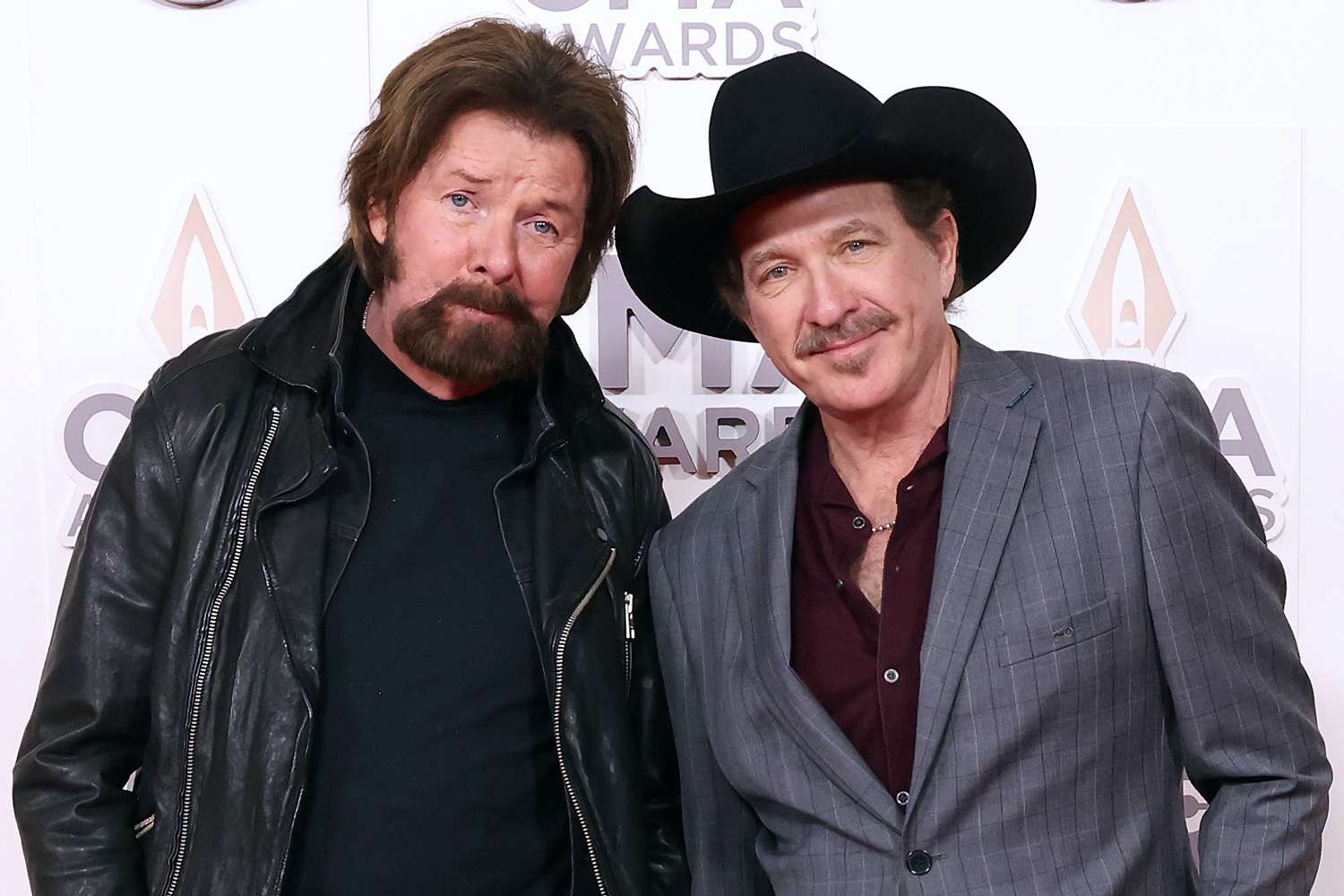
Brooks & Dunn were supposed to be celebrating one of the greatest honours of their careers, but their tribute at the 2026 CMA Awards sparked a debate that went far beyond one controversial performance. While some viewers criticised the hard-rock arrangements of their classic songs, Ronnie Dunn and Kix Brooks quietly achieved another remarkable milestone that same evening. Their 17th Vocal Duo of the Year victory raised a fascinating question about country music: after decades of changing trends and emerging stars, why does this legendary partnership continue to command such extraordinary recognition?
The November 18 ceremony at Nashville’s Bridgestone Arena was already set to be a special occasion for the duo. They were receiving the Willie Nelson Lifetime Achievement Award, one of the Country Music Association’s most prestigious honours, recognising artists whose careers have made an enduring contribution to the genre.
Taylor Swift presented the award, bringing another major country music figure into a celebration of two performers whose influence reaches across generations.
But before Brooks and Dunn accepted the honour, an ambitious group of musicians took the stage to reinterpret some of their best-known recordings.

The tribute featured Marcus King, members of Halestorm, Brothers Osborne, Brad Paisley, Luke Bryan and HARDY. Together, they performed a medley that included “Boot Scootin’ Boogie,” “Rock My World (Little Country Girl),” “Hard Workin’ Man,” “Hillbilly Deluxe” and “Play Something Country.”
It was an unusual combination of performers, blending traditional country personalities with musicians better known for heavier rock influences.
For some viewers, that creative decision was difficult to accept.
Social media reactions included complaints about the aggressive arrangements and the decision to give familiar country songs a noticeably harder sound. One viewer described the performance as an atrocious heavy-metal tribute, while another questioned why the organisers had chosen that musical direction.
Lzzy Hale’s powerful rock-style vocals attracted particular attention, with some viewers arguing that the performance moved too far away from the sound that made Brooks & Dunn famous.
Yet the controversy also highlighted something interesting about the duo’s musical legacy.
Brooks & Dunn have never been confined entirely to the softer, more traditional side of country music. Throughout their career, they have embraced energetic performances, electric guitars, driving rhythms and songs designed to fill large concert venues.
Their catalogue contains emotional ballads, but it also includes some of the genre’s most recognisable country-rock anthems.
That musical diversity helps explain why the CMA organisers may have considered a rock-influenced tribute appropriate, even if the final arrangements disappointed some longtime listeners.

“Hard Workin’ Man,” for example, has an energetic musical identity that naturally lends itself to a louder interpretation. “Hillbilly Deluxe” and “Play Something Country” also draw on the more forceful side of the duo’s catalogue.
But there is a difference between incorporating rock influences into country music and transforming a familiar song into something audiences barely recognise.
That distinction became central to the disagreement surrounding the performance.
For fans who associate Brooks & Dunn with the original recordings, the tribute may have felt disconnected from the music they wanted to celebrate. For others, bringing together musicians from different styles could be interpreted as an attempt to demonstrate the duo’s wider influence.
Both perspectives reveal how strongly listeners identify with songs that have accompanied them for decades.
And few country acts have produced as many enduring recordings as Brooks & Dunn.
The partnership began in 1990, when Kix Brooks and Ronnie Dunn joined forces after pursuing individual musical careers. What followed was one of the most successful collaborations in modern country music history.
Their debut album, Brand New Man, arrived in 1991 and introduced audiences to a sound that combined Dunn’s distinctive lead vocals with Brooks’ energetic personality and songwriting.
The album produced a series of major hits, including the title track, “My Next Broken Heart,” “Neon Moon” and “Boot Scootin’ Boogie.”
Those songs helped establish the duo as a defining act of the 1990s country boom.
“Boot Scootin’ Boogie” became particularly influential, connecting country music with the popularity of line dancing and introducing the duo to audiences who might not otherwise have followed the genre closely.
Meanwhile, “Neon Moon” demonstrated a very different side of their artistry, becoming one of the most enduring heartbreak songs in their catalogue.
That combination of high-energy entertainment and emotionally direct storytelling proved enormously successful.
Over the following years, Brooks & Dunn continued releasing major hits, touring extensively and collecting industry recognition.
Their ability to move between different musical moods helped them maintain a broad audience during a period when country music was undergoing significant commercial and stylistic changes.
The duo eventually announced a farewell tour in 2009 and went their separate ways professionally in 2010.
For many fans, that decision appeared to mark the end of an extraordinary partnership.
But their story was not finished.
Brooks & Dunn reunited for a Las Vegas residency with Reba McEntire beginning in 2015, reconnecting with audiences who had continued supporting their music.
Their later projects also introduced their catalogue to younger performers and listeners.

The 2019 album Reboot featured collaborations with contemporary country artists, offering new interpretations of established Brooks & Dunn recordings.
It demonstrated that their songs could remain relevant even when performed alongside musicians from a different generation.
That history makes the 2026 CMA tribute particularly interesting.
The controversial medley was not the first attempt to reinterpret Brooks & Dunn’s music through a newer musical perspective. But it showed that the boundary between honouring a classic recording and substantially changing its identity can be difficult to navigate.
Perhaps the most important part of the evening, however, came when the duo received another Vocal Duo of the Year award.
Their 17th victory in the category extended an extraordinary record of industry recognition.
Unlike the Lifetime Achievement Award, which celebrates an artist’s overall contribution, Vocal Duo of the Year is a competitive honour voted on by CMA members.
Winning it again after such a long career demonstrates the continued regard in which Brooks & Dunn are held within the country music industry.
It also raises questions about how established performers compete against newer artists.
Country music has no shortage of talented contemporary duos, many of whom are developing their own musical identities and audiences.
Yet Brooks & Dunn remain an unusually powerful presence in the category, supported by decades of influential recordings and a reputation that continues to resonate with industry voters.

Their latest victory does not mean newer artists lack talent or recognition. It does, however, demonstrate the remarkable durability of the duo’s standing within the genre.
When Brooks accepted the Lifetime Achievement Award, he approached the moment with characteristic humour.
“I love to hear myself talk, and I’ve actually run out of things to say,” he joked before expressing gratitude to the audience.
He then offered a simple message: “Thanks for making us famous.”
The words captured something important about the relationship between the duo and their listeners.
Awards may provide official recognition, but the longevity of Brooks & Dunn’s career has depended on people continuing to listen to their music, attend their performances and introduce their songs to new generations.

In my view, that connection is more significant than whether every arrangement in the tribute worked.
The criticism surrounding the performance reflects how protective fans can become of music that holds personal meaning. But the evening’s bigger story was that Brooks & Dunn remain influential enough to inspire an ambitious tribute while continuing to receive competitive recognition decades after their breakthrough.
Their 17th Vocal Duo of the Year award and Lifetime Achievement honour represented two different forms of success: continued industry recognition and an enduring musical legacy.
And while the rock-heavy tribute may remain a divisive memory from the ceremony, the songs at its centre have already survived decades of changing musical tastes.

The real question is whether future tributes should preserve the original sound that made Brooks & Dunn famous or allow younger performers to reinterpret those classics in entirely different ways.
What do you think? Did the CMA tribute go too far by transforming Brooks & Dunn’s country hits into rock anthems, or was the bold musical approach a fitting celebration of a duo that helped expand country music’s boundaries?