WHEN BRUCE SPRINGSTEEN AND TAYLOR SWIFT FACED PUBLIC ATTACKS FROM PRESIDENT DONALD TRUMP, THE AMERICAN FEDERATION OF MUSICIANS DELIVERED A CLEAR MESSAGE: ARTISTS HAVE THE RIGHT TO SPEAK THEIR MINDS.
They come from different musical worlds. Springsteen built his reputation on heartland rock, working-class stories, and anthems that have filled stadiums for generations. Swift became one of the defining singer-songwriters of her era, connecting with millions through personal lyrics and a career that crossed genres.
But in May 2025, the two superstars found themselves at the center of the same political controversy.
After Trump publicly criticized both artists, the American Federation of Musicians of the United States and Canada issued a statement defending its members and affirming their right to freedom of expression.
The message was significant not because the two artists had joined forces onstage, but because a major musicians’ union had chosen to speak publicly in their defense.
It became another reminder that the relationship between music, politics, and free expression remains a powerful subject in American culture.
TWO SUPERSTARS, ONE PUBLIC CONTROVERSY
Bruce Springsteen and Taylor Swift have followed very different paths to international fame.
Springsteen, known to generations of fans as “The Boss,” has spent decades writing about American life, economic struggle, hope, and the people trying to build a better future. His songs often explore the distance between the promises of the American dream and the realities experienced by ordinary people.
Swift, meanwhile, has built a global following through her songwriting, evolving musical styles, and deeply engaged fan community. Her influence extends beyond music, and her public statements and political endorsements have attracted considerable attention.
Their careers rarely intersect directly, but both have become figures whose words can generate headlines well beyond the entertainment industry.
That visibility can bring admiration, criticism, and political scrutiny.
In May 2025, Trump directed public attacks at both musicians through posts on his social media platform, Truth Social. Those comments prompted a response from the American Federation of Musicians, which represents professional musicians across the United States and Canada.
THE UNION ISSUED A STATEMENT OF SOLIDARITY
On May 16, 2025, AFM International President Tino Gagliardi issued a statement addressing the attacks on Springsteen and Swift.
The union said it would not remain silent while two of its members were being singled out and personally criticized by the president.
It also recognized the cultural influence of both performers, referring to Springsteen’s Born in the U.S.A. and Swift’s Eras Tour as examples of their impact.
The statement concluded with a principle central to the union’s position: musicians have the right to freedom of expression, and the organization stands in solidarity with its members.
It was a defense of artists’ ability to express themselves, even when their statements or political views attract criticism from powerful public figures.
The union did not announce a joint concert featuring Springsteen and Swift. Nor did its statement describe a shared performance or a special stage appearance.
Its message was about professional solidarity and the freedom of musicians to speak their minds.
WHY BRUCE SPRINGSTEEN’S WORDS CARRY WEIGHT
Springsteen has never been a musician whose work can be separated entirely from the world around him.
From The River to Nebraska and Born in the U.S.A., his catalogue has repeatedly explored the struggles of workers, veterans, families, and people facing uncertain futures.
His songs have become part of the American musical landscape because they tell stories about lives that are often complicated, painful, and full of contradictions.
Over the years, Springsteen has also spoken openly about political issues and supported candidates whose positions align with his own.
That willingness to express his views has earned him support from fans who appreciate his candor, while drawing criticism from others who disagree with his politics.
For Springsteen, the connection between music and public life has long been part of his identity as an artist.
His supporters see his statements as an extension of the themes that have shaped his songwriting. His critics may prefer that entertainers avoid political commentary or focus more exclusively on their music.
The disagreement reflects a larger question that has followed rock and roll for generations: Should musicians use their fame to speak about the issues they believe matter?
TAYLOR SWIFT HAS ALSO FACED POLITICAL SCRUTINY
Swift’s experience illustrates how political attention can follow an artist far beyond the stage.
Her endorsement of Kamala Harris in the 2024 presidential election brought another wave of public discussion about celebrity involvement in politics.
Swift has a particularly large and engaged audience, and her public statements can become major news events. Supporters argue that she has the same right as any other citizen to express political preferences. Critics have questioned the role of celebrity endorsements in political debate.
Whatever their conclusions, her public profile has made her political choices difficult to ignore.
When Trump criticized Swift again in May 2025, the resulting controversy placed her alongside Springsteen in the AFM’s statement.
The union’s position was not that every listener had to agree with either artist. It was that musicians should be able to express their views without being denied that basic freedom because of their profession.
That distinction is important in a country where political opinions often divide families, communities, and audiences.
DID SPRINGSTEEN AND SWIFT PERFORM TOGETHER?
Despite dramatic social media posts claiming that Springsteen and Swift appeared together in a defiant concert, there is no verified evidence that the two performed onstage together in response to Trump’s criticism.
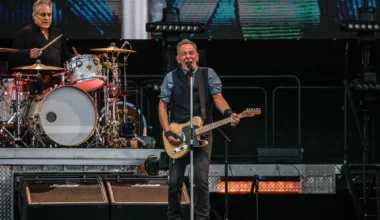
A fact-check published by Snopes on May 21, 2025, examined the viral claim and rated it false. The photographs circulating with the story showed the artists performing on separate occasions, rather than at a shared event.
The posts described an emotional joint performance, enthusiastic crowds, and signs declaring support for the musicians. But those details were not supported by reliable reporting or authentic footage of the supposed concert.
The story demonstrates how easily a real news event can become the foundation for a misleading viral narrative.
The AFM really did issue its statement. Trump really did criticize the artists. The union really did defend their right to freedom of expression.
But those facts do not establish that Springsteen and Swift shared a stage.
The real story is meaningful enough without adding an event that never happened.
WHY THE UNION’S MESSAGE MATTERED
For working musicians, the issue extends beyond the fame of two internationally recognized performers.
The AFM represents musicians whose work includes live performances, recordings, theater productions, and many other parts of the music industry.
Its public statement connected the controversy surrounding Springsteen and Swift to a broader principle: musicians should have the freedom to express themselves.
That does not mean audiences must agree with their views. Nor does it prevent listeners from criticizing an artist’s statements or choosing not to support a performer whose politics they oppose.
Freedom of expression allows people to speak, while public debate allows others to respond.
The union’s statement defended that freedom for its members, regardless of whether every listener welcomed what they had to say.
In an industry where artists can face intense public scrutiny, that position was a notable show of institutional support.
MUSIC HAS ALWAYS INSPIRED DEBATE
From protest songs to patriotic anthems, music has long provided a way to discuss difficult questions about society.
A song can express grief, anger, pride, hope, or disagreement without offering a simple answer. It can become a source of comfort for one listener and a point of contention for another.
Springsteen’s music has often explored the tensions within American life. Swift’s songwriting has created its own conversations about identity, relationships, fame, and the influence of popular culture.
Both artists have audiences that extend far beyond a single political viewpoint.
That reach makes their public statements influential, but it also makes controversy almost inevitable.
Some fans want artists to speak openly about their beliefs. Others would rather keep politics outside the concert hall. Many fall somewhere between those positions, appreciating the music while forming their own judgments about the person behind it.
There is no universal agreement about where the boundary should lie.
What the AFM statement made clear was that musicians should retain the right to participate in those conversations.
A REAL STORY OF SOLIDARITY — WITHOUT A FICTIONAL DUET
The viral story of Springsteen and Swift performing together offered a dramatic image: two superstars standing side by side, turning a concert into a public declaration of unity.
But the verified event was different.
There was no confirmed joint performance. Instead, there was a public dispute, two artists facing criticism, and a professional union choosing to defend its members.
That story still raises an important question about the relationship between music and public life.
Must artists keep their opinions private to protect their careers? Should fans expect musicians to take a stand on issues they care about? And how should audiences respond when a performer expresses views they do not share?
These questions cannot be answered by a single statement from a union or a single post on social media.
They require an ongoing conversation about artistic freedom, public responsibility, and the expectations audiences bring to music.
Springsteen and Swift have built their careers through different musical paths, but their experiences show how public attention can follow an artist well beyond a recording studio or concert stage.