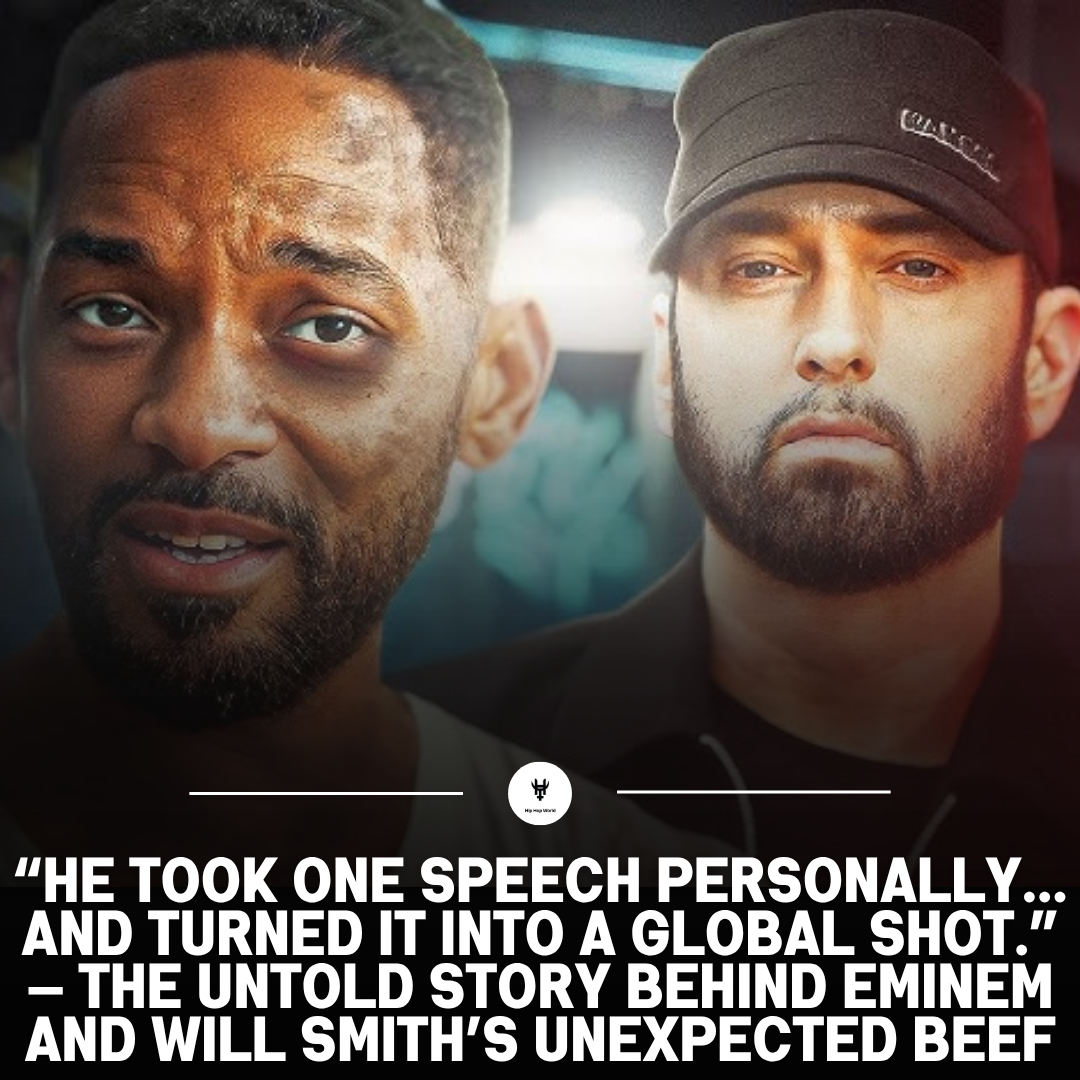
The year was 2000, and hip-hop was no longer just a genre—it was a battlefield of identities.
On one side stood Eminem, volatile, unapologetic, and impossible to ignore. His voice cut through the industry like a blade—fast, aggressive, and laced with a kind of humor that made people laugh even as it unsettled them. On the other side stood Will Smith, polished and charismatic, a global star who had built a career on accessibility, positivity, and clean storytelling.
They weren’t just two artists.
They were two completely different visions of what hip-hop was supposed to be.
And for a brief moment, those visions collided in a way that said more about the culture than either artist ever could alone.
A Voice That Refused to Be Filtered
By the time The Marshall Mathers LP arrived, Eminem had already made it clear that he wasn’t interested in fitting into any acceptable mold. His music was chaotic, deeply personal, and often deliberately provocative. He didn’t just rap—he disrupted.
“The Real Slim Shady,” the album’s lead single, became a defining moment in that disruption. It wasn’t just a hit—it was a statement. A record that mocked celebrity culture, questioned authenticity, and turned criticism into fuel.
And buried within its sharp, satirical verses was a line that stood out even among the chaos.
A direct shot at Will Smith.
“Will Smith don’t gotta cuss in his raps to sell records…”
It was blunt. It was dismissive. And it wasn’t random.
It was personal.
The Moment That Sparked It
The tension didn’t begin with that lyric. It had been building quietly in the background.
Years earlier, Smith had encountered Eminem at a point when his future was still uncertain. According to DJ Jazzy Jeff, Smith’s reaction to Eminem’s early work carried a kind of blunt honesty—suggesting that he would either fail completely or become something massive.
It wasn’t necessarily an insult. But it wasn’t encouragement either.
Eminem, known for absorbing every slight and turning it into material, didn’t forget.
Then came the 1999 MTV Video Music Awards.
Standing on stage after winning Best Male Video for “Miami,” Smith addressed the audience with a message that felt simple—but landed differently depending on who was listening.
He emphasized that he had achieved success without profanity or violence in his music.
To some, it was a statement of pride.
To others, it sounded like a quiet judgment.
And in a room filled with artists whose careers were built on raw expression, it didn’t go unnoticed.
A Clash of Philosophies
What followed wasn’t just a diss—it was a reflection of a deeper divide.
Eminem’s response, both in music and in interviews, made it clear that he didn’t see Smith’s approach as just different. He saw it as dismissive of an entire side of hip-hop.
To him, rap wasn’t supposed to be clean.
It was supposed to be real.
And reality, as he saw it, wasn’t always comfortable, positive, or appropriate for all audiences. It was messy, angry, and sometimes dark. That was the point.
Smith, on the other hand, represented a version of hip-hop that had found a way to exist within mainstream entertainment without losing its reach. His music didn’t rely on shock—it relied on connection.
He made rap accessible to households that might never have embraced it otherwise.
Neither approach was wrong.
But they weren’t compatible.
And that incompatibility became the story.
More Than Just a Diss Track
Eminem’s criticism of Smith extended beyond a single lyric. In interviews, he spoke openly about what he felt Smith’s message implied—not just about him, but about the genre itself.
To him, suggesting that success required being clean carried an unspoken message: that everything else—the anger, the explicit storytelling, the raw emotion—was somehow lesser.
He rejected that idea completely.
For Eminem, hip-hop wasn’t supposed to be sanitized. It was supposed to reflect life as it was experienced by the people creating it. And not everyone’s reality looked like Will Smith’s.
Some people didn’t see life as bright, optimistic, or neatly packaged.
Some people saw something else entirely.
And that perspective deserved to exist just as much.
A Cultural Mirror
What made this moment significant wasn’t the conflict itself—it was what it represented.
At the turn of the millennium, hip-hop was expanding rapidly. It was entering mainstream spaces while still holding onto its roots in raw, unfiltered storytelling. And as it grew, questions began to emerge.
What version of hip-hop would define its future?
Would it be the polished, family-friendly version that could reach everyone?
Or the unfiltered, confrontational version that refused to compromise?
The exchange between Eminem and Smith didn’t answer that question.
But it forced people to think about it.
Because for the first time, the contrast was impossible to ignore.
The Legacy of the Divide
Looking back, the moment feels less like a feud and more like a snapshot of a turning point.
Eminem would go on to become one of the most influential rappers of all time, pushing boundaries and redefining what lyricism could look like. His willingness to say what others wouldn’t became part of his identity.
Will Smith, meanwhile, continued to build a career that transcended music entirely, becoming one of the most recognizable figures in global entertainment. His approach to hip-hop—clean, structured, and universally accessible—proved that there was space for that voice too.
Neither path erased the other.
They simply coexisted.
And in that coexistence, hip-hop found its range.
Two Visions, One Culture
In the end, the tension between Eminem and Will Smith wasn’t about who was right.
It was about what hip-hop could be.
One artist chose to reflect the chaos of life without restraint.
The other chose to shape it into something uplifting and widely accessible.
Both approaches reached millions.
Both left a mark.
And together, they revealed something essential about the genre itself—that hip-hop was never meant to be one thing. It was meant to hold everything.