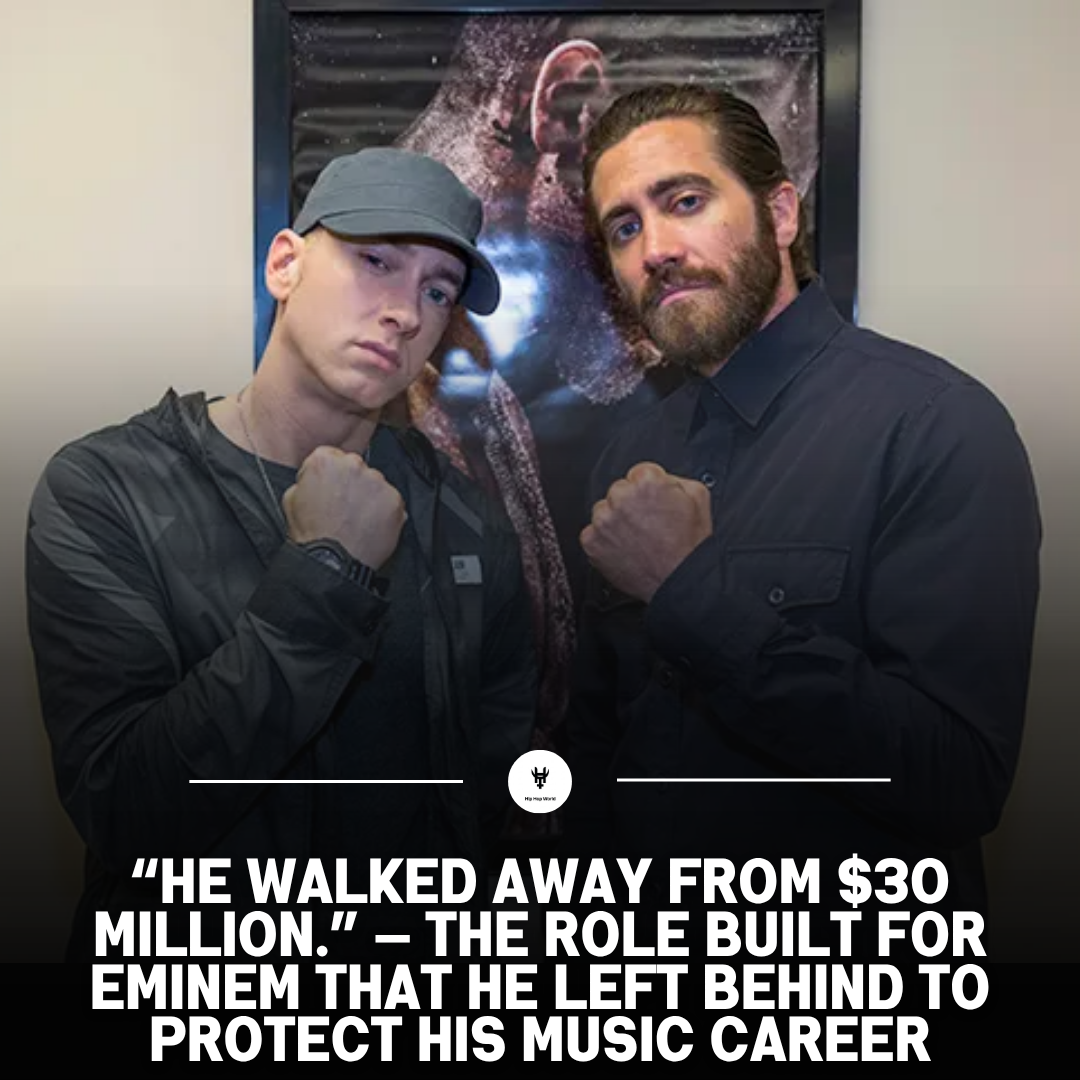
In another version of 2015, Eminem isn’t in the studio—he’s in the ring.
The cameras are rolling, the lights are harsh, and Billy Hope’s story unfolds not through an actor’s transformation, but through the raw presence of Marshall Mathers himself. The role feels personal because it was meant to be. Southpaw wasn’t just another script circulating through Hollywood—it was shaped with Eminem in mind, a continuation of the emotional terrain he once explored in 8 Mile.
But that version of the story never happened.
A Film Built Around His Reality
When Kurt Sutter wrote Southpaw, the parallels weren’t subtle. A fighter at the top of his game loses everything—his family, his stability, his sense of control—and is forced to rebuild from the ground up. It echoed pieces of Eminem’s own life, from public scrutiny to deeply personal battles that played out beyond the music.
Studios saw more than a film. They saw potential—awards, recognition, a performance that could bridge music and cinema once again. With Antoine Fuqua directing and major backing behind it, the project carried weight before production even began.
For Eminem, it wasn’t just another opportunity.
It was a crossroads.
The Decision That Changed The Outcome
As the film moved closer to production, something else was happening quietly—momentum in the studio. The creative energy that had defined his earlier work was returning, and it demanded attention.
Taking on Southpaw meant stepping away from that.
Acting at that level isn’t part-time. It requires immersion, discipline, and distance from everything else. For Eminem, that meant time away from music at a moment when his voice was beginning to sharpen again.
So he made the call.
He walked away.
Not from a role—but from a different version of his career.
A New Fighter Steps In
When Jake Gyllenhaal took the role, he approached it with full commitment. The transformation was physical, relentless, and visible in every frame. Training became routine, the character became lived-in, and the performance carried the intensity the story demanded.
The film found its lead.
But the shadow of its original intention remained.
Even in its final form, Southpaw feels connected to Eminem. The title itself reflects his left-handed identity, an unorthodox trait that mirrors his own entry into hip-hop. The themes—resilience, isolation, redemption—are familiar not just as fiction, but as lived experience.
It’s a story that fits him, even without his presence onscreen.
Telling The Story Without Appearing In It
Though he stepped away from acting, Eminem didn’t fully leave the project behind. Through Shady Records, he shaped the film’s soundtrack, bringing his voice into the story in a different way.
“Phenomenal” carried the film’s energy forward. “Kings Never Die,” with Gwen Stefani, closed it with reflection and weight.
He didn’t play the fighter.
He narrated the fight.
And in doing so, he maintained a connection without compromising his focus.
Choosing The Path That Defined Him
The decision confused many at the time. Walking away from a major film, from a role built specifically for him, and from a reported $30 million payday wasn’t typical.
But the result clarified everything.
The Marshall Mathers LP 2 arrived not long after, reestablishing his place in hip-hop with precision and intensity. Tracks like “Rap God” reminded listeners exactly where his strength lay—not in performance for the camera, but in command of language, rhythm, and identity.
The moment wasn’t about what he lost.
It was about what he protected.
The Story That Stays Unfinished
There will always be curiosity around what could have been. A version of Southpaw led by Eminem, shaped even more directly by his own experiences, is easy to imagine. The emotional weight, the authenticity—it all feels within reach.
But some stories don’t need to be retold in a different form.
8 Mile already captured the struggle.
His music continues to capture everything after.
Where The Real Fight Was Won
In the end, stepping away from Southpaw wasn’t a retreat—it was a decision about identity. At a moment when two paths were equally visible, Eminem chose the one that kept him rooted in what he does best.
Hollywood lost a leading man.
But hip-hop kept one of its most defining voices.