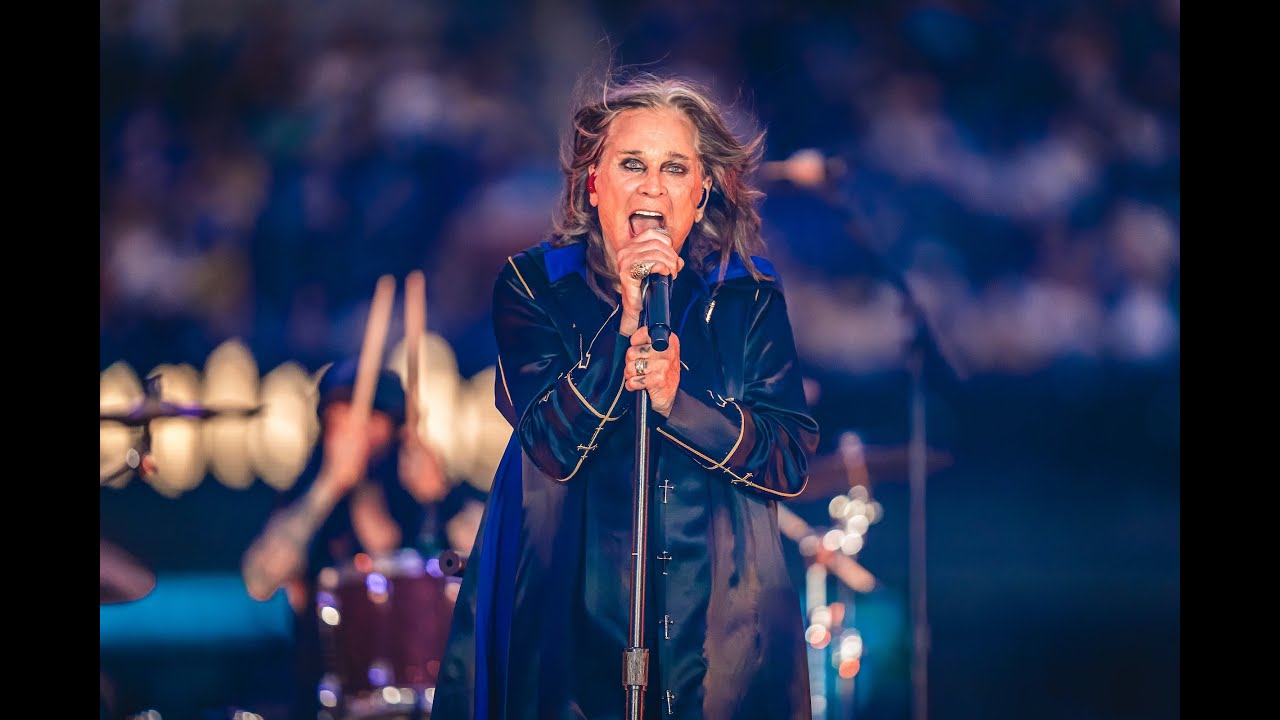
As the opening chords of “Mama, I’m Coming Home” sliced through the Birmingham air, a cathedral-like hush fell over the 40,000-strong crowd at Villa Park. It was July 5, 2025, and Ozzy Osbourne, the Prince of Darkness, stood alone in the spotlight—no pyrotechnics, no theatrics, just a man and his microphone, pouring every ounce of his weathered soul into a song that had always carried his heart. The wide-angle footage, released days later, captured it all: a sea of fans, hands clasped, eyes glistening, hanging on every trembling note as if time itself had paused to listen.
This wasn’t just a performance. It was a reckoning. Written in 1991 for his wife Sharon, “Mama, I’m Coming Home” had climbed to #28 in 1992, a tender outlier in Ozzy’s catalog of rebellion. But that night, it transformed into something mythic—a love letter to Sharon, to his fans, to life itself. His voice, frail yet fierce, cracked with the weight of a thousand battles fought against addiction, illness, and time. Each lyric landed like a stone dropped into still water, rippling through the stadium with raw, unspoken finality.
Those closest to Ozzy later revealed he knew the end was near. Diagnosed with a worsening condition, he’d pushed through pain to make this night happen. Yet there he was, not retreating but rising, giving every fractured piece of himself to the crowd that had carried him for decades. The footage shows it all: his eyes, heavy with gratitude and grief, locking with fans in the front row, as if he were singing to each one personally. The crowd answered back, their voices swelling into a chorus that seemed to hold him up, a shared act of love and defiance against the inevitable.
What happened next was nothing short of a miracle. In the weeks following, that performance of “Mama, I’m Coming Home” became a global phenomenon. Shared across platforms, it wasn’t just metalheads or longtime fans passing it along—everyone from casual listeners to music critics to A-list artists was captivated. The clip, raw and unpolished, struck a universal chord: the human need to say goodbye and to be heard. By late July, powered by 8.7 million streams and 15,000 downloads, the song did the unthinkable—it re-entered the Billboard Hot 100, 33 years after its debut, not as a chart hit but as a requiem for a legend.
This wasn’t nostalgia. It was a collective outpouring of love for a man who’d turned his pain into anthems that saved lives. Fans flooded comment sections with tributes: “You got me through my darkest days, Ozzy,” one wrote. “Rest easy, you mad bastard,” said another. The song became a hymn for the grieving, a beacon for the lost, a celebration of a life lived at full volume.
Ozzy’s funeral days later mirrored that night in Villa Park. Birmingham’s streets overflowed with fans, their silence as heavy as the chords that once shook arenas. “Mama, I’m Coming Home” played softly from speakers, a final embrace from a city to its son. Sharon Osbourne, his rock through decades of madness, raised her hand in a quiet, mirrored version of Ozzy’s iconic devil horns—a gesture that broke hearts worldwide. It was her farewell not just to a husband, but to a legacy forged in sweat, screams, and sacrifice.
The poetry of it all feels almost scripted by fate. The song’s return to the charts, the timing of that final show, the way “Mama, I’m Coming Home” became a vessel for collective mourning—it’s as if the universe gave Ozzy one last stage to speak. Like Freddie Mercury’s final bow with Queen or Johnny Cash’s stark cover of “Hurt,” this was a moment that transcended music, defining an era, an emotion, a generation.
Today, every stream of that song feels like a vigil. Fans still post tributes, from tearful thank-yous to stories of how Ozzy’s music pulled them from the edge. The charts don’t lie—this wasn’t just a hit; it was a cultural touchstone, a reminder that true artists don’t fade. They echo. In our playlists, our memories, our moments of need, Ozzy is there.
“Mama, I’m Coming Home” was never just a song. That night, it became a promise kept—a vow that Ozzy Osbourne, the man who screamed for the outcasts and fought every demon to keep singing, would always find his way back to us. The Prince of Darkness may have left the stage, but his light, raw and radiant, burns eternal.