What does it take to impress a country music star so much that he jokes about abandoning his fellow coaches? For 19-year-old Joe Henley, the answer might be something he has spent years underestimating: his own voice.
The Voice Season 30 contestant has received plenty of encouragement throughout his time on Team Riley Green, but one particular exchange with his coach revealed just how highly Green regards the young singer’s potential. And while Henley may still be learning how to handle the spotlight, the country star’s remarkable praise raises an intriguing question about what could happen when the competition is over.
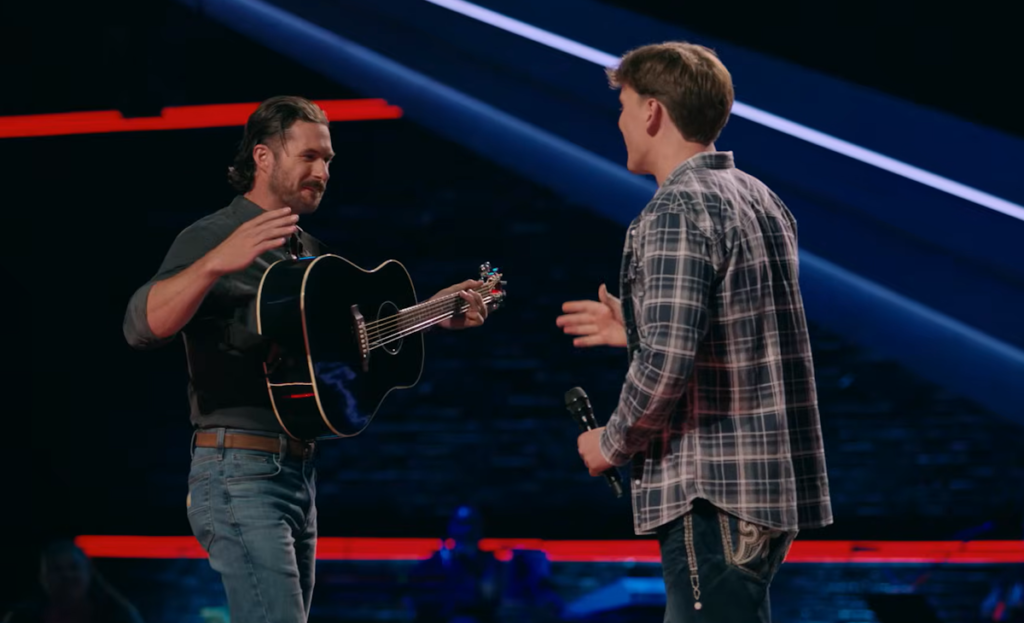
Green, an established country artist who understands the demands of performing for large audiences, apparently sees something special in Henley’s natural ability. During their time working together, he joked that if he possessed the teenager’s voice, he would already be rich and famous and would stop answering calls from fellow coach Adam Levine.
It was the sort of outrageous compliment that could easily leave a young contestant wondering whether to laugh or take it seriously. Green reportedly doubled down on the sentiment during another exchange, suggesting he would not bother speaking to anyone else in the room if he could sing like Henley.

For someone who had never performed professionally before arriving on The Voice, those words carry considerable weight. Henley entered the competition without the extensive stage experience that some contestants bring to televised singing competitions. Now, he has an established recording artist openly celebrating the very talent that once existed largely outside the professional music world.
What makes their relationship particularly interesting is that Green’s praise comes wrapped in humor rather than a serious speech about musical greatness. Henley has explained that he and his coach share a similar sense of humor, which helps make their working relationship comfortable even when the stakes are high.
That connection matters more than it might initially appear. Television singing competitions demand that contestants absorb criticism, learn unfamiliar arrangements, adapt quickly and deliver performances under enormous pressure. Having a coach who can make those moments feel less intimidating may be especially valuable for a teenager still discovering his confidence.
But Green’s admiration also raises a bigger question: What exactly makes Henley the kind of singer a successful country artist would envy?
The answer may lie in his traditional country sound and his instinct for emotional storytelling. Rather than relying entirely on dramatic vocal displays, Henley has shown an interest in performances that allow the meaning of a song to take center stage.

His approach to Lee Ann Womack’s “I Hope You Dance” offers a particularly revealing example. Instead of attempting to overpower the original recording with an increasingly forceful delivery, Henley worked with the team to create a softer, slower arrangement.
The decision was not simply about making the song easier to sing. It reflected a deliberate artistic preference for restraint, allowing the lyrics and emotional message to carry the performance rather than turning every musical moment into a demonstration of vocal strength.
That distinction is important in country music, where a singer’s ability to communicate a story can be just as memorable as technical vocal ability. A powerful voice may attract attention during an audition, but interpreting a song in a way that feels personal can help an artist establish a recognisable musical identity.
Henley’s earlier song selections also suggest a strong connection to the genre’s traditional roots. His Blind Audition featured Travis Tritt’s “Anymore,” a choice that earned chair turns from both Green and Kelly Clarkson.
Those two coaches represent different musical backgrounds, making their shared interest in Henley particularly noteworthy. Clarkson’s response suggested that his appeal was not necessarily limited to listeners who already favour traditional country music.
Ultimately, Henley chose Green, placing himself alongside a coach whose own career offered a direct connection to the musical world he hoped to enter.

His subsequent performances continued that country-focused direction. After defeating Kenna Elpers in the Battle Rounds, Henley advanced through Cut Week with Keith Whitley’s “Don’t Close Your Eyes,” another selection associated with the emotional storytelling traditions of country music.
Together, those choices reveal a young artist who appears more interested in understanding his musical strengths than chasing every opportunity to show off.
There is, however, another side to Henley’s story that makes Green’s compliments even more striking. Despite his impressive singing ability, the teenager has admitted that performing in front of unfamiliar people once frightened him.
Before joining the competition, even entering a room full of strangers could leave him struggling to speak comfortably. The prospect of singing in front of those people was an entirely different challenge.
His background in basketball has provided an unexpected source of preparation. Henley has compared the pressure of live performances with the nerves he experienced during important rivalry games in crowded gymnasiums.
The similarities are understandable. Both situations demand concentration while an audience watches, and both can punish hesitation at precisely the wrong moment.
Henley has carried some of his sporting habits into his singing routine, including stretching and using mental techniques to avoid becoming overwhelmed by the crowd. He has also incorporated breathing exercises learned through his vocal training.
These details reveal something that television audiences do not always see. A contestant can possess extraordinary natural ability while still working hard to overcome the fear of sharing it publicly.
And that may be where Green’s influence becomes especially significant.
A coach cannot simply give someone a new voice. What a coach can do is help a singer understand how to use the voice they already have, develop confidence in their musical choices and recognise qualities that might otherwise go unnoticed.
Green’s humorous praise appears to serve that purpose for Henley. It gives the young singer permission to recognise his own ability without making every conversation feel like another high-pressure evaluation.
There is also something refreshing about a mentorship built around genuine musical appreciation rather than constant declarations about winning.
Of course, a coach’s admiration does not guarantee commercial success. The history of television singing competitions is filled with talented performers who faced difficult decisions after the cameras stopped rolling. Building a sustainable career requires original material, artistic direction, industry relationships and an audience willing to follow an artist beyond the programme.

Still, Henley has several qualities that could give him a foundation to build upon. He has a distinctive musical direction, experience performing on national television and a mentor who clearly believes in his potential.
Perhaps most importantly, he is learning that confidence does not have to mean becoming an entirely different person. His quieter, storytelling-focused approach may be precisely what distinguishes him from performers who rely on bigger and louder moments.
From an editorial perspective, that is the most compelling part of Henley’s relationship with Green. The country star is not merely telling a contestant that he sings well. His exaggerated compliments suggest he recognises a voice worth developing long after the immediate pressure of competition has passed.
Whether Henley ultimately wins The Voice or takes another route into the music industry, his experience has already introduced him to possibilities he had never previously explored as a professional performer.
And if Riley Green genuinely wishes he could borrow Joe Henley’s voice, perhaps country music listeners should be paying particularly close attention to what the teenager does with it next.
Is Henley’s traditional country sound strong enough to make him a lasting star beyond The Voice, or will his greatest challenge be finding the right songs to match the talent his coach clearly admires?