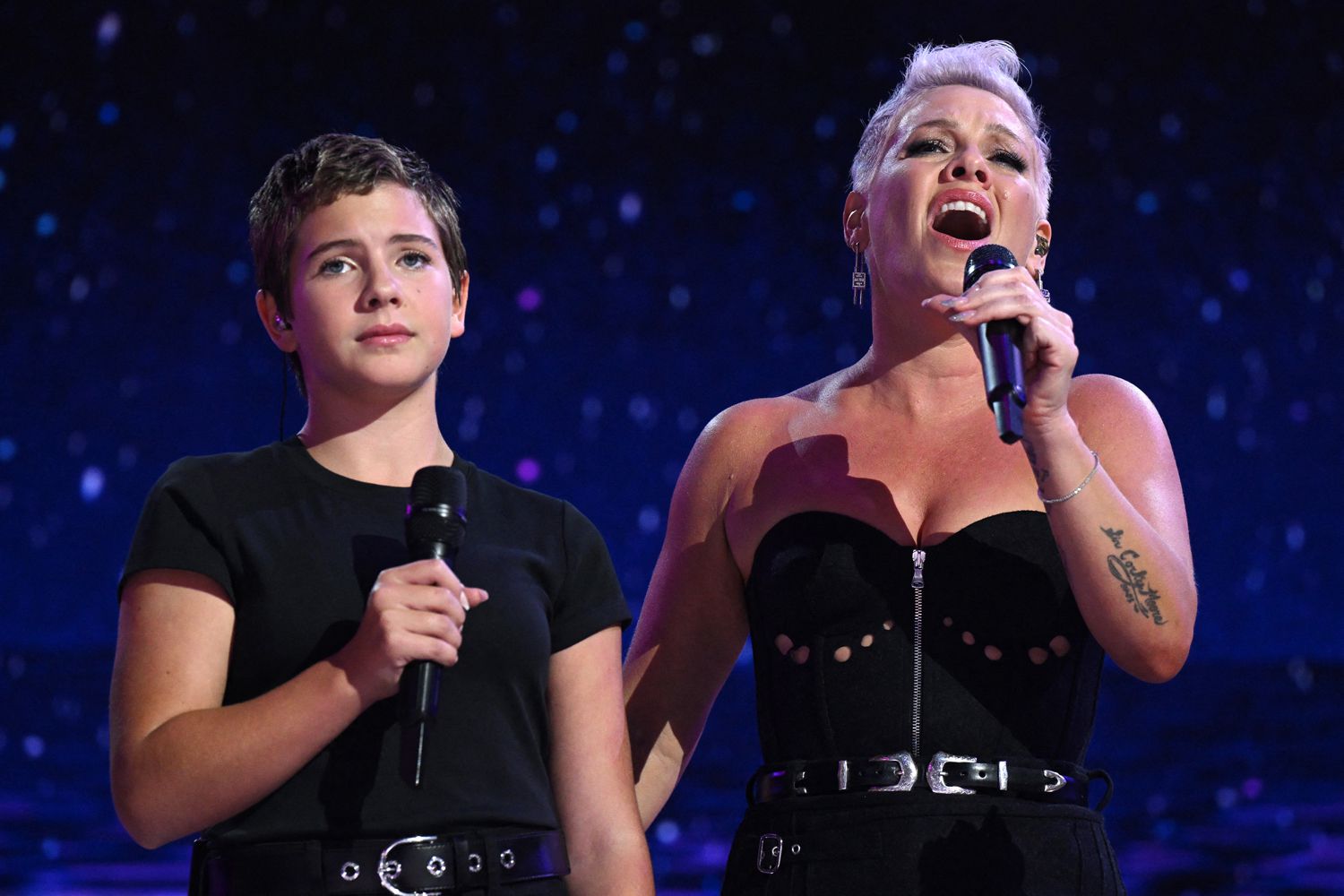
When Pink looks at her daughter on stage, she doesn’t just see talent.
She sees a version of herself—at the same age, standing at the edge of an industry that can build you up just as quickly as it can take things away.
And that’s where the emotion comes from.
Not just pride.
But awareness.
The difference between then and now
At 14, Pink was entering a world she didn’t fully understand.
The music industry can feel like momentum—fast, exciting, full of opportunity. But underneath that momentum is pressure: to perform, to fit, to adapt quickly to expectations that aren’t always clearly stated.
When you’re young, you don’t always recognize those pressures for what they are.
You just respond to them.
That’s what makes her reflection—“she’s stronger than I was at 14”—so layered.
It’s not just admiration.
It’s perspective.
Watching your child step into your past
Seeing Willow perform in front of thousands isn’t just a proud-parent moment.
It’s a mirror.
Pink knows what comes with that kind of visibility:
- The attention that feels flattering at first
- The expectations that grow quietly in the background
- The scrutiny that arrives without warning
And unlike most parents, she doesn’t have to imagine what those things might feel like.
She remembers.
That’s what makes the experience both exciting and unsettling at the same time.
Why strength alone isn’t enough
Saying Willow is “stronger” doesn’t mean she’s immune.
It means she’s starting from a different place.
Because strength, without support, can still be overwhelmed. Talent, without boundaries, can still be exploited. Confidence, without guidance, can still be shaken.
What Pink is really doing isn’t just recognizing her daughter’s resilience.
She’s building a system around it.
A different kind of introduction to the spotlight
Instead of pushing Willow toward independence too early, Pink has chosen something more controlled.
Willow performs:
- Within her mother’s tour
- Inside a familiar, protected environment
- With built-in support and supervision
That matters.
Because the difference between being exposed to an industry and being launched into it is significant.
One allows exploration.
The other demands survival.
Pink is choosing the first.
The boundaries that change everything
Perhaps the most important part of her approach isn’t what Willow is doing on stage.
It’s what she’s not being asked to do off it.
There’s no rush toward:
- Solo contracts
- Full-time industry commitments
- A career defined before adulthood
Instead, there’s balance.
School. Friendships. A life that exists outside performance.
That balance is intentional.
Because one of the biggest risks for young performers isn’t failure—it’s losing a sense of self too early.
What experience teaches that ambition doesn’t
Many parents in the entertainment world see opportunity and want to maximize it.
Pink sees opportunity—and remembers the cost.
She understands:
- How quickly control can shift away from the artist
- How external voices can shape internal identity
- How success can come before emotional readiness
That knowledge changes how decisions are made.
It slows things down.
It asks different questions.
Not “How far can this go?”
But “What’s worth protecting along the way?”
The invisible work of protection
From the outside, it might look simple: a mother supporting her daughter’s talent.
But underneath that is constant evaluation.
What contracts are acceptable?
What exposure is too much?
What feedback should be filtered out?
These are decisions most teenagers never have to face.
And Pink is handling them before they ever reach Willow.
That’s what protection looks like at this level.
Not restriction.
Translation.
Redefining success as a parent
For much of her career, success for Pink was measurable:
- Albums sold
- Tours completed
- Audiences reached
Now, the metric has shifted.
Success is no longer about scale.
It’s about stability.
About whether her daughter can experience growth without losing grounding. About whether she can explore talent without being defined by it too early.
It’s quieter.
But arguably more difficult.
Why this moment resonates beyond celebrity
At its core, this isn’t just a story about fame.
It’s about generational change.
The desire to give your child something you didn’t have:
- More awareness
- More protection
- More space to grow
That impulse exists everywhere—not just in the spotlight.
Pink’s version is simply happening on a larger stage.
Strength, with something new added
When Pink says Willow is stronger than she was, it’s not a comparison rooted in competition.
It’s an acknowledgment of evolution.
Because Willow’s strength isn’t just her own.
It’s supported.
Guided.
Protected by someone who understands exactly what she’s stepping into.
The promise behind the words
That single sentence carries an unspoken extension:
She’s stronger—and she won’t have to figure it out alone.
That’s the real difference.
And that’s what makes this moment more than a proud observation.
It’s a commitment.
A new kind of legacy
Pink’s legacy will always include music, performances, and a career built on defying expectations.
But this chapter adds something else.
A deliberate effort to ensure that the next generation doesn’t have to learn the same lessons the hard way.
Not by keeping her daughter away from the spotlight.
But by standing beside her in it.
What audiences are really witnessing
When fans watch Willow perform, they see talent.
When Pink watches, she sees context.
She sees where it could go.
She sees what it could cost.
And she’s making sure those two things never lose balance.
Because this time, strength isn’t the only thing in the room.
Protection is there too.