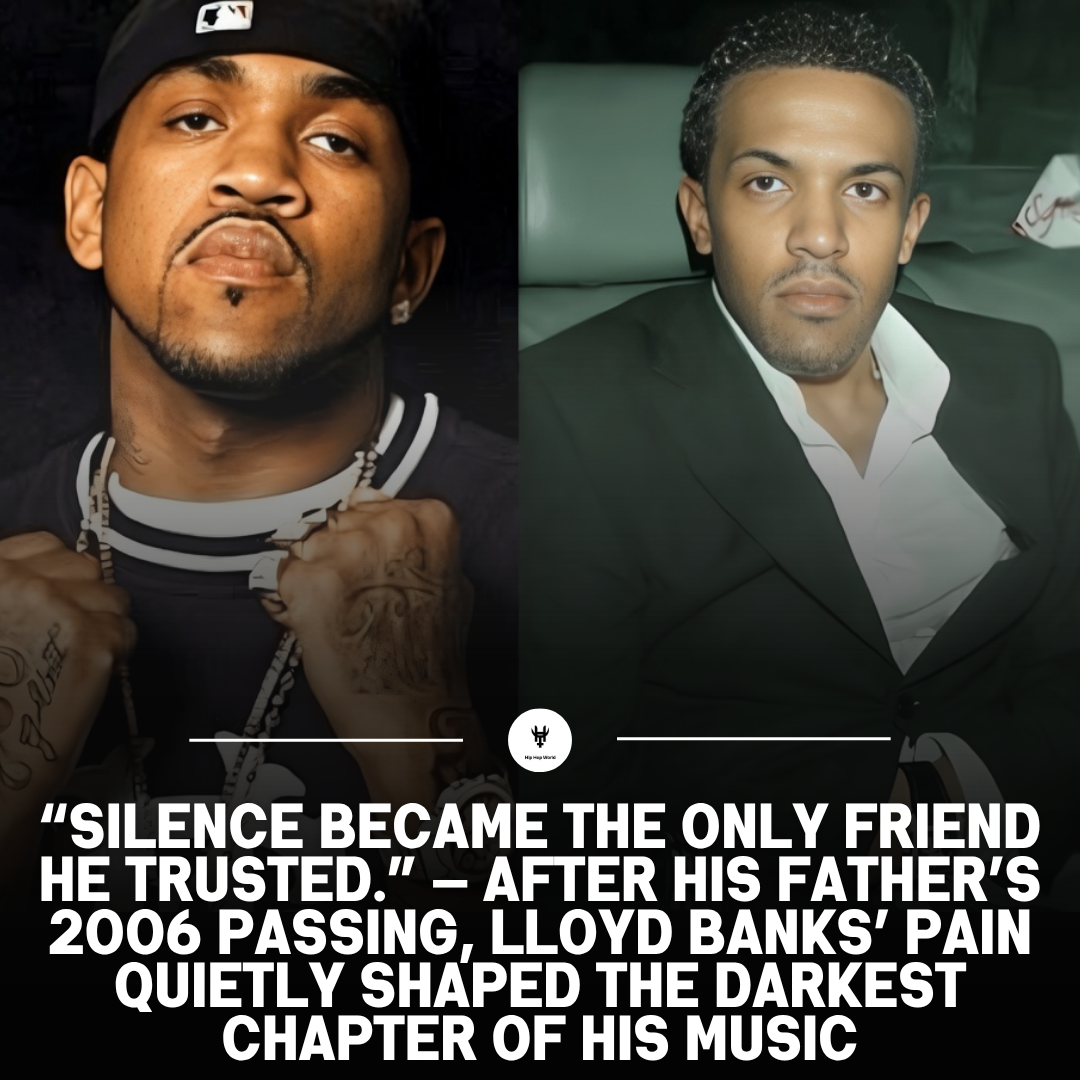
The room is quiet, but not empty.
In the early days of G-Unit, that silence often belonged to Lloyd Banks. Not because he had nothing to say, but because he chose when to say it. While 50 Cent commanded attention with presence and momentum, Banks moved differently—observing, calculating, letting his verses carry the weight instead of his voice.
He didn’t compete for space.
He occupied it in his own way.
That balance helped define G-Unit’s identity. A group built on contrast—loud and quiet, direct and reflective. And within that dynamic, Banks found his place without ever needing to explain it.
But in 2006, something changed.
When Silence Stops Being a Choice
The shift didn’t happen on stage or in the studio.
It happened privately.
The loss of his father introduced a different kind of silence into Banks’ life—one that had nothing to do with personality or artistic preference. Their relationship had been distant, shaped by absence and unresolved connection. And when that kind of relationship ends suddenly, it doesn’t close cleanly.
It lingers.
Because grief, in those moments, isn’t just about losing someone. It’s about losing the chance to understand them, to reconcile, to rewrite what was left incomplete.
For Banks, that weight didn’t translate into public expression.
It stayed internal.
A Withdrawal Few Understood
Those around him noticed the difference.
According to 50 Cent, Banks became more withdrawn after the loss. Communication, already minimal, became even more restrained. Conversations shortened. Responses felt distant—not out of coldness, but out of something harder to define.
It wasn’t avoidance.
It was processing.
There are moments when stepping back isn’t a decision—it’s a necessity. When emotions don’t organize themselves into words, silence becomes the only place where they can exist without pressure.
Banks leaned into that space.
Not publicly. Not dramatically. But gradually.
He pulled away from the spotlight, from the expectations, and at times, even from the people closest to him. And because there was no clear explanation, that distance was often misunderstood.
From the outside, it looked like disengagement.
From the inside, it was something else entirely.
When the Music Begins to Change
What Banks didn’t say in conversation began to surface elsewhere.
In the music.
The tone shifted—not in a way that announced itself, but in a way that revealed itself over time. The lyricism remained sharp, controlled, precise. But beneath that structure, something heavier began to take shape.
Themes of isolation.
Unresolved tension.
Emotional distance that didn’t need to be explained to be felt.
This wasn’t a reinvention of Lloyd Banks as an artist. It was an extension of who he had always been—just without the filters that once kept those layers hidden.
The quiet became deeper.
More intentional.
More real.
50 Cent and the Weight of Watching
For 50 Cent, observing that shift carried its own complexity.
There’s a tension that exists when someone close to you withdraws. The instinct is to reach in—to break the silence, to pull them back into connection. But not all silence is meant to be interrupted.
Some of it has to be lived through.
And understanding that requires patience.
It requires recognizing that healing doesn’t always look like progress. Sometimes it looks like distance. Like fewer words. Like someone choosing to step away until they’re ready to return on their own terms.
That’s what this period became for Banks.
Not absence.
But transition.
The Difference Between Disappearing and Processing
In hip-hop, visibility is often tied to relevance. When an artist steps back, the assumption is immediate—they’ve lost momentum, lost focus, or simply faded.
But that assumption doesn’t always hold.
Because not every absence is a retreat from the craft.
Sometimes, it’s a return to self.
For Lloyd Banks, that period wasn’t about disappearing from the culture. It was about creating space to process something that couldn’t be rushed or explained in real time.
And when he did return—through his music—it carried a different weight.
Not louder.
But deeper.
What Remains After the Silence
Looking back, that chapter in Banks’ life doesn’t stand out because of what was said.
It stands out because of what wasn’t.
The silence that surrounded him during that time wasn’t empty. It was filled with everything that couldn’t yet be put into words. And when those words finally came—through verses, through tone, through the subtle shifts in his music—they carried a clarity that conversation rarely achieves.
Because sometimes, the most honest expression doesn’t happen in the moment.
It happens later.
After the silence has done its work.
And for Lloyd Banks, that silence didn’t erase his voice.
It refined it.