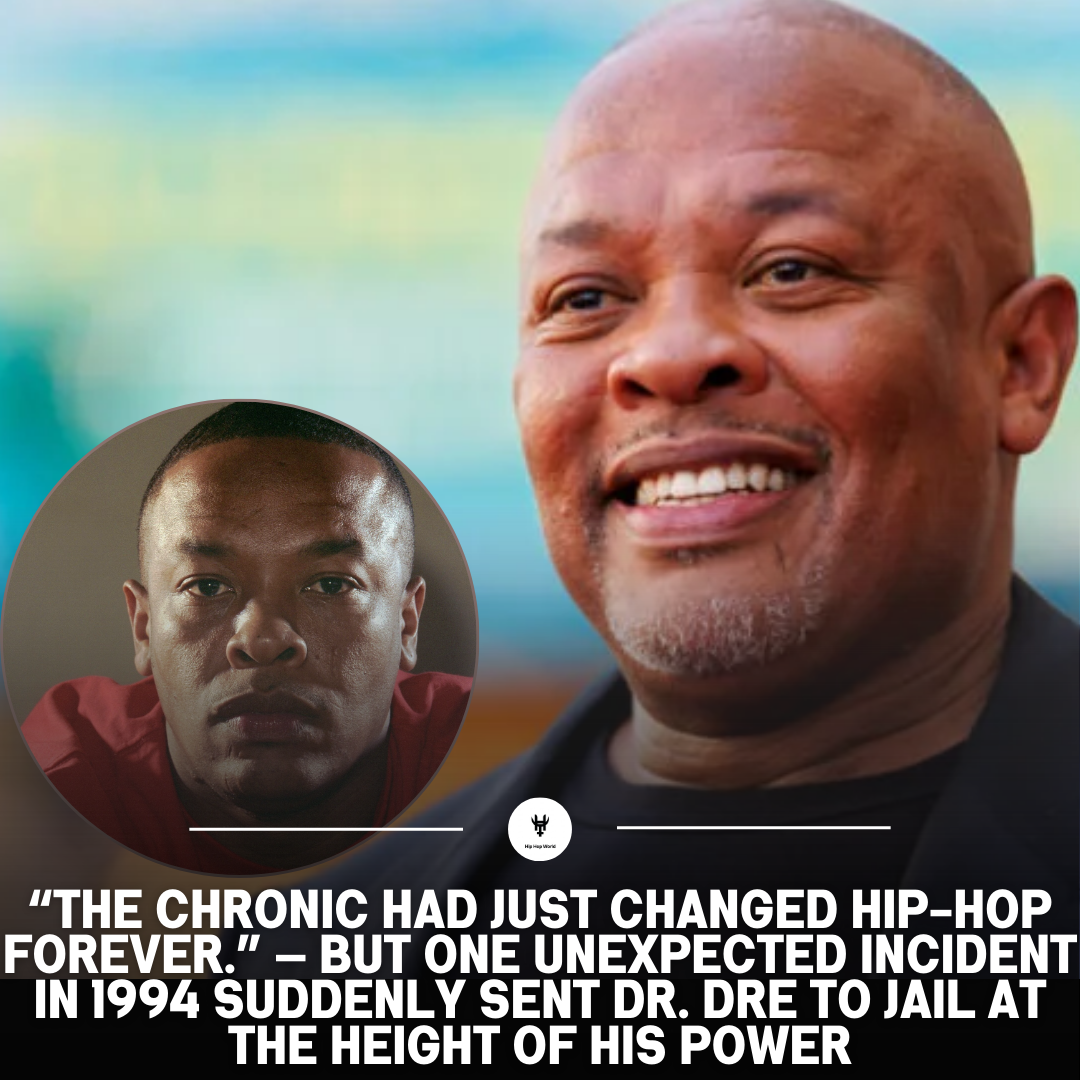
When Success Couldn’t Silence the Past
By the mid-1990s, Dr. Dre stood at the center of hip-hop’s power structure. Few artists had reshaped the genre as dramatically as he had. After helping redefine West Coast rap with N.W.A in the late 1980s, Dre had walked away from Ruthless Records and helped build Death Row Records into one of the most dominant forces in the music industry.
Then came The Chronic.
Released in late 1992, the album didn’t simply succeed commercially—it transformed the sound of American rap. Dre’s production fused funk-inspired grooves with vivid street storytelling and cinematic atmosphere. The record introduced a new sonic identity for the West Coast, one that quickly became the blueprint for mainstream hip-hop during the decade.
By 1994, Dre was a Grammy winner, a cultural tastemaker, and one of the most influential producers in music.
But while his career was reaching extraordinary heights, a different story was quietly unfolding outside the studio.
A Pattern That Couldn’t Be Ignored
Dr. Dre’s legal troubles had not appeared suddenly in 1994. They had been building for years.
One of the most widely discussed incidents occurred in 1991, when Dre assaulted television host Dee Barnes following a dispute connected to an interview segment. The incident quickly became a major controversy and remained a painful chapter in Dre’s public history.
Not long after, another legal issue followed.
In 1992, Dre was convicted of battery after attacking a man outside the home of his girlfriend. The assault left the victim with a broken jaw. At the time, the case received far less public attention than his rapidly rising music career, but the conviction placed Dre under court-ordered probation.
That detail would later become crucial.
With probation in effect, any new offense—even one that might normally result in a lighter penalty—could trigger far more serious consequences.
The Night in Beverly Hills
In the early hours of January 10th, 1994, those consequences began to take shape.
Driving through Beverly Hills in his red Ferrari Testarossa, Dre attracted the attention of police officers after reportedly traveling at a very high speed. Instead of immediately pulling over, he continued driving, leading officers on a pursuit that reportedly reached speeds approaching 90 miles per hour.
When the car eventually stopped, officers administered a sobriety test.
The result showed that Dre’s blood alcohol level measured 0.16—roughly twice the legal limit in California.
On its own, the incident would likely have resulted in fines, restrictions, and mandatory programs typically associated with drunk-driving charges.
But Dre was still under probation from the earlier battery conviction.
That technicality changed everything.
A Probation Violation
Because the DUI occurred during the probationary period connected to his earlier conviction, the offense automatically counted as a violation of the court’s conditions.
For the legal system, this wasn’t simply a case of reckless driving by a celebrity. It was viewed as evidence that Dre had failed to follow the requirements imposed after the earlier violent incident.
The violation meant the court could impose jail time.
In August 1994, Los Angeles Municipal Court Judge Paula Mabrey handed down a sentence that required Dre to serve eight months in jail. In addition, he was fined more than $1,000 and ordered to complete a state-approved alcohol education program.
The sentence carried an unusual condition.
Rather than serving the time entirely behind bars, Dre was granted a work-release arrangement. During the day he could continue working in the studio. At night, however, he was required to return to jail.
The sentence officially began in January 1995.
A Career That Didn’t Stop
Despite the legal setback, the machinery of Death Row Records continued moving forward.
Even while serving the work-release sentence, Dre remained active in the studio, producing records and helping guide the careers of artists associated with the label. One of the most prominent among them was Snoop Dogg, whose early success had been closely tied to Dre’s production.
From a public perspective, the jail sentence never became a defining collapse of Dre’s career.
Instead, it existed almost as a footnote during a period when Death Row’s dominance still commanded headlines.
An Uncomfortable Chapter
Looking back today, the events surrounding Dr. Dre’s 1994 jail sentence remain a complicated part of his legacy.
The legal troubles were not isolated mistakes but part of a pattern that included violence and reckless behavior earlier in his career. Those incidents continue to be discussed whenever the history of West Coast hip-hop is examined.
At the same time, the episode did not permanently derail Dre’s trajectory.
In the years that followed, he would leave Death Row Records and launch Aftermath Entertainment. That decision would lead to a second era of influence, as Dre helped introduce artists such as Eminem and later 50 Cent to global audiences.
Those discoveries reshaped mainstream hip-hop yet again.
The Second Act
History often remembers Dr. Dre for his groundbreaking production, his role in launching legendary artists, and his ability to redefine the sound of hip-hop across multiple decades.
But the events of 1994 serve as a reminder that even the most influential careers can carry difficult chapters.
The legal troubles that briefly placed Dre behind bars did not end his influence. Instead, they became part of a larger story—one that eventually led to a second act that would once again transform the landscape of rap music.
And in the unpredictable history of hip-hop, few figures have rewritten their legacy as dramatically as Dr. Dre.