Some albums arrive complete. Others arrive compromised.
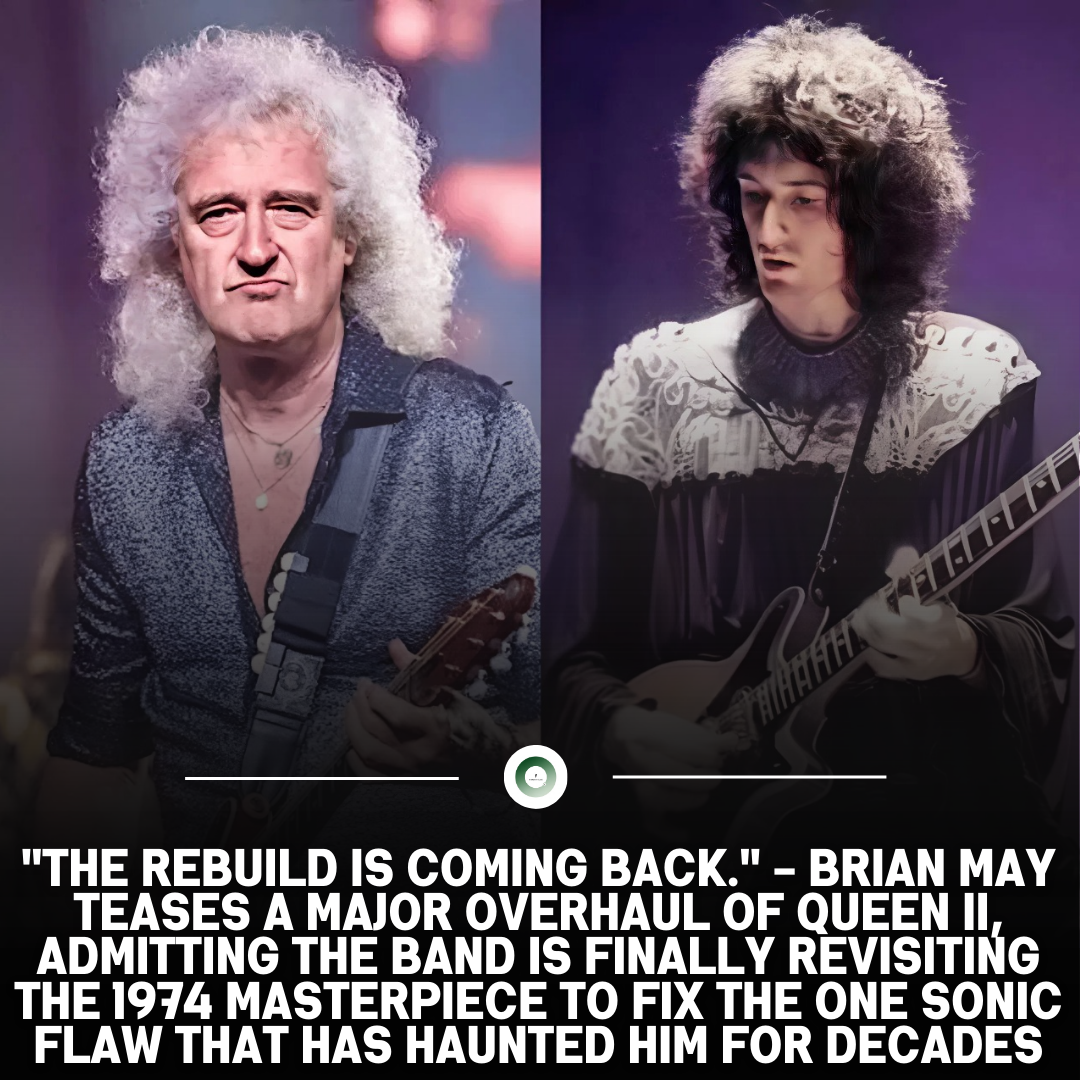
For Brian May, Queen II had never fully escaped the conditions that created it. Released in 1974, it marked the point where Queen’s identity began to take its permanent form. The theatrical ambition was no longer restrained. The architecture was more complex, more deliberate, more willing to abandon convention. But the sound itself—the final document of those ideas—had never fully reflected what the band believed they had built.
More than fifty years later, May has decided to revisit it.
Not to preserve it.
To correct it.
The Version the World Heard Was Not the Version They Created
When Queen entered Trident Studios to record their second album, they were operating inside limits they could not control. Budget constraints shaped decisions. Technology imposed boundaries. The band was attempting arrangements that exceeded what analogue recording could cleanly contain. Layered guitars, stacked harmonies, and structural density collided inside a system not yet capable of separating them.
The result was permanence without precision.
The ideas survived. The clarity did not.
May has acknowledged this openly. The original mix, while historically intact, did not fully capture the internal balance the band had constructed. Elements competed rather than coexisted. Space collapsed where expansion had been intended.
The album existed.
But not exactly as they had heard it.
Why Brian May Is Returning to Something That Already Exists
Revisiting Queen II is not an act of nostalgia. It is an act of unfinished authorship.
In recent interviews, May described the project as a sonic “rebuild”—a term that implies reconstruction rather than revision. The distinction matters. This is not about replacing performances or altering decisions. It is about removing the technical limitations that prevented those decisions from fully emerging.
“There are a couple of things you haven’t heard,” he said, referencing elements that had remained buried within the original analogue recordings.
Not lost.
Buried.
The difference suggests that the album has always contained more than listeners were able to access.
The rebuild is intended to expose it.
Technology Has Changed What Is Possible Without Changing What Happened
Modern de-mixing tools now allow engineers to isolate individual elements that were previously locked together. Guitar layers can be separated. Vocal harmonies can be repositioned. Balance can be restored without erasing the original performance.
This capability did not exist when Queen II was first recorded.
Now, it does.
For May, this creates an opportunity that had never been available before. Not to reinterpret the album, but to remove the technical compression that had constrained it. To allow the internal structure of the music to exist with the clarity it had always possessed in theory.
The performances remain untouched.
The environment around them changes.
The Discovery of Material That Was Never Meant to Disappear
The rebuild has also reopened access to recordings that had remained outside the album’s original release. Among them is “Polar Bear,” a song written during May’s pre-Queen years with Smile. Long believed to exist only in fragments, a Queen-era version has now surfaced—featuring Freddie Mercury’s voice integrated into its structure.
This recording had not been erased.
It had simply remained inaccessible.
Its emergence reinforces the idea that Queen II was not a closed document. It was a collection shaped by decisions, omissions, and limitations that no longer apply.
The rebuild does not create new history.
It reveals parts of it that were never fully exposed.
Why Brian May Is Choosing to Do This Now
The timing reflects a shift in focus.
With touring reduced and Queen’s live future uncertain, May has directed attention inward—toward the foundation that preceded everything else. The rebuild of Queen II follows the reconstruction of their debut album, applying the same philosophy of restoration rather than reinvention.
It is not driven by commercial urgency.
It is driven by authorship.
May has spent decades living alongside the version of Queen II that listeners accepted. But acceptance did not resolve the distance between intention and outcome. That distance remained.
Until now.
The Album Is No Longer Bound by the Moment That Created It
When Queen II was first released, it carried the limitations of its time. Those limitations became part of its identity. They shaped how it was heard, how it was remembered, and how it was preserved.
But limitations are not permanent.
They are conditional.
The rebuild scheduled for release in 2026 represents an attempt to remove those conditions—not by altering the past, but by allowing the past to exist without the constraints that originally defined it.
The album has always existed.
What is changing is how completely it can finally be heard.